Behind the evolution of Us By Night with founder Rizon Parein
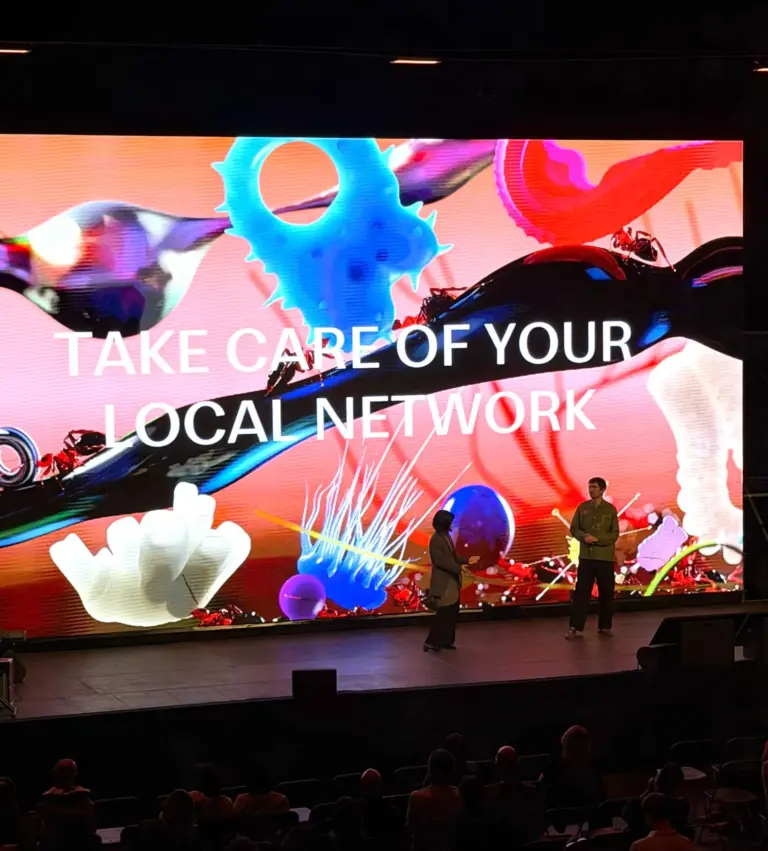
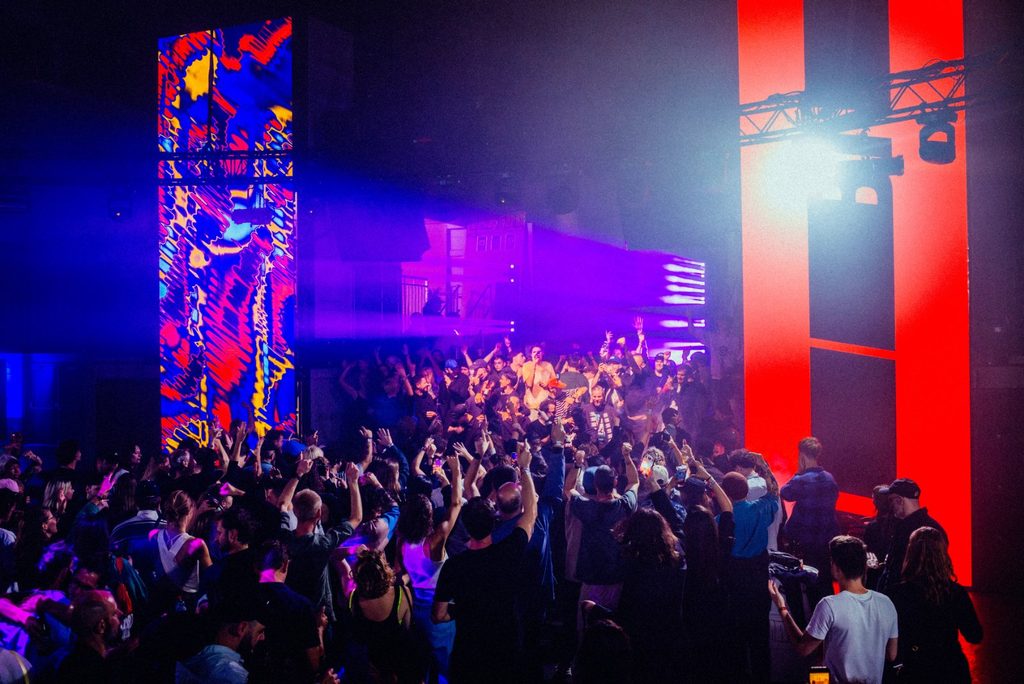
Us By Night returns to Antwerp from 24 to 26 September 2026 for three nights dedicated to design and creativity. Taking place in a transformed industrial warehouse on the city’s docks, the festival brings together an international creative community around 45 inspirational talks, a nightmarket and a club. Its nocturnal format extends beyond the conventional conference model, combining programmed content with spaces for meeting, exchange and experiences that continue throughout the night—enriching a European festival circuit where Designblok 2026 brings light-themed design festival to Prague, and OFFF Barcelona 2026 returns for its 26th edition at Disseny Hub Barcelona celebrating global digital design culture.
As a media partner of Us By Night 2026, Visual Atelier 8 speaks with Rizon Parein about the thinking behind the festival and how its identity has evolved over the years. The conversation moves through independence, experimentation, community and the realities of creating an event of this scale. It also looks at the role of spontaneity in the Us By Night experience and at what Parein imagines for its future.
Us By Night began in 2016 after the City of Antwerp invited you to create something for the city’s creative scene. At what point did you realise it could become something much bigger than a conventional design event?
I don’t think I was ever motivated by making something bigger than a conventional design event. I was more triggered by: how can we challenge it? I started doing graffiti when I was around 15, in the ’90s, when it was still very connected to hip-hop culture. You had graffiti jams and hip-hop jams, you travelled with friends and met people from all over the world. The community around it was almost as important to me as the graffiti itself.
When I stopped doing graffiti, I lost some of that. Then years later, through design conferences, I found it again. You knew these people’s work, you communicated online, and then once a year you physically met. You realised you were all quite like-minded. Somehow you liked the same work, but also the same restaurants, bars, music, clubs.
At the same time, I always thought design conferences could be a little wilder. A lot of designers spend an incredible amount of time alone behind a computer. I certainly did. You’re completely absorbed in this nerdy world, working late into the night, and then when you finally leave the house, there’s this explosion of social energy. So bringing those worlds together felt very natural to me.
What I hadn’t anticipated was the feeling of actually seeing Us By Night come alive. As a designer, you work on something for a few weeks, deliver it and move on. With this, you work towards something for almost a year, and then suddenly thousands of people are inside this thing that existed only in your head. Seeing them enjoying it, meeting each other, feeling that energy, that was insane. That was probably the moment I realised there was something here worth continuing to explore.
The festival was built around a simple but unusual idea: take the energy of nightlife and combine it with serious creative talks. Why did that format feel more natural to you than the traditional conference model?
Because creative people are quite wild people. We’re curious. We like things that are edgy. We’re constantly looking for something new, whether that’s an image, a technique, a piece of music, a brand, a restaurant or a club. So I never really understood why, when we come together as an industry, suddenly everything has to become so academic and formal. Sit in a chair. Watch a presentation. Applaud. Next speaker. It can be much more organic than that.
There’s also a very natural relationship between design and nightlife. So many designers of my generation started by making flyers, record sleeves, posters, things for clubs. I did too. And many of us were working behind our computers until ridiculously late at night anyway. So why not create an environment that reflects the people who are actually in it? Serious talks can coexist with music, food, dancing, chaos and unexpected encounters. For me those things don’t undermine the content. They make the whole experience richer.
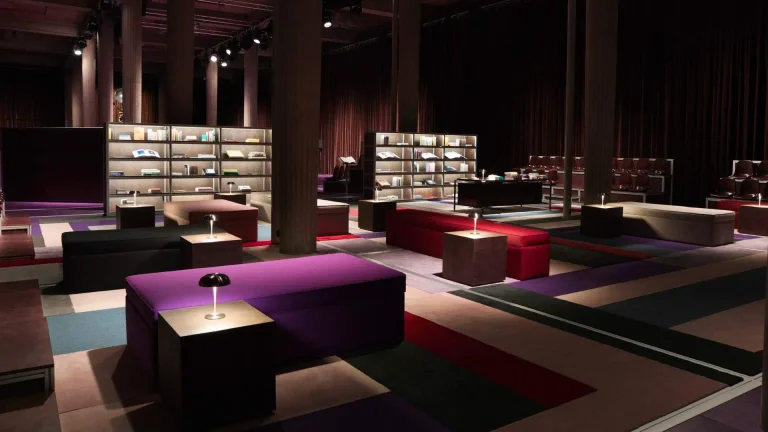
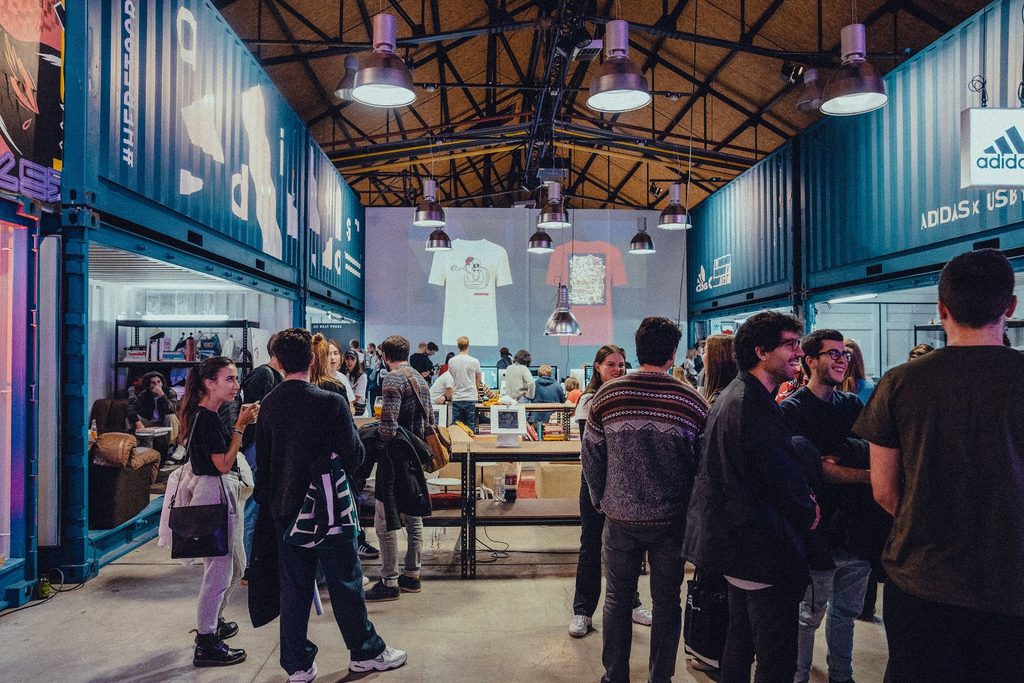
Us By Night is designed almost like a temporary city, with stages, a night market, installations, workshops, a club, and spaces where people can simply meet. How much of the festival is about shaping the way people interact, rather than simply programming content?
Totally. What happens next to the stages is equally important to me as what happens on them. A lot of it is about removing friction between people. People are shy. You see somebody interesting and think, who is that person? What do they do? But you don’t walk over because it can feel invasive or inappropriate.
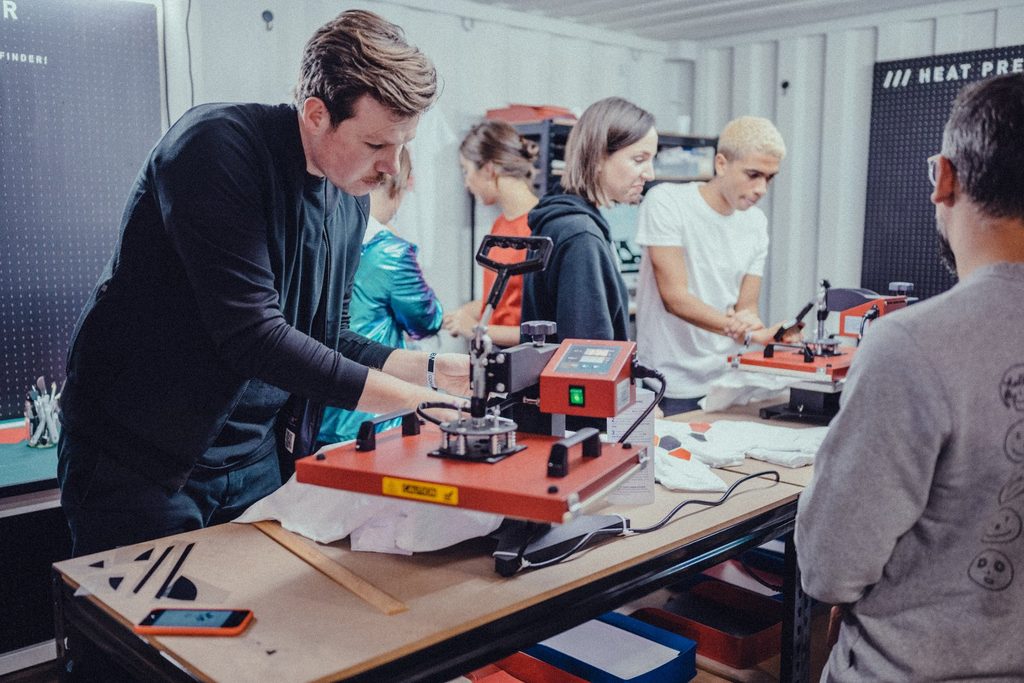
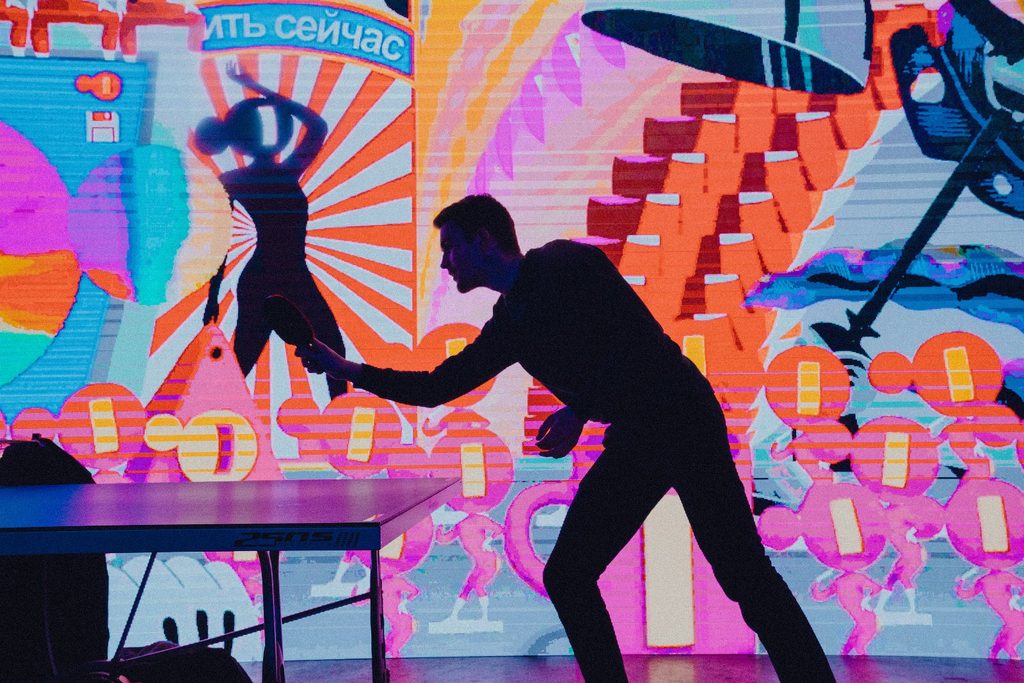
The simplest way to break that is through food, drinks, music, dancing, games, ping-pong, a giant Jenga, tattoos, even a massage salon in the middle of the Nightmarket. Things that are slightly unexpected and allow you to become a child again for a moment. They’re social excuses. We also deliberately invite speakers who will mingle. We don’t want this huge separation between the person onstage and the person in the audience.
The UBN app actually came from exactly the same thought. When you’re visiting a city for a conference and see somebody walking around with the same wristband, you’re curious about them, but again, you probably don’t say hello. So with the app, visitors can create their own little events around our hotspot map, a run, breakfast, coffee, gallery visit, whatever.
By creating one, you’re basically saying: I’m open to meeting you. And when somebody joins, they’re saying the same thing. It’s a tiny invitation, but it removes that barrier. That, for me, is a huge part of Us By Night: creating circumstances where saying hello becomes easy.
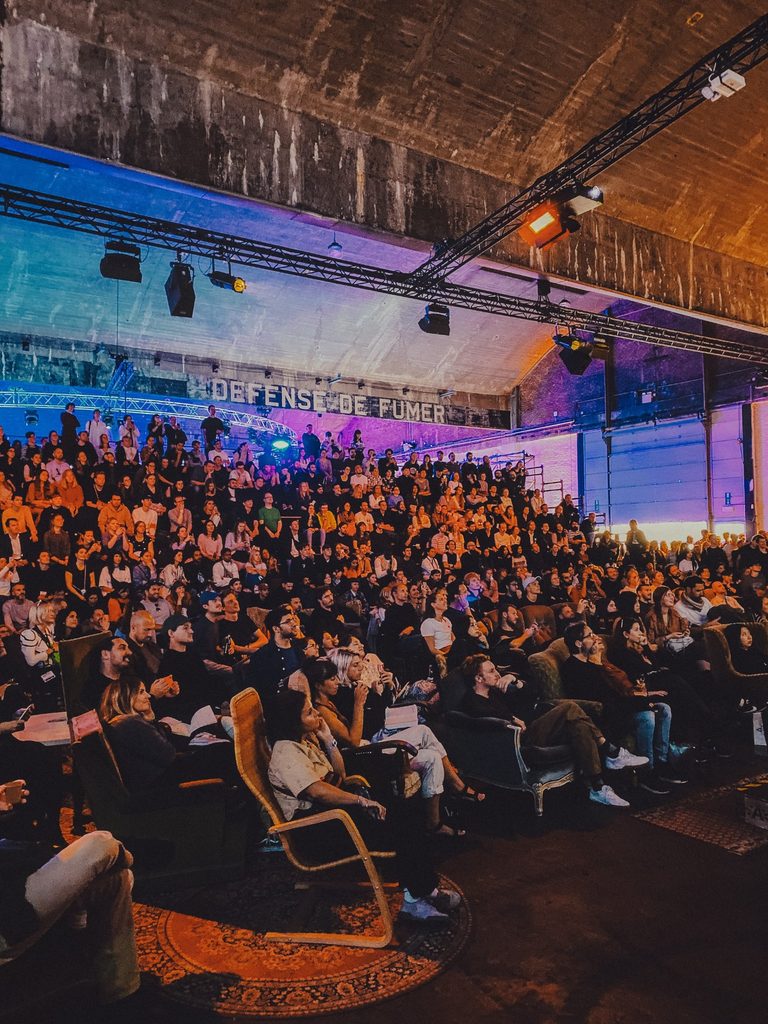
You have said that the strength of the programme is not in individual names but in the mix of generations, disciplines and personalities. When you build the lineup, what makes someone feel right for Us By Night beyond reputation or visibility?
The work always comes first. I look for people whose work feels like it could only come from them, a clear signature, an original voice, somebody who is an originator rather than a follower. But then I also want to understand the person behind it. Are they kind? Do they like sharing? Is there a giant ego involved? You can often feel that quite quickly.
Of course, sometimes the work is simply so fucking good that you make an exception. But generally we’re trying to curate not only great work, but good souls. We also tell speakers that there is no theme they have to fit into. Talk about whatever you think is relevant. But we encourage vulnerability. Don’t only show us why you’re brilliant. Show us the failures, the wrong turns, the hurdles along the way.
There’s something incredibly powerful about seeing somebody you consider a hero talk about failing. Suddenly they’re human. You can identify with them. You leave thinking: maybe they’re not a superhero. Maybe I can do this too. And then there is the lineup as a whole. I always describe it almost like making a painting. You start adding people, then step backwards and look at it from a distance. What’s missing? Another generation? Another discipline? Another personality? At some point the complete image has to feel right.
One of my favourite compliments is when somebody comes for a person they already love and leaves talking about someone they’d never heard of. That’s where the cross-pollination happens. If you’re a graphic designer and only ever look at graphic designers, you’re probably going to make more graphic design. Sometimes you need to see somebody from a completely different world to take you somewhere new.
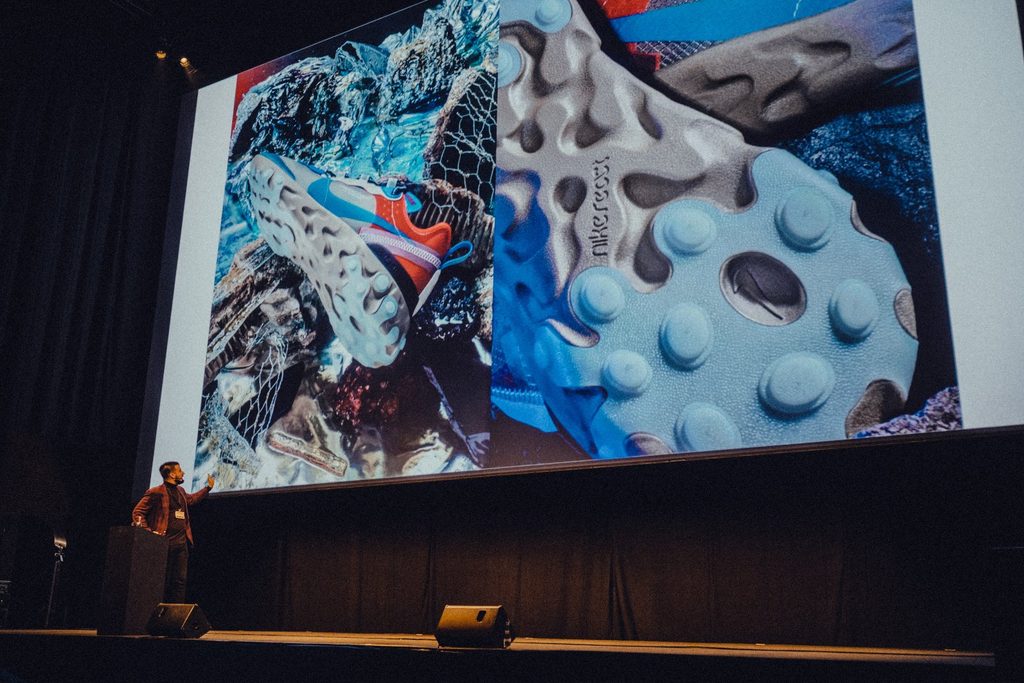
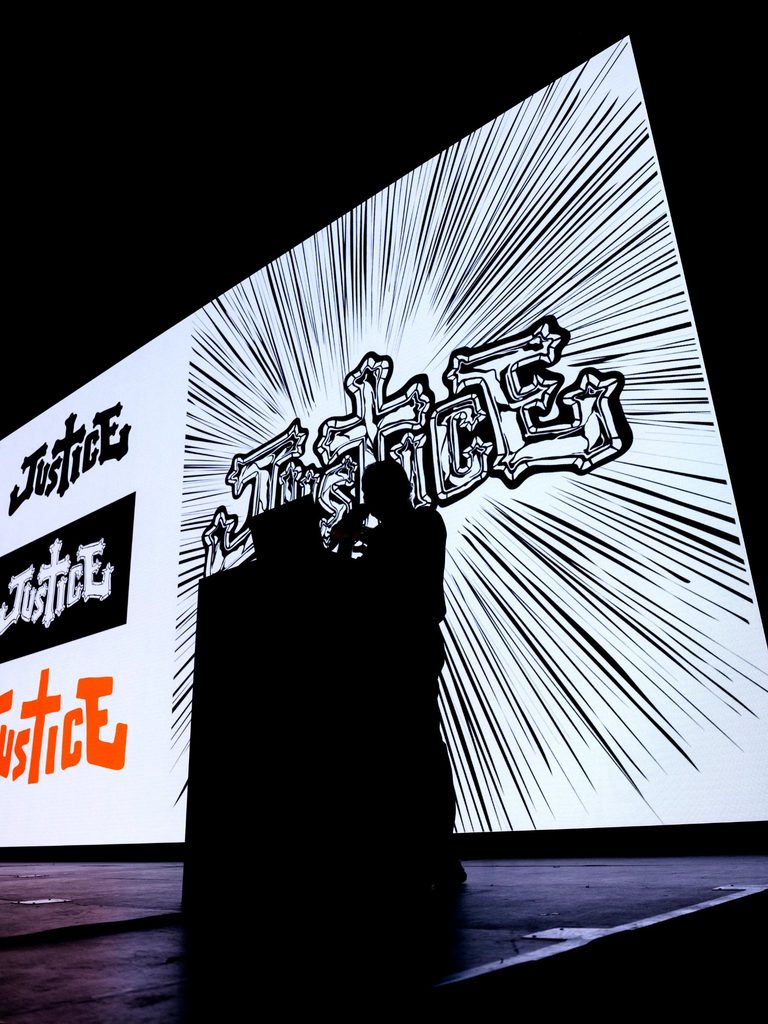
Your own career began with graffiti and nightclub flyers before moving into 3D design and major international work. Do you think that background in underground and nightlife culture still influences the way you approach Us By Night today?
Absolutely. Nightlife is still one of the lenses through which I look at Us By Night. I used to photograph nightlife a lot as well. I don’t really do that anymore, but I’m still fascinated by that energy, music, hospitality, strangers meeting, the little bit of danger and excitement that comes with the night.
People behave differently at night. They’re more open. Things happen that wouldn’t happen at two in the afternoon. We’ve even had love stories start at Us By Night. I’m not trying to recreate a nightclub inside a design festival. But that feeling is definitely an ingredient: unpredictability, attraction, freedom, people letting their guard down a little. I think I’ll always be intrigued by nightlife, so inevitably Us By Night will always be infused with some of it.
The festival is rebuilt from scratch every year and disappears again after three nights. Does that temporary nature give you a freedom that a permanent institution could never have?
Absolutely. Building this environment from scratch is fundamental to Us By Night. You can put somebody on a stage, hang a few posters and organise a great conference, respect for that, but you can’t create the kind of magic we’re after that way. Some of the most memorable parties I went to when I was younger completely reinvented themselves every edition. You were curious before you even arrived: what have they built this time? You could feel that the people behind them understood architecture, graphic design, spatial design, music and storytelling. That stayed with me.
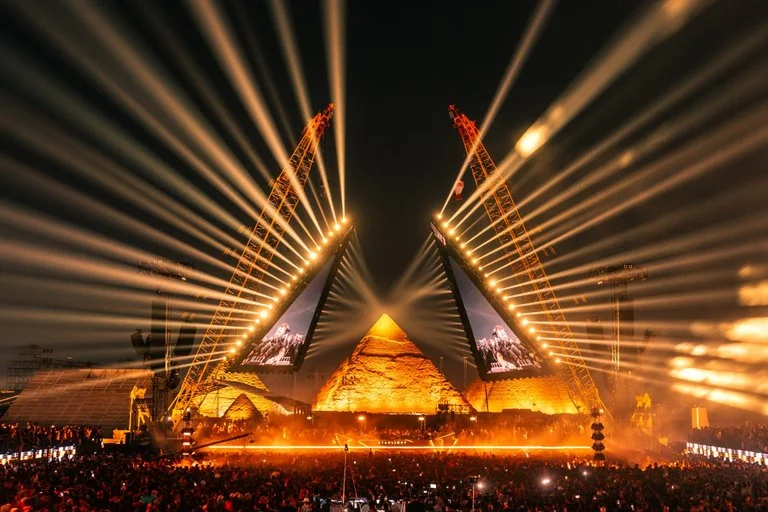
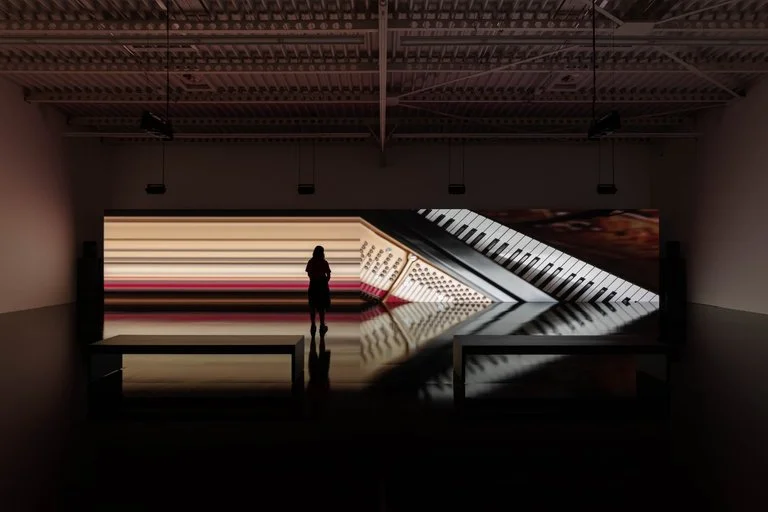
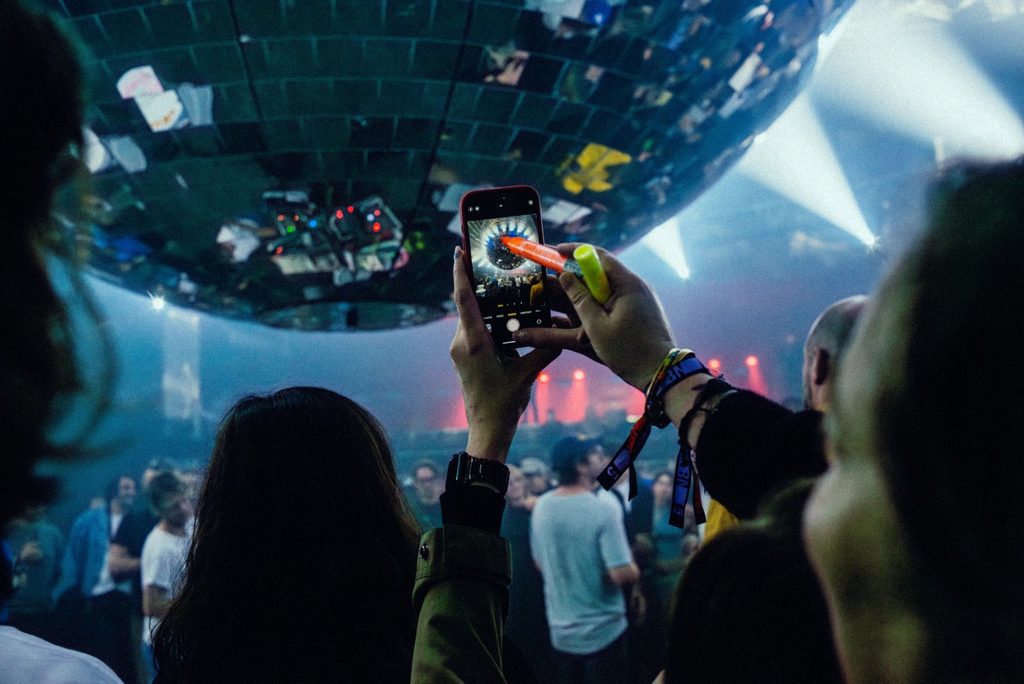
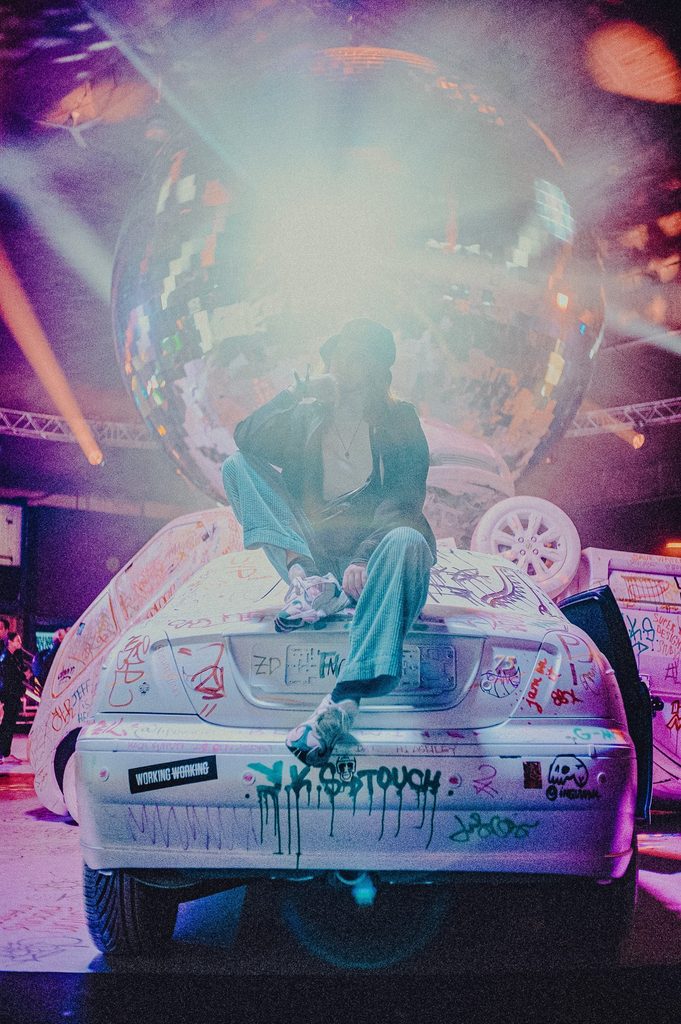
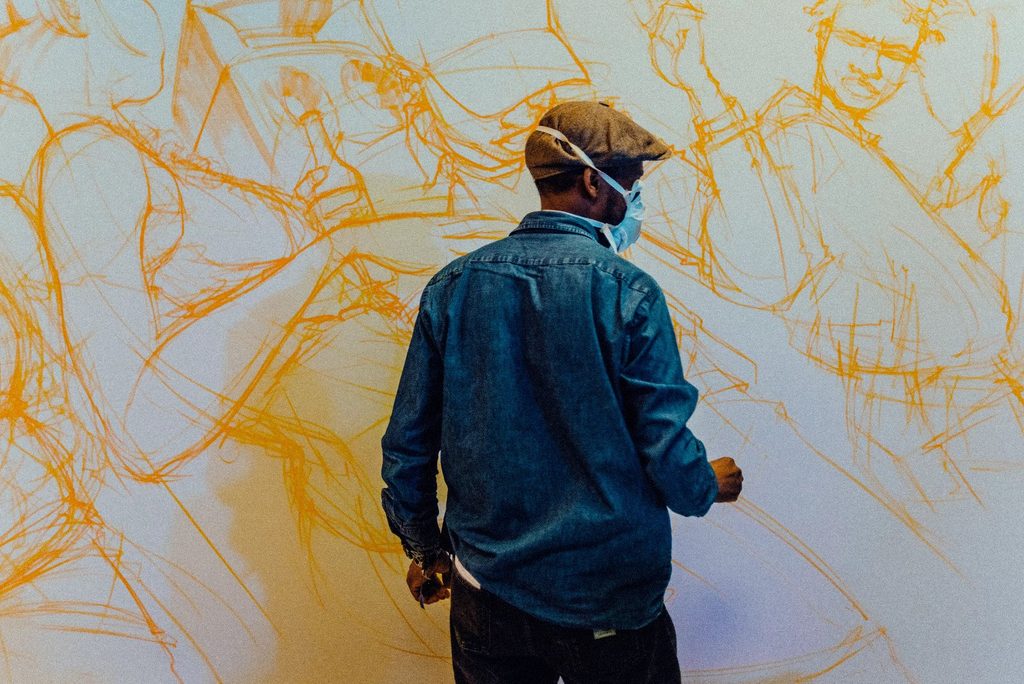
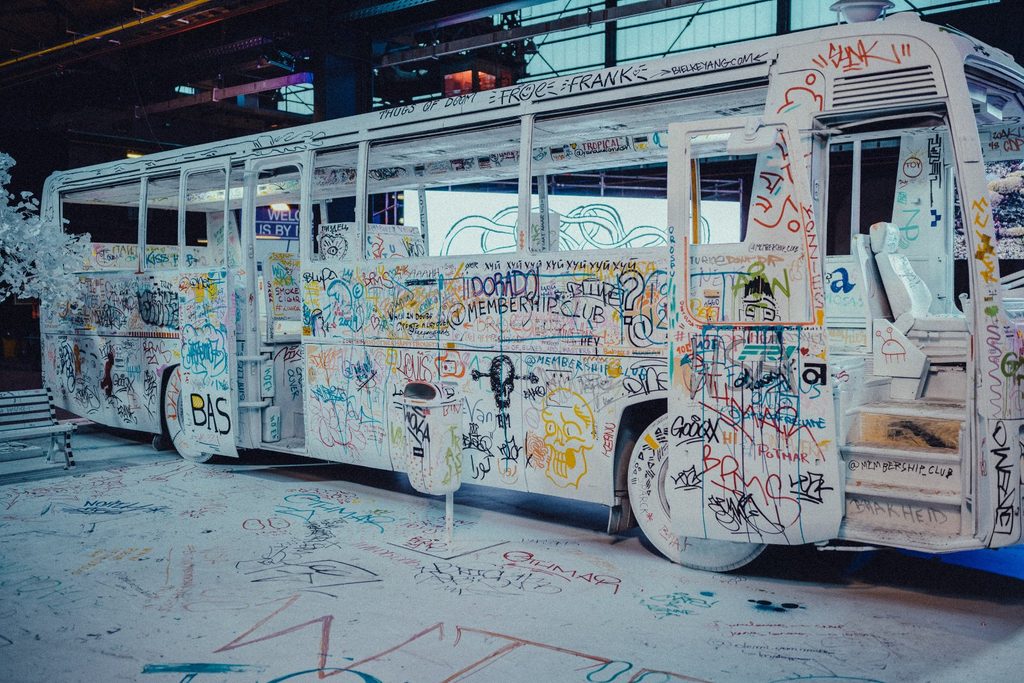
So the scenography of Us By Night is almost as important to me as the lineup. It can be a gigantic disco ball, a 70-metre wheatpasting wall, or this year building a huge scaffolding balcony around the main stage inspired by Lina Bo Bardi’s Teatro Oficina in São Paulo. I’m obsessed with quite simple spatial things too: bridges, tunnels, height, looking down onto something, discovering another space behind something.
Those things completely change how you experience a place. Every year we say, next year let’s keep the scenography. It would make our lives so much easier. And then we never do. Because once we start drawing again, curiosity takes over. There’s simply too much pleasure in asking: what else could this become?
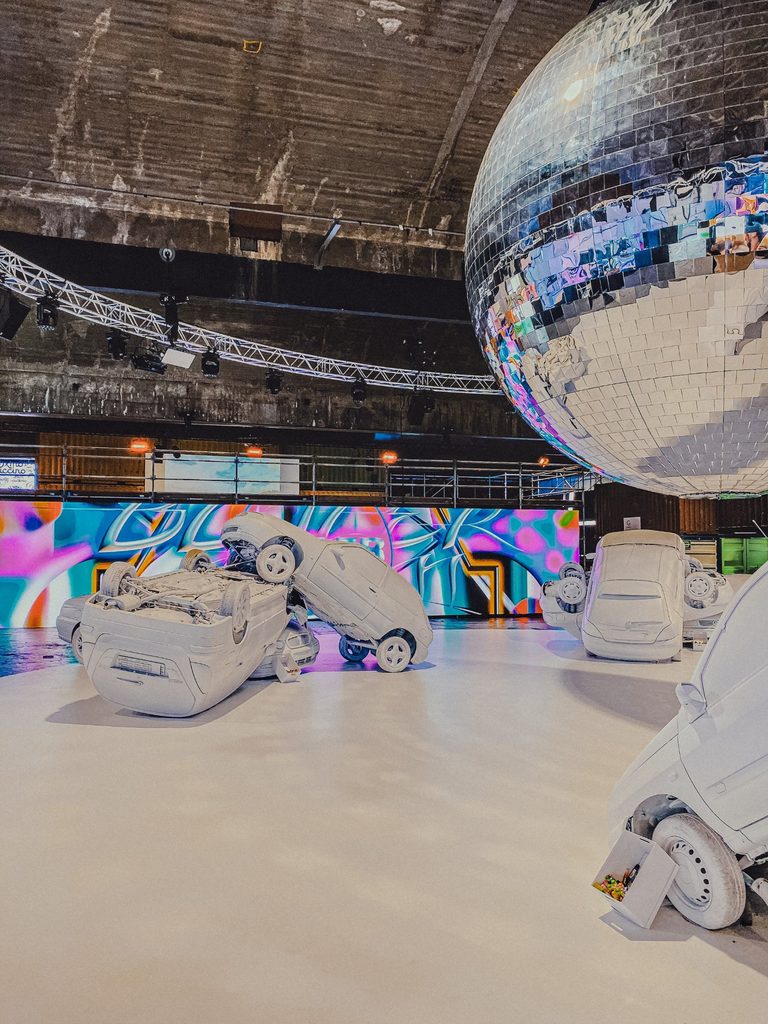
Us By Night has grown into an international meeting point, with people travelling from around the world to Antwerp. As the festival becomes bigger, what do you work hardest to protect from the intimacy and spontaneity of the early editions?
I learned something interesting from nightlife. A new club opens and the first year it’s full of the people shaping the culture of that city, musicians, designers, artists, underground people. Then it becomes successful. Everybody hears about it and wants to get in. By year three the original crowd starts saying, “It’s not what it used to be.” A few years later, they’ve moved somewhere else. I’ve watched that cycle happen many times, including with the club I ran myself for three years.
So I’ve always wondered: can you grow a festival without killing the thing that made people love it? In the early editions of OFFF Barcelona, it sometimes felt like 80% of the audience were people actively making the work that was defining the industry at that moment. Everybody seemed to know everybody. It was almost like a club with the best door policy, although I generally hate door policies. That’s why I’ve never been obsessed with maximum exposure. People have told me: get a big PR company, get into every newspaper. But I’m not sure that’s necessarily good for us.
In a strange way, how we communicate the festival is a kind of door policy. I’d rather grow slower and reach the right people. In terms of spontaneity, we take a lot of pride in creating new things, challenging the status quo and challenging ourselves. We just can’t sit still. It’s probably not the most rational business model because we’re driven first by curiosity and playfulness, not by what makes the most business sense.
But it’s authentic and genuine, and I simply have to believe that at some point that pays off. Although I must admit, sometimes it feels a little like taking 3,000 people to a restaurant and picking up the bill, haha. Not because people don’t pay for their tickets, obviously, but because we keep putting so much into the experience. We keep building, adding, experimenting and trying to surprise people. It makes it a risky undertaking, but it’s also exactly what makes Us By Night what it is.
As AI changes creative work, you have spoken about the growing importance of real-life encounters. Do you think the more digital creativity becomes, the more valuable physical creative communities will become?
Absolutely. And strangely, I’m quite optimistic about it. I use AI a lot. I find it amazing. It allows me to make things I couldn’t make before because I didn’t have the skills, or because it would have required too many people or too much money. I’ve actually discovered creative qualities in myself through AI that I didn’t realise I had. So I don’t believe AI kills creativity. Jobs will shift, absolutely, and there is already a crisis happening. But creative people will transform into different kinds of creatives. If you’re genuinely creative, I think you’ll remain creative.
What interests me more is trust. I’m already looking at images on Instagram thinking: is that AI? I’m hesitant to buy certain artwork because I don’t know how it was made. Even with an incredibly empathetic email you can wonder: did this person actually write this? Multiply that by everything on the internet and it becomes an enormous pile of information, fake stuff, great stuff, garbage, and AI will increase that exponentially. At some point I think we’re going to become exhausted trying to navigate it ourselves.
We’re already seeing the beginning of something else. I’ve been working with AI and vibe coding, and I’m baffled by what I can build simply by talking to a model. And suddenly it feels ridiculous that to organise one dinner I might need Google Maps, WhatsApp, iMessage, iCal, a restaurant app and a phone call. I think eventually that disappears. Instead of us navigating 100 apps and the entire internet, we’ll have an agent doing it for us. Maybe the operating system becomes a voice. You tell it what you need, it creates software when necessary, talks to other agents and brings back what is relevant.
Of course, there are enormous questions around bias and who controls that filter. But my optimistic version is that much more of the digital world disappears into the background. And we come back into the foreground. Because when everything digital can be generated, manipulated or questioned, the physical encounter becomes the thing you can trust. I think people will become hungry for the real shit.
Seeing somebody perform. Seeing craftsmanship happening in front of you. Sport. Painting. Music. Somebody standing on a stage telling you something and knowing they’re actually there. The performance and the moment become more valuable than simply seeing the result afterwards. So strangely enough, AI might make places like Us By Night more relevant, not less. The more synthetic the digital world becomes, the more precious it becomes to put 3,000 actual human beings in a room together.
You have experienced both sides of the creative industry, as a designer working for global brands and as a founder building a platform for other creatives. Has running Us By Night changed the way you think about success or ambition in your own career?
Completely. I never finished school. I stopped when I was around 17 – 18, did some shitty jobs, and had no degree or obvious career ahead of me. Then I bought a computer and decided to become a graphic designer. Suddenly I had total freedom. No boss, working from home, no commute. I was lucky enough to become successful and make good money doing something I loved. It was an amazing life.
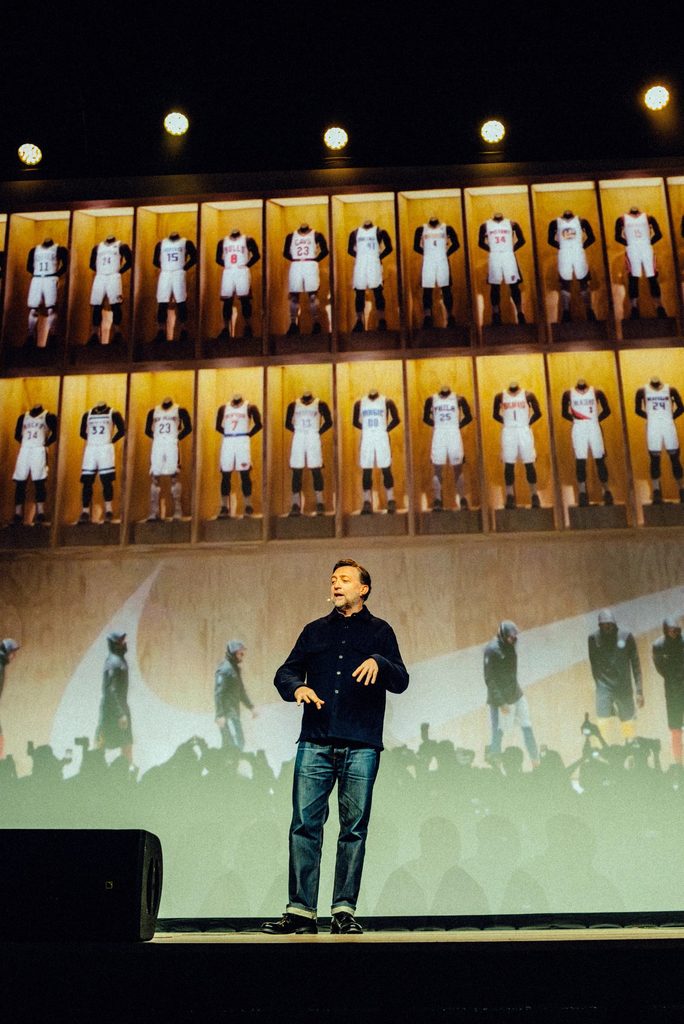
But advertising could also be frustrating. I always wanted to challenge things and make something original, while the client’s ambition wasn’t necessarily the same. Sometimes an agency had already sold an idea based on a reference of somebody else’s work, and your job became reproducing it. I spent a lot of energy fighting against that. The highlight for me was probably working directly with Nike Brand Design. There was genuine creative dialogue and room to experiment. We could spend months jamming on things. Maybe 80% would disappear, but something discovered during that process might suddenly reappear in another project. I loved that organic way of designing.
Then Us By Night happened. At the first edition my wife was pregnant with our son, almost at her due date. I remember looking around and suddenly thinking: when my son arrives, maybe this is what I want to do. Something that actually does something to people. I’d spent years making advertising, and occasionally somebody would ask, “But what good does it actually do for the world?” And I never really knew how to answer that. Then I saw Us By Night. The smiles, the community, younger creatives being inspired. I remember almost crying from happiness, thinking: did I just do this?
It changed something. I wanted to be that person next to my son. I wanted him to see me building something I genuinely believed in. That doesn’t mean I stopped loving design. Sometimes I desperately miss those quiet nights where the entire universe is one curve, one bevel, one tiny problem you’re trying to solve. Then you render it, look at it and think: that’s done. Next. There’s something beautiful about that simplicity. So maybe my definition of success hasn’t become one thing instead of another. I’ve realised that I need conviction. Once I genuinely believe in something, passion follows, and then almost anything feels possible.
Ten years after the first edition, Us By Night still talks about sending people home with new energy, ideas and people in their lives. Looking ahead, where do you want to take the festival next, and what still feels unexplored to you?
It’s funny, because I’m slightly uncomfortable saying “ten years of Us By Night.” We started in 2016, so technically it is ten years, but it’s not our tenth edition. There was the pandemic in between. Saying it too loudly almost feels like cheating. And saying, “It’s ten years, so now we’re going to do something special,” doesn’t really fit us either. We try to do something special every year. Otherwise I get bored.
That’s probably the answer to where it goes next as well. We’re currently having conversations that could lead to a pretty dramatic next chapter for Us By Night, including the possibility of taking the festival to a new city. I can’t announce the details yet because some decisions are literally being made as we speak, but there’s a very real chance that this edition marks the end of one chapter and the beginning of a completely new one. Keep an eye on our socials and newsletter over the next few weeks!
What I can say is that Antwerp has been incredibly important to us. Without Antwerp, Us By Night simply wouldn’t exist. But I also feel that curiosity again. We’ve now learned how to do this. Another edition in the same place would inevitably become a little easier. And “easier” doesn’t excite me.
I get energy from the moment where there’s a new idea and I don’t entirely know whether it’s going to work yet. Creating a new story. Breaking our own rules again. Finding something that gives me that slightly naive conviction we had at the beginning. So there is a very real possibility that what comes next will be quite a departure from what people expect from Us By Night. I probably shouldn’t say much more yet. Let’s PLAY!
All images courtesy of Us By Night, shared with permission