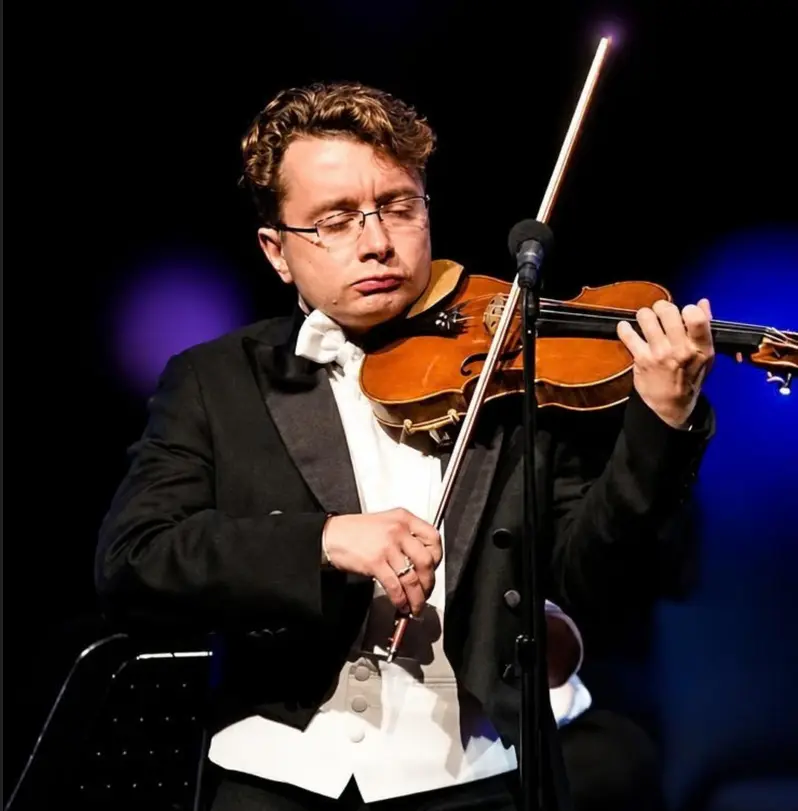
Sergiy Bolotny’s “Reflections: Oh, Human Destiny” turns the solo violin into a machine that keeps moving without offering relief. The piece uses a stark, mechanical pulse to carry the Ukrainian folk song Ой, доле людська (Oh, Human Destiny), stripping it of its softer associations and leaving its sense of exhaustion exposed.
The violin does not chase virtuoso display here. Its repetition becomes the main force, an engine that keeps grinding forward while the folk melody appears inside it, depleted and distant. The contrast gives the piece its weight. The pulse continues with little concern for what happens around it, while the melody carries grief that cannot stop the machine.
As the prologue to Bolotny’s Echoes on Ukrainian Themes cycle, “Oh, Human Destiny” places an old song inside a contemporary reality shaped by war. The melody remains recognizable as something inherited, but the world around it has changed. The violin keeps going.
For those who might not know you yet, how would you introduce yourself?
I would start with my name. I’m Sergiy Bolotny, a violinist and composer. 51 years old, married, no children. My wife is also a musician, and we perform together in many projects. I was born in Ukraine back during the Soviet era. I studied in several cities, and the last—and perhaps most important—station of my education was Vienna, the famous center of “Her Majesty” Music.
My idol is the Fiddler from the famous musical Fiddler on the Roof. My goal is literally to be that fiddler on the roof.
I follow world politics, but I hate political games and parties; I don’t have any preferences, and I never know which party to choose. I just want to make music, and make it professionally. My hobby is practicing languages on Duolingo—though honestly, I don’t speak any of them well, including my mother tongue! As for exercise, I don’t do much, only when I really need to lose weight.
If you had to bottle up your sound into just three words, which ones would you choose?
Acoustic. Honest. Soulful.
Which artists (not only music-related) or moments have left the biggest mark on your music?
As a violinist, Niccolò Paganini. As a composer, Beethoven. As a painter, Van Gogh. And as an actor, Christoph Waltz.
When you hit play on your songs, what kind of feeling takes over?
There are so many feelings: melancholy, sentimentality, euphoria, bitterness, sarcasm, or emptiness…
But above all, there is always a feeling of responsibility toward the audience to tell a true story—whether it’s a quiet personal drama, a virtuosic firework, a helpless human tragedy, or a sharp caricature. Music can tell us everything. But music can also heal.
If you could team up with anyone in the world, no limits, who would be that dream collaborator?
Such a difficult question! My wife, Keiko Sakuma, is my dream collaborator. Also my friends Tim Nobel and Don Hofstee from the Bolotny Trio.
You never know what tomorrow brings—maybe an unexpected new project. But don’t take it too seriously: my dream would be playing the Fiddler in a movie version of Fiddler on the Roof alongside Christoph Waltz as Tevye!
What are you working on now, and what are your plans for the future? Anything exciting you can tell us about?
Right now, I’m working to finish, record, and release several large solo violin cycles on streaming platforms: the 24 Ukrainian Caprices, Little Dutch Rhapsodies, Funny Thirds and Sad Sixths, Three Echoes on Ukrainian Themes, and Four Lyrical Pieces.
It’s a lot of work for the next couple of years, and we will see where it leads!
Can you walk us through the story or emotion behind “Reflections: Oh, Human Destiny”?
This piece opens my cycle Three Echoes on Ukrainian Themes:
- Reflections: Oh, Human Destiny
- Intermezzo: Why, Why My Dear Land?
- Nightingale’s Farewell Song: Farewell, Dear Country Home
In each piece, I blend a traditional folk melody with my own musical material—using a mechanical, minimalist repetition that suggests the different ways destiny comes to us in life.
In the first piece, that repetition feels very somber and heavy. It reflects the destiny of people who have lost their loved ones, lost their homes, who are caught in the middle of war, or living as refugees. Just like the old Ukrainian folk song says: “Oh human destiny, destiny is blind…”
In the second part, the mood becomes light and cheerful; the repetition mirrors nature—the wind or a stream—and a feeling of simple happiness.
The third part is perhaps the saddest: the repetition carries a nightingale’s song in the dark or early morning, telling the drama of someone who is forced to leave their home, or even more.