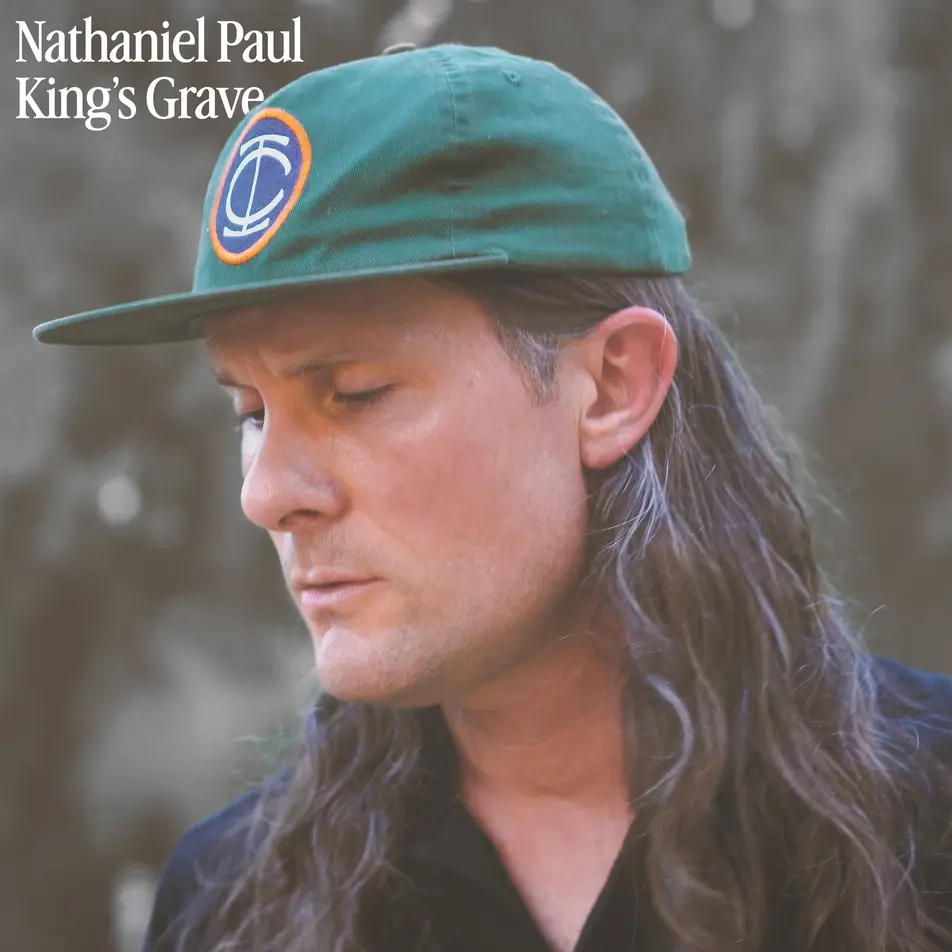
Nathaniel Paul buries an old idea of the future in “King’s Grave,” a song about the distance between what people hope for and what life gives them. The line “I know how bad it is out there, when I think about how great it could be” puts that disappointment into plain words. The king becomes a figure for all the possibilities that never came to pass.
The loss of his father fuels the reflection on time and expectations, but the invitation to “come along” shifts the focus toward the people who remain. Paul finds a reason to keep going in companionship, even when the larger picture no longer matches what he once imagined. There is no promise that things will improve, only someone asking another person to stay close.
As one half of The Bergamot, Paul has built a body of work around love and personal experience. Here, the indie-folk approach gives the words room to carry the weight of the subject. The king is gone, but the invitation remains.
For those who might not know you yet, how would you introduce yourself?
My name is Nathaniel Paul Hoff. I’m a singer-songwriter, multi-instrumentalist, and filmmaker with a background in classical guitar. I play guitar, piano, and harmonica, and I’ve been writing and producing music since I was a kid. If there’s one thing that defines me, it’s persistence. I’ve always believed that if you commit yourself to something creatively, you have to see it through. That philosophy led me to produce and star in State of the Unity, a documentary that brought my two greatest passions, music and filmmaking, together. The film is currently available on Apple TV, and its transcript is preserved in the Margaret Herrick Library of the Academy of Motion Picture Arts and Sciences in Beverly Hills. It was a true labor of love and, in many ways, my magnum opus. The film went on to receive recognition at more than 20 film festivals across the United States and internationally. For me, music and creativity aren’t just things you do. They’re a way of life. I’ve found that the more you create, the more creativity seems to find its way back to you.
If you had to bottle up your sound into just three words, which ones would you choose?
Pontoon. Surf. Sunshine.
Which artists (not only music-related) or moments have left the biggest mark on your
music?
I actually wrote my first research paper in grade school on Jerry Garcia and the Grateful Dead. Even as a young kid, I was fascinated by their music, but also by the culture and sense of community that surrounded it. There was something about that world that really drew me in.
As I got older, I gravitated toward alternative rock bands like Caroline’s Spine and Silverchair. Eventually, I discovered Dave Matthews Band, and that opened up an entirely new musical world for me. I loved the way they blended rock, jazz, and acoustic instrumentation into something so distinctive. Outside of music, I’ve always been drawn to the visual arts. I spent a lot of time drawing when I was younger, especially with colored pencils, and I was absolutely enamored with Vincent van Gogh. I wasn’t much of a painter myself, but I’ve always had tremendous admiration for people who can capture emotion through color and imagery. I think all of those influences have stayed with me. Whether it’s a guitar part, a lyric, or a visual concept, I’m always searching for that intersection where music and imagery create something bigger than either could on its own.
When you hit play on your songs, what kind of feeling takes over?
From the streets of Brooklyn to the inland lakes of Michigan, my songs tend to take me places. I’ve always been fascinated by how music can transport you to a particular moment, landscape, or feeling. When I’m writing, I try to create that connection to a place. Sometimes it’s a memory, sometimes it’s a feeling I can’t quite put into words, and sometimes it’s simply the atmosphere of somewhere I’ve been. Musically, I love paying homage to artists like Steely Dan and Dave Matthews, who have had such a profound influence on me. But I’m always trying to take those inspirations somewhere new, into a fresh sonic space that feels distinctly my own. Ultimately, I want someone listening to one of my songs to feel like they’ve traveled somewhere, even if they haven’t left the room.
If you could team up with anyone in the world, no limits, who would be that dream
collaborator?
I’m going to split this into two categories: one living and one no longer with us. For someone from the past, it would absolutely be Frédéric Chopin. I’m part Polish, and I’ve always felt a deep connection to his music. There’s something incredibly moving about the emotion he could communicate through the piano. His life was tragically short, yet the body of work he left behind is extraordinary. I would have loved to sit in a room with him and experience
that creative mind firsthand. For someone living, I’d choose Dave Matthews. I think he’s an absolute genius on the acoustic guitar. The way he integrates jazz influences into his playing while maintaining such a recognizable songwriting style is remarkable. That’s no easy feat.
I’ve admired his music for years, and I have tremendous respect for his musicianship and
songwriting. Getting to collaborate with him would be a dream.
What are you working on now, and what are your plans for the future? Anything exciting you can tell us about?
There’s a lot happening right now, which is exactly how I like it. One of my favorite performances of the year is coming up on Saturday, November 28, at the Morris Performing Arts Center in South Bend, Indiana. It’s genuinely one of my favorite venues in the country, right up there with Radio City Music Hall and the Ryman Auditorium. Built in the 1920s, it’s an incredible historic gem, and this will be our third consecutive year bringing A South Shore Christmas to that stage with The Bergamot. Every time I walk into that theater, I feel a tremendous sense of gratitude. It’s a real honor to perform there. I’m also preparing to score my first narrative feature film, working alongside an incredibly talented team of actors and producers. Film scoring has been a dream of mine for a long time, so I’m especially excited to explore that side of my creativity.
Beyond that, we just signed a distribution deal for our film State of the Unity in Germany as well as developing a sequel, and I’m working on two new records: one with The Bergamot and another under my solo project, Nathaniel Paul. Both are planned for release in 2027.
We’ll also be heading back out on tour with The Bergamot next year.
There’s a lot of new music, filmmaking, and creative exploration ahead. I feel like I’m ente ing a really exciting chapter artistically, and I’m grateful to still be finding new ways to challenge myself.
Can you walk us through the story or emotion behind “King’s Grave”? Can you tell us about the storytelling and the visual approach to the video?
“King’s Grave” is about the death of idealism. I think we all grow up carrying certain beliefs about life, about the world, and about how things are supposed to unfold. But sometimes something happens that changes the way you see everything.
For me, that moment was losing my father.
He passed away on April 10, 2026, and it’s a day that changed my life forever. He was a wonderful man, and losing him forced me to confront a lot of things I hadn’t fully considered before. There’s a certain innocence you lose when someone who has always been part of your world is suddenly no longer there. In many ways, “King’s Grave” came out of that experience. It’s about grieving not only someone you love, but also the version of the world you believed in before that loss.
But the song has another meaning as well. When I look at what’s happening in America, I see a similar loss of idealism. There’s a growing disconnect between everyday people and those who are supposed to represent them. I’m not someone who spends a lot of time talking about politics, but I do care deeply about people, and I think a lot of Americans are feeling that disconnect right now.
That duality became the heart of the song: personal grief on one side and a broader sense of disillusionment on the other.
For the music video, I wanted to explore that contrast visually. The central imagery revolves around an extravagant feast, a group of people surrounded by opulence and excess. At a time when so many people are struggling just to pay their bills or put a little money aside, that imagery felt especially powerful to me. I contrasted those scenes with a single performance take of myself singing, using color against a black-and-white background. I loved the symbolism of that. It’s almost as if the world around you is slowly losing its color, even while you’re trying to hold on to something real. I wanted the video to feel timeless, almost like an image from another era, while still speaking to something we’re experiencing today. Ultimately, “King’s Grave” is about loss, change, and the difficult process of letting go of the world as you once understood it. But I also believe that when old ideals fall away, there’s an opportunity to build something new. And maybe that’s where hope begins.