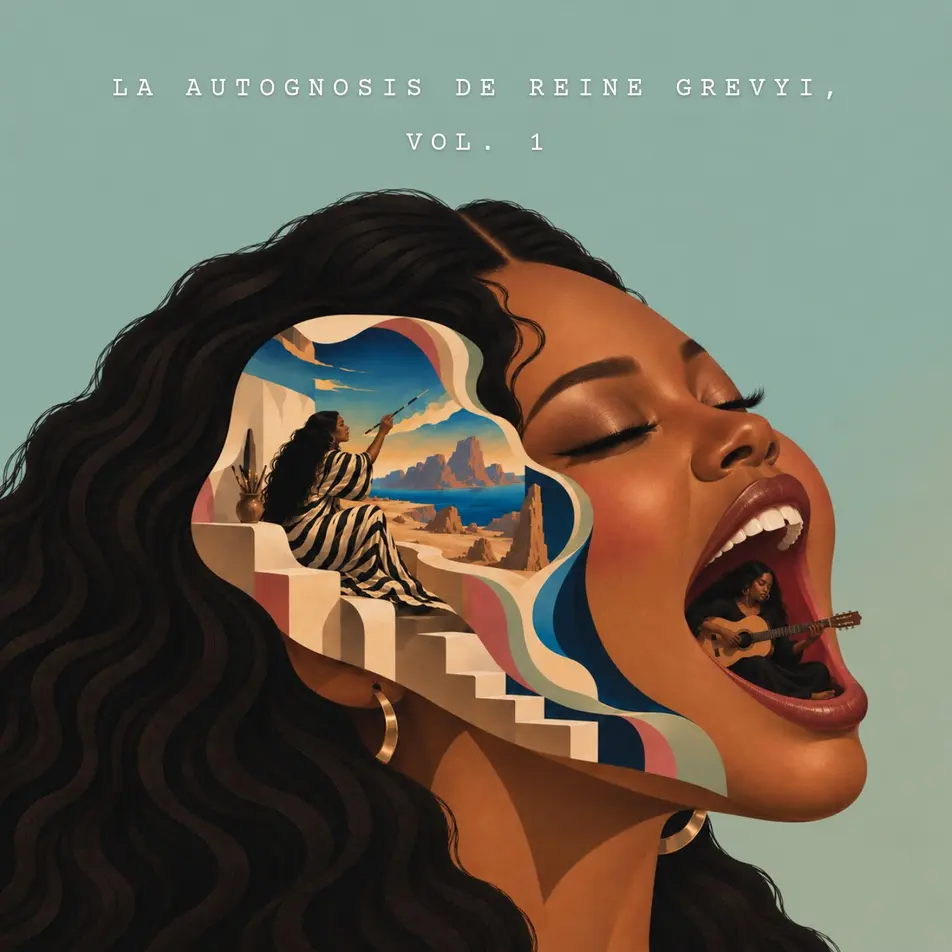
Böitaari finds an unexpected connection between four different musical compositions in La Autognosis de Reine Grevyi, Vol. 1, an EP shaped by the process of recognizing emotions that had not yet found a name. Moving between Ghetto Zouk, Kizomba, Flamenco, Congolese Rumba, Moroccan Gnawa, and Cameroonian Mbolé, the Spanish-Equatoguinean artist brings distinct musical traditions into a project that also introduces her visual art identity, Reine Grevyi. The four tracks began as separate works before revealing a shared personal thread.
“Bruma” gives that process a particularly clear image: two people separated by an architectural threshold, their hands reaching towards each other but never meeting. Böitaari describes the song as the hesitation that keeps desire suspended before it becomes action. The accompanying animated visualizer develops the same idea through two sculptural figures facing each other across the sea, beneath a melting clock. Their hands approach by millimeters, then retreat, repeating a gesture that never reaches its destination.
The relationship between the music and the paintings gives the EP another dimension, with Reine Grevyi providing a visual counterpart to emotions that were not fully understood when the songs first took shape. In “Bruma,” the distance between two hands becomes the distance between wanting something and daring to reach for it. The clock keeps melting. The hands keep moving.
For those who might not know you yet, how would you introduce yourself?
I am Böitaari, a multidisciplinary artist, music researcher, and cultural educator born in Spain with roots in Equatorial Guinea, Sierra Leone, and Cuba. My work reimagines Afro-diasporic and Mediterranean traditions through an experimental, avant-garde lens enriched by subtle electronic textures. Rather than treating music as an isolated medium, I conceive my practice as a living world-building project where sound, surrealist visual art, and archival storytelling exist in constant dialogue.
If you had to bottle up your sound into just three words, which ones would you choose?
Eclectic, evocative and Afromediterranean.
Which artists (not only music-related) or moments have left the biggest mark on your music?
Visually, I am deeply drawn to the surrealist and symbolic worlds of Salvador Dalí, Maruja Mallo, and Remedios Varo, alongside contemporary painters like Moses Tibor and Myriame Dachraoui. Musically, however, I am moved far more by collective rhythmic lineages than by individual names —drawing from Mediterranean and Middle Eastern traditions such as Flamenco, Shaabi, Manele, Chalga, Dabke, and Iraqi Chobi, as well as Afro-diasporic and Latin languages like Kizomba, Zouk, Kompa, Bachata, Merengue, Cumbia, Bolero, Salsa, Samba, and Bossa Nova. The most defining moment happened when I returned to digital painting while listening back to four unreleased tracks I had written separately. Translating them onto a canvas revealed the unspoken emotional thread connecting them—truths I had been holding back even from myself—giving birth to my visual alter ego, Reine Grevyi, and uniting sound and image as one process of self-knowledge. That exact convergence is how my latest EP, La Autognosis de Reine Grevyi, Vol. 1, was born.
When you hit play on your songs, what kind of feeling takes over?
It feels like stepping into a threshold—that quiet, suspended space between memory and release. There is an emotional vulnerability at the core of the songs, as if each track were a confession finally spoken out loud once the weight of silence becomes too heavy to carry.
If you could team up with anyone in the world, no limits, who would be that dream collaborator?
Rather than one single name, my dream collaboration is a dialogue between three creative forces that define my universe:
First, visionary artists reshaping Mediterranean, Middle Eastern, and Balkan traditions into contemporary avant-garde—such as Sevdaliza, Marina Satti, María José Llergo, Zeyne, Ruby, Galena, and Gya. Second, vital voices across the African continent and its diaspora, from Nélida Karr in Equatorial Guinea to icons and pioneers like Angélique Kidjo, Kaysha, Mika Mendes, and Philip Monteiro. And third, larger-than-life Latin, Caribbean, and Brazilian forces whose rhythmic joy shaped my upbringing, from Juan Luis Guerra and Olga Tañón to Anitta and Grupo Revelação. Anyone who honors where they come from while fearlessly bending form belongs in that
dream room.
What are you working on now, and what are your plans for the future? Anything exciting you can tell us about?
Right now, I am immersing myself in expanding the universe around my latest EP, La Autognosis de Reine Grevyi, Vol. 1, unveiling the four surrealist digital paintings paired with each track—“Bruma”, “Caoba”, “Legendaria”, and “Élan”. In parallel, I am actively growing Böitaapedia, a Spanish-language music and cultural research platform focused on Global South expressions, with a strong emphasis on Afro-diasporic and Mediterranean traditions. Launched in June 2025 as an editorial project by Bilëbbó Fusión, its mission is to
amplify these musical narratives for the international Spanish-speaking community.
Looking ahead, I am already working on new music slated for 2027, and there are also exciting surprises brewing on the Reine Grevyi side—new ways of bringing that visual world beyond the digital canvas that I cannot quite reveal just yet.
Can you walk us through the story or emotion behind “Bruma”? About the video, can you tell us about the storytelling and the visual approach to it.
“Bruma” is about the fog of hesitation—the art of not daring to step forward when fear or uncertainty clouds what you feel. Emotionally, it inhabits that misty borderline where desire remains suspended before ever becoming an action. For the video, I created an animated visualizer built directly from the surrealist digital painting Reine Grevyi made for the song. In the piece, two sculptural figures sit on
opposite sides of an architectural threshold overlooking the sea, their heads enveloped in mist beneath a melting clock that suspends time. Through subtle animation, their outstretched arms reach forward—coming millimeters away from touching—only to pull
back again in a continuous loop, visually mirroring that exact emotional tug-of-war between longing and holding back.