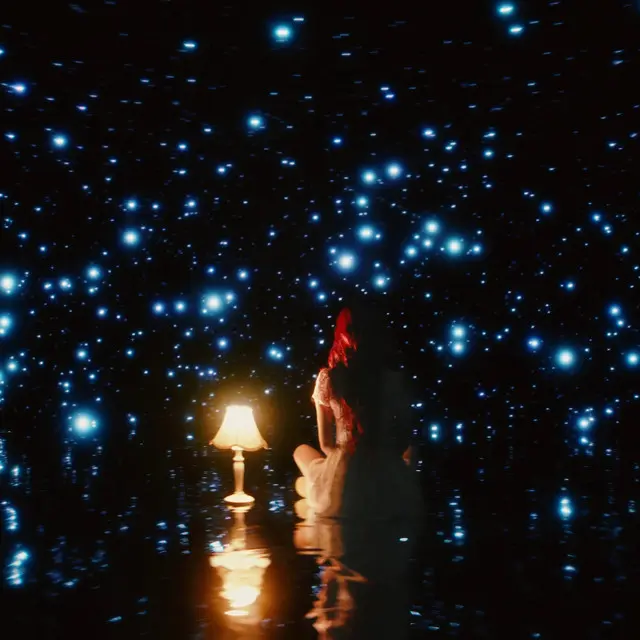
DRIGA’s Quiet Luxury follows a woman moving through loneliness, freedom, and frustration, with each state opening onto a different way of seeing herself and the world. The album takes a contemplative direction after Investment Portfolio, leaving behind some of its predecessor’s energy and wit. Olga, the Dubai-based songwriter and producer behind DRIGA, draws on dreams and subconscious narratives to shape these scenes.
The individual tracks approach different kinds of experience. “Carbon” considers the scale of eternity, “Sans memoire” finds relief in emptiness, and “Gaussian dream” turns toward instinct and the untamed. These subjects give the album a broad emotional range, though its central character remains the woman moving through them. The stories are less concerned with reaching a final answer than with staying inside each state long enough to recognize it.
Quiet Luxury favors reflection over momentum. Its atmosphere gives the songs room to move between personal uncertainty and more abstract questions, following the heroine without judging her choices. DRIGA’s dream-based writing provides the frame for an album interested in what happens inside a person when the outside world falls quiet.
If you had to describe your sound in just three words, which ones would you choose — and why?
Cinematic. Unexpected. Intimate.
Cinematic, because I rarely think of music as sound alone. Every song suggests images, places, characters, and stories. Even when there’s no actual music video, there’s usually a little film playing in my imagination.
Unexpected, because I love combining things that aren’t supposed to belong together. I don’t feel particularly loyal to one genre. Sometimes the most interesting result comes from putting two completely incompatible ideas in the same room and seeing what happens.
And intimate, because regardless of how elaborate the arrangement becomes, I want the listener to feel that there’s a real thought or emotion underneath it.
I love the contrast between an almost whispered vocal and a large, cinematic musical landscape. Something can feel both delicate and immense at the same time.
Which artists, experiences, or unexpected moments have left the biggest mark on your music?
I don’t think I have a conventional answer to this question. I’m not sure I could name a particular musician or artist who has shaped my sound. My inspiration tends to come from much less predictable places — a sentence overheard somewhere, an unusual painting, the name of a place, or an idea that suddenly refuses to leave my mind.
For example, I once visited Finistère, a coastal region in Brittany, France, whose name literally means “the end of the earth.” I found that name absolutely fascinating. What would the edge of the world actually look like? What would happen if you could reach it? That simple question gradually evolved into an entire imaginary mythology and eventually became my song “Is It Ever Over?” from Quiet Luxury.
Another example comes from Breaking Bad. There’s a scene where Walter is facing cancer, and Hank tells him, “You were dealt a shit hand.”
That expression stayed with me because it captures something profoundly unfair about life: we don’t all start with the same cards. What comes easily to one person may require an extraordinary struggle from another. Yet even with the worst possible hand, you can still choose how to play it. That idea became “The Secret Recipe,” a song from my upcoming album about perseverance and refusing to give up, even when the circumstances seem overwhelmingly against you.
And sometimes inspiration takes an even stranger route.
Years ago, while traveling through Sicily, I discovered an art book in a small bookshop. Inside was a Van Gogh painting called Still Life with Four Stone Bottles.
What caught my attention was a rather peculiar yellow cup. I was completely captivated by it — its irregular shape, color, something almost inexplicably moving about such an ordinary object.
When I returned home, I spent quite some time painting my own version of that cup: a strange yellow cup against a green background, in a Van Gogh style.
Years later, the same image unexpectedly resurfaced in “Let You Go,” a song from my upcoming EP Looked Like Love. This time, the cup became a symbol of someone you’ve lost — something once familiar and precious that you can no longer hold on to.
I love how an image can stay somewhere in your mind for years and then suddenly acquire an entirely different emotional meaning.
Sometimes the heroines of my songs even enter into imaginary conversations with other artists’ characters. In “Ophelia’s Window,” the protagonist responds to Taylor Swift’s The Fate of Ophelia, offering my own spin on the story. And in my upcoming song “Shape of Me,” she enters into a kind of imaginary dialogue with the protagonist of Ed Sheeran’s Shape of You.
I suppose that’s how inspiration works for me. I’m constantly collecting little fragments of the world without necessarily knowing what I’ll do with them.
Sometimes a painting becomes a love song. Sometimes a television line becomes a philosophy of resilience. And sometimes the name of a place becomes an entire universe.
The most fascinating part is that I rarely know where an idea is going to take me until I get there.
How do you turn these surreal experiences into music?
Some of my songs are not simply inspired by dreams. They are dreams, transformed into music.
“Gaussian Dream” is a perfect example. I actually dreamed the entire story — the tigers, the financial markets, the strange events unfolding around me. The dream was incredibly vivid, long, and full of details.
My challenge was to translate it into words without losing its essence. I spent a long time working on the lyrics, trying to distill this elaborate dream into something like its emotional and symbolic DNA.
I didn’t need to invent a surreal story. My subconscious had already done that for me.
Another example is “My Feet Stay Dry,” one of the first songs in which I attempted to preserve a dream almost entirely through poetry.
At the time, I was reading Carl Jung’s The Red Book and Marie-Louise von Franz’s work on dreams. I’ve always been fascinated by the unconscious, and I keep a dream journal.
Sometimes I wake up with an image or a story so extraordinary that I simply cannot let it disappear. I carry it around in my mind, examining it from different angles, until I find a way to give it form.
It’s almost like sculpting. A sculptor takes an intangible idea and turns it into something physical. I try to do something similar with certain dreams, using music and language.
“Castle in Rewind,” from Quiet Luxury, is another dream preserved in musical form.
And “Dancing on Your Gunpowder” began with a dream in which I was dancing on a road covered in gunpowder. Later, I connected that image to the emotional experience of a turbulent, push-pull relationship — the kind where two people are constantly drawn together and pushed apart.
I had experienced that emotional dynamic in the past, and I remember the feeling very well. The dream image became a perfect metaphor for the instability and danger of that emotional dance.
I love that dreams can reveal connections we might never consciously invent.
Your background in physics includes research at CERN and Princeton. Do you see a connection between scientific discovery and artistic creation?
Absolutely. I think science and art have much more in common than people realize.
Both begin with curiosity, imagination, and the desire to understand something that isn’t immediately visible.
In physics, we look for structures, patterns, and elegant explanations. We try to understand how individual elements interact to create something larger and more complex.
I approach songwriting in a surprisingly similar way.
I’m very deliberate about designing my songs. I don’t think only about the melody or the meaning of the lyrics. I work with phonetics, rhythm, repetition, imagery, metaphors, and musical structure as interconnected elements.
For example, in “Is It Ever Over?”, which explores the mythical edge of the world, I wanted the song itself to resemble waves rolling toward the shore.
I experimented with the sounds of words, particularly the alternation of W and S sounds, and with repeating structures that create a sense of movement and return.
I wanted the listener to experience the waves not only through the story, but through the physical sound and rhythm of the language.
That’s what I love about creating music: an idea can exist simultaneously on so many levels — phonetic, musical, emotional, visual, and philosophical.
And when all these elements begin to reinforce one another, something fascinating happens. The song becomes more than the sum of its parts.
I suppose that’s where my scientific background comes in. I enjoy understanding how things work, but I also love designing systems in which unexpected beauty can emerge.
Of course, there’s one wonderful difference between science and art.
In science, your ideas must eventually answer to reality. In art, you’re allowed to create your own.
In “Gaussian Dream,” you bring together wild tigers, financial markets, music, and mathematics. How did such an unusual story come to life?
The thing is, I didn’t consciously bring these worlds together. They were already connected in my dream.
I dreamed of wild tigers entering my world, of Dubai’s fountains transforming into financial market charts, and of events that were simultaneously beautiful, absurd, and strangely logical.
The dream was much longer and more detailed than the finished song. My first challenge was deciding what to preserve and how to translate its unusual logic into poetry.
But there was one part that required something more than transcription.
I kept thinking about the difference between the tigers and the armed men who appear in the story.
Why were the tigers there? Why did other large predators eventually join them? And why did the human characters feel so fundamentally different?
Intuitively, I understood the contrast, but for a long time I couldn’t quite explain it.
Eventually, I realized that the animals represented a kind of natural order. A tiger can be dangerous, but it doesn’t accumulate wealth, seek power for its own sake, or take more than its instincts demand.
Humans, on the other hand, are capable of inventing elaborate justifications for greed and domination.
That realization became the bridge of the song.
For me, it was the moment when the dream’s emotional logic finally became something I could express consciously.
The Gaussian distribution offered another layer of meaning: the possibility that beneath what we perceive as randomness, there may be structures and relationships we don’t immediately recognize.
That’s what fascinates me about this song. The dream arrived first. Understanding it became part of the creative journey.
Can you walk us through the story and emotions behind “Quiet Luxury”? How does it connect to your previous album, “Investment Portfolio”?
I actually see these two albums as consecutive chapters in the same journey.
Investment Portfolio is a playful, energetic nu-disco album about freedom, ambition, and the many different things we invest in throughout our lives.
And despite its title, it’s not really about money.
Every song explores a different kind of investment.
In “Like Pasha Durov,” for example, the central idea isn’t the wealth of a billionaire. It’s the freedom to live on your own terms and do what you truly want. To me, that’s one of the most valuable investments imaginable.
“My Feet Stay Dry” presents a surreal world collapsing around its protagonist, while somehow her feet remain dry. It’s a metaphor for surviving uncertainty and financial crashes — particularly the wild unpredictability of cryptocurrency markets.
“Pump Crypto Up” is an energetic workout track built around another idea: invest in your body and your health. Financial markets can collapse and fortunes can disappear, but taking care of yourself is an investment that continues to matter.
Other songs explore love, relationships, and the sometimes questionable returns on emotional investments — occasionally with a good deal of irony. There’s also room for freedom, spontaneity, and the simple pleasure of having fun.
But the album’s emotional conclusion is “I Will Make It.”
That song is deeply personal to me. I can hardly listen to it without crying, even though I’ve heard it countless times.
It’s about realizing that the ultimate investment isn’t necessarily in wealth, success, or achieving some external goal.
It’s in yourself. In becoming who you are, believing in your own path, and allowing yourself to live it.
And that’s precisely where Quiet Luxury begins.
If the protagonist of Investment Portfolio was exploring the world, investing, striving, and discovering what truly matters, in Quiet Luxury she reaches a different state of mind.
There’s less urgency to achieve, and more desire to understand, observe, and simply exist.
The album turns toward much larger questions — the nature of the universe, time, matter, and the invisible forces shaping existence.
Songs such as “Carbon,” “Same Six Protons,” “Is It Ever Over?” and “Big Big Cold” explore these ideas through mythology, physics, and personal experience.
“Big Big Cold,” for instance, comes partly from my fascination with cold water and ice baths. To me, cold carries an almost primordial power — something ancient, immense, and indifferent to human concerns.
I imagined this great, eternal cold as a force capable of absorbing everything unnecessary, leaving you with a sense of clarity and emptiness.
The album itself is also designed as a cycle.
“Carbon” and “Same Six Protons” return to almost the same musical material, but with a different perspective and meaning.
I wanted to evoke the feeling of time moving in a spiral rather than a straight line.
We may return to the same place, the same elements, even the same melody — but we are no longer exactly who we were before.
You can never step into the same river twice.
For me, that is the essence of Quiet Luxury: the freedom to stop chasing the world long enough to experience its extraordinary depth.
Your music has a strong cinematic quality. Can you tell us about the storytelling and visual approach behind your videos?
I see music videos as extensions of the worlds I create in my songs.
But I don’t necessarily want to illustrate the lyrics literally. I’m more interested in finding a visual story that complements the music, reveals another layer of meaning, or expresses the same idea through a different metaphor.
For example, in the video for “Chicken Wing Spell,” a prince takes the place of the cat from the original narrative.
The characters are different, but the underlying idea remains the same: love cannot be bought.
In “Carbon,” the approach is completely different.
The video is centered around a piano performance, but the setting is what gives it a deeper meaning.
I chose a salt island in the Dead Sea — a landscape within one of the lowest-lying regions on Earth.
There’s something incredibly powerful about placing music inspired by the fundamental elements of existence in such an extraordinary location.
I love when a landscape becomes part of the storytelling rather than simply a beautiful background.
That is how I think about visual art in general.
Music, words, images, locations, colors, and symbols can all tell different parts of the same story.
Ideally, each element adds something that the others couldn’t express on their own.
When you listen to your own songs, what feelings take over? Do you want listeners to understand the meanings behind your music, or simply lose themselves in it?
I often joke that I’m a completely self-sufficient music business: I write my own songs, produce them, listen to them myself, and then cry over them myself.
But there’s quite a lot of truth in that joke.
Every song I create, including my cover versions, is deeply personal to me.
I invest so much emotion into the process that I often find myself crying like a child while working on a song.
Sometimes it’s because the music finally expresses something I’ve been carrying inside for a long time. Sometimes a particular arrangement, a line, or even a small musical detail suddenly brings an emotion to the surface.
And some songs remain so emotionally charged that even after they’re finished and released, listening to them can instantly bring me back to the experience that inspired them.
I don’t just remember the emotion. I relive it.
As for the listeners, I don’t think they need to understand every metaphor or reference.
I love creating multiple layers of meaning, but they are invitations, not instructions.
Someone can simply enjoy the melody. Someone else might connect to the emotional story. And another listener might discover a philosophical interpretation I never consciously considered.
I find all of these reactions equally valuable.
Music doesn’t have to be intellectually decoded to be deeply understood.
If you could collaborate with anyone in the world — a musician, filmmaker, visual artist, or scientist — who would you choose and what would you create together?
To be honest, I don’t have a particularly good answer to this question. I’ve actually thought about it quite a lot.
I think what I would really love is to become part of a much larger music production system — perhaps a major record label or a strong creative production team — where I could work with people who have the expertise and resources to help me bring my ideas to life as fully as possible.
I have so many ideas, often far more than I can realistically develop on my own. And I would love to have the opportunity to explore them on a much bigger scale.
But when it comes to collaborating with one particular famous artist, it’s a little more complicated.
Of course, I have my idols. There are musicians, filmmakers, and actors whose work I’ve admired since childhood.
But whenever I imagine actually meeting them, I realize I wouldn’t really know what to say beyond something embarrassingly ordinary like, “I’m such a huge fan of your work!”
And then what?
What could I possibly suggest we create together? What could I add to something I already find so brilliant and complete?
For example, I’ve loved Metallica since childhood. I admire Quentin Tarantino enormously. I’m fascinated by the work of producers like FINNEAS, Rick Rubin, and Mark Ronson. And I think Leonardo DiCaprio is an absolutely extraordinary actor.
But when I think about their work, I don’t find myself imagining how I could improve it or what I would want them to do differently.
I simply admire what they create.
So perhaps my dream collaboration isn’t really about meeting one particular celebrity.
It’s about finding a creative environment where talented people can help one another realize ideas that would be impossible to achieve alone.
I’d love to be part of a team that could take one of my strange little dreams and turn it into something extraordinary.
What are you working on now, and which new creative worlds can we expect to discover next?
I’m constantly developing new music and visual concepts.
My next release is an EP called “Looked Like Love,” which explores a turbulent, push-pull relationship, complete with a rather Lars von Trier-like ending.
My next full-length album, “Embracing the Shade,” will include songs such as “Dancing on Your Gunpowder,” “Ophelia’s Window,” and “Shape of Me,” alongside many more dynamic, seductive, and humorous tracks.
I’m also preparing a major cover album, “Ukrainian Heritage,” to honor my Ukrainian roots and spirit. And I have plans to release several English-language covers of some of my favorite songs.
Last but not least, there’s a big Christmas project called “Your Christmas Playlist,” designed to bring a little extra holiday spirit into the world.
It sounds like a lot, and it is.
But I swear, every single song I work on goes through a stage where I’m convinced it’s completely hopeless. And then I tell myself, “You don’t have to release it.” And that’s such a relief 🙂