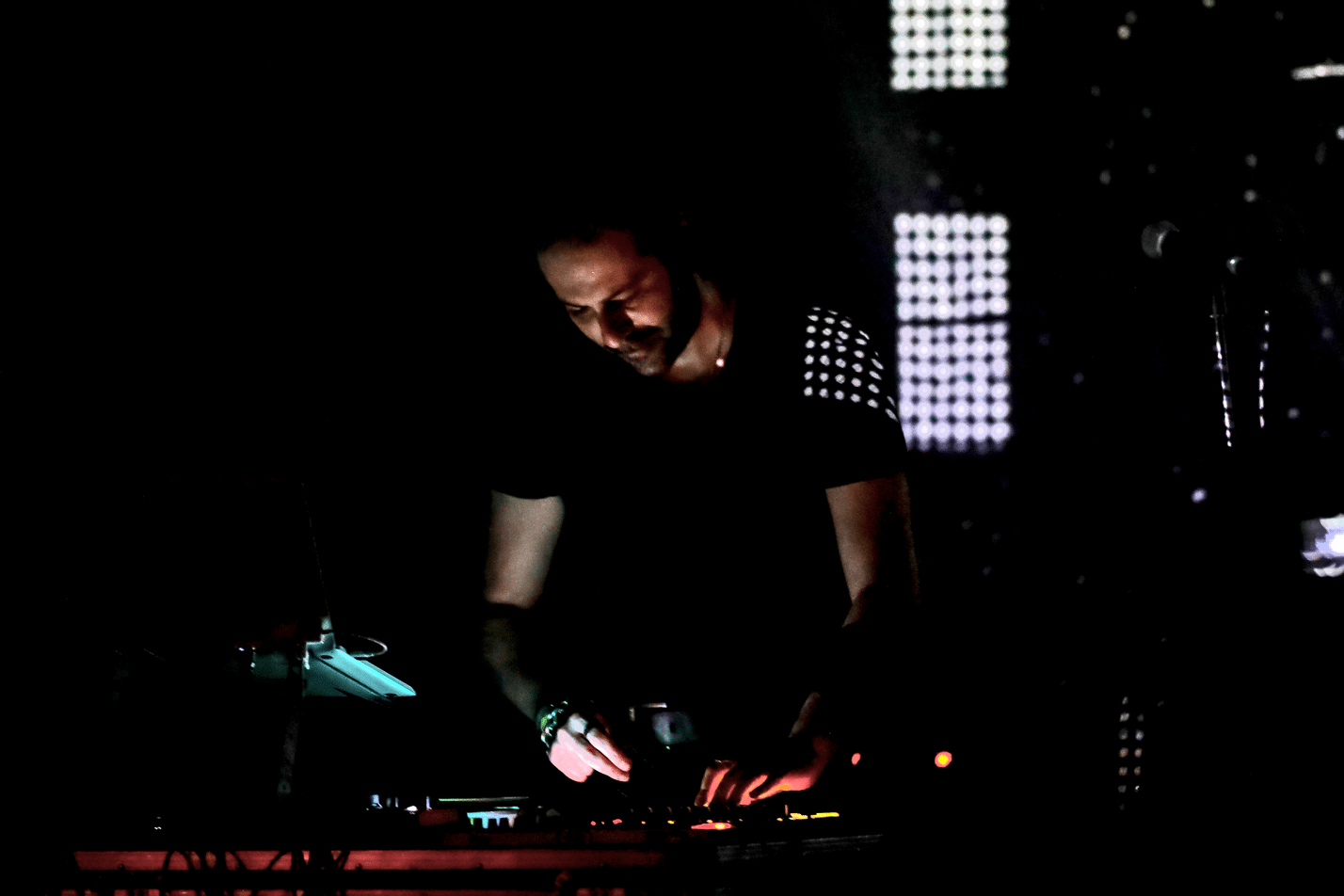
In Mekanikaru, Electrons in Slow Motion doesn’t just compose electronic music: he architects a future where pulse and pulse-width modulation replace heartbeat and breath. Conceived as a negotiation between the human spirit and the cold logic of machinery, the album unfolds like a film set in the last free district of a mechanised city. Born in Bucharest amid the unravelling days of the 1980s communist era, Marius Copel: better known as Electrons in Slo|w Motion, carries into his sound a lived understanding of how systems press against autonomy.
As a political film festival director, he’s watched countless stories of resistance and revelation; Mekanikaru distills that into a sonic manifesto. Each track resides at the fault line between order and chaos, questioning whether surrendering to algorithmic precision is easier than confronting the unruly nature of the self.
Can you walk us through the story or emotion behind “Never surrender”?
Never Surrender isn’t a slogan — it’s a state of mind… it is already an act of rebellion. It was initiated in a moment where giving up felt easier than continuing. The moments before the pandemic period. But It never stopped, it accumulated momentum and clarity. With Never Surrender, I didn’t start from a melody — I started from a rhythm. I wanted the track to feel like pressure rather than progression. So a lot of the structure is built around restraint: slow harmonic movement, minimal chord changes, some very direct guitar stabs, and a pulse that never fully resolves. The pressure is constant. The rhythm is deliberately patient — almost stubborn — like it refuses to rush toward a payoff.
Sound-design-wise, I treated the synths like light sources in a dark room. And also like human voices. Most of the parts are narrow in spectrum, slightly distorted, filtered, and automated, so they’re constantly breathing — opening, closing, decaying. Nothing static. Everythingis slowly shifting.
There’s also a lot of emotional information hidden in the details: degraded reverbs, long tails, low-level noise, subtle modulation drift. The imperfections are intentional — they make the track feel human inside a machine. Structurally, I avoided a classic “drop.” Instead, the track accumulates weight. It becomes heavier without becoming louder. More dense without becoming explosive. Like endurance instead of impact. The goal wasn’t excitement. It was a tension you could live inside. Fun fact: the track ends with the defiant and playful bark of my dog. (That will also be the last sound on the A-Side of the vinyl edition).
If you could team up with anyone in the world—no limits—who would be that dream collaborator? I don’t really dream in names. I dream in atmospheres. But if I had to speak in human terms… someone like Denis Villeneuve. I’m interested in collaboration as world-building. In creating spaces where sound and image become inseparable, where music doesn’t sit beneath the story… it becomes part of the architecture of the world itself.
For those who might not know you yet, how would you introduce yourself?
I’m Marius Copel — operating under the name Electrons in Slow Motion. I make music for the hours when the city stops pretending. For empty streets, glowing windows, late trains, and the quiet machinery of thought.
My sound lives somewhere between ambient, cinematic electronica, post-rock and some updated IDM or deep-techno — but it’s really about atmosphere. About tension. About what hides beneath the surface. Every track is a fragment from a larger world: half-dream, half-future, always restless.
I’m interested in liminal states… in moments where things almost fall apart, and almost come alive at the same time. No clean endings. No bright resolutions. Just pulse, shadow, and momentum.
If you had to bottle up your sound into just three words, which ones would you choose?
Magnetic. Cinematic. Untamed. Because the music isn’t meant to just be heard —
it’s meant to pull you in, play like a film behind your eyes, and leave a little chaos behind when it’s over. Because it doesn’t behave like music. It haunts. It stalks. It drags you into a city that doesn’t exist — and then dares you to find your way out.
Which artists (not only music-related) or moments have left the biggest mark on your music?
I’ve always been shaped more by atmospheres than by scenes. Cinema came first — worlds that felt heavier than reality. The out-of-this-world spiritual states of Andrei Tarkovsky, the neon melancholy of Blade Runner, the quiet violence of Stefano Sollima, the beauty and magic of Paolo Sorrentino… they taught me how silence can speak, how light can wound, how cities can feel alive.
In music, I was drawn to architects of feeling rather than genre — artists who build inner universes. The fluidity of Jean Michel Jarre, the directness and torque of Prodigy and Underworld, the emotional geometry of Trent Reznor or Boards of Canada, the precision and dream-logic of Ryuichi Sakamoto, Alva Noto, Fennesz.
They made me understand that sound can behave like memory. Also architecture. The constructions that become characters and worlds. Tadao Ando, Kenzō Tange, Renzo Piano. But just as much… moments shaped me. Cities at 4 a.m. Long train rides with no destination. Standing still while the world kept moving. That’s where my music really comes from. Not from influence — but from atmosphere, and the feeling that you’re inside something bigger than yourself.
When you hit play on your songs, what kind of feeling takes over?
It feels like stepping into a city I built… and no longer fully control. There’s a strange calm in it. A sense of distance. Like looking at your own life through rain-streaked glass. Sometimes it feels like a memory. Sometimes, like prediction. Most times, like being alone in a beautiful machine that refuses to sleep. It isn’t nostalgia. It isn’t comfort. It’s that quiet electricity you feel when something inside you finally starts moving again.
Outside of music, what brings you joy or keeps you grounded?
Walking without a destination. With my dog, preferably. Cities at their quietest hour. Old buildings that remember things. Centuries in the walls. Trains cutting through misted countryside. Church bells dissolving into city noise. Film. Architecture. Music in my earphones as a soundtrack for the inner journey. The way light moves across a wall at the end of the day. And distance — not from people, but from noise. Silence is where I recalibrate. Where I remember what’s real. I don’t need much. Just enough space to think… and enough shadow to breathe.
Do you have a favourite quote or mantra that keeps you motivated on tough days?
I don’t really collect quotes. I return to a sentence of my own: Never stop. It reminds me that staying — creating, feeling, moving forward — is already resistance. That showing up is an act of defiance. And generosity. And, at the end of the day, it brings victory. And peace.
Find all his info here.