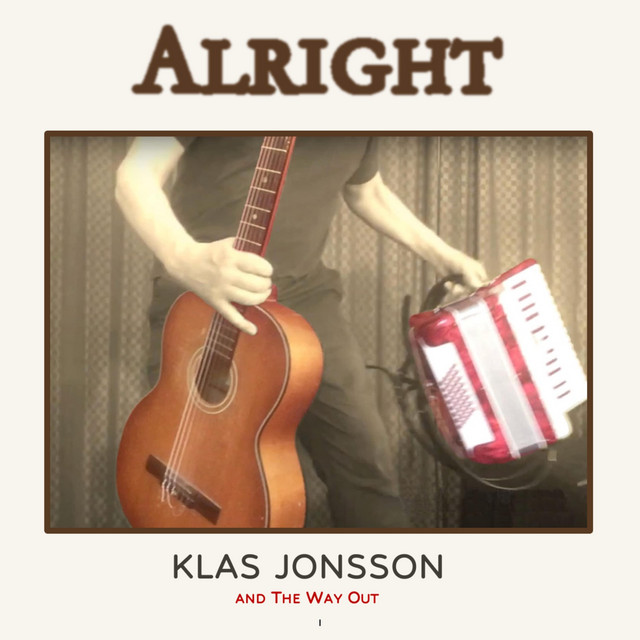
Klas Jonsson is a Swedish composer and multi-instrumentalist who works at the scale his music actually requires. Accordion, one-man live sets, collaborators brought in for specific purposes, the whole operation built around the song rather than around the career. Three tracks from his catalog demonstrate a consistent method: Jonsson writes the choruses, hands the verses to someone else, and trusts the gap between the two to do the work.
Sad & Ugly
“Sad & Ugly” arrives as a gospel track wearing a gloomy title, the contradiction built into the premise before a note plays. Jonsson and co-lyricist Emma Nordenstam split the song along a fault line: the choruses carry the blunt adjective pair, the verses fill in the character underneath. Misery of this kind doesn’t perform itself. It just sits there making everything around it look worse.
The music refuses the lyrics their full weight. A gospel warmth builds toward the end, not as irony but as something more uncomfortable, the possibility that the arrangement knows something the narrator doesn’t. Jonsson doesn’t resolve the gap between the sad character and the not-quite-sad music. He leaves both standing.
I’ll Be Alright
A return to a shared place, now emptied of its original function. Charlotta Frändberg’s verses arrive with alliterations and assonances dense enough to make the singing itself an act of effort, which is its own kind of accuracy.
The title is a statement that keeps examining itself. Said once it’s a conclusion. Said in a song it becomes something to test against the music, against the room being visited, against the silence on the other side of the breakup. Jonsson doesn’t confirm or deny it. The narrator leaves the same way he arrived, still saying it.
Sleepless (Banjo Version)
At three in the morning, new love doesn’t ask permission. “Sleepless” is built around that specific arithmetic, translated from Swedish with help from Nandi Lee, the lyrics carrying the particular logic of new love, where the intrusion is welcome and the cost is just tiredness.
The banjo version adds a carefree quality that matches the content without explaining it, happy harmonies for a happy problem. Filip Runesson’s violin and Jonsson’s accordion break into improvised combat mid-track, a burst of energy that mirrors the sleepless mind’s own tendency to run off on its own. The song doesn’t apologize for any of it.