With “Work to Die”, JeezJesus sharpens his industrial-synthpop edge into a biting social anthem for the overworked and underpaid. The use of an anthemic scope of synth-driven pop with a rugged alternative-rock undercurrent channels Joe McIntosh’s (a.k.a. JeezJesus) frustration at an economy rigged against the everyday worker.
Its pulsing synths, soaring hooks, and ironic sense of unity make it both a cathartic release and a rallying cry for those trapped in the grind. Equal parts sarcasm and sincerity, “Work to Die” captures the spirit of resistance through rhythm.
How did the concept for this project come together, and where did the creative spark start?
This project was primarily born out of the ashes of a former subversive performance art solo project I started called GIMP back in 2017. My first album, ‘Dr. Electro Love,’ was originally going to be the first GIMP album. It’s actually quite a long story as to why I started this project. During the start of the pandemic, I finished ‘Dr. Electro Love’ so 2020. I had a few concerns about continuing to market serious artistic work under a brand image that had such ties to the fetish community. Creatively, I felt it left me no scope, so I spent a while figuring out how to push the project forward from a marketing perspective. Eventually, I lost faith in myself, rejected myself as a creative and decided to push my creativity aside to become more ‘normal’ I guess.
I was working a very corporate, mundane Government job (linked to the pandemic), which gave me lots of time to reminisce on who I had been before the pandemic. I got up one day at the end of 2022 after years of putting music and creativity to the side, I listened back to what I had created back in 2019/2020 and said to myself, ‘What am I doing? This is me. I am a creative!’ I loved who I was, hated who I was becoming and dreaded where I was going. I
basically had been faking trying to be a non-creative person, I guess a sort of ‘normal’ person (I’ve never felt normal, really, by society’s expectations on many levels), when in reality it was such a massive part of my life and I couldn’t live without creating. I am what I create. It’s so important to me and my identity.
So I released ‘Dr. Electro Love,’ at the end of 2022, under my Instagram name JeezJesus and began writing and writing and writing. I was covering creative ground I had never covered before and gaining a new love for creation that I had never quite felt before. It was almost like I was born again. Out of the ashes of failure, I reinvented myself more authentically, more unapologetic and more passionate than ever before. It felt spiritual; it was a rebirth.
Can you walk us through your songwriting and production process for this project?
Over the years, I have realised the value in efficient work practice, working within heavily procedure-based environments has heavily influenced my creative practice. I’m a very structured and organised person and try to organise the chaos of my own creativity with very efficient working processes and excellent time management. I genuinely believe that what is holding a lot of creative people back from producing work is a lack of discipline when
approaching their own creative output. My own songwriting starts in many different ways; it can be as simple as one synthesiser patch, a two-note melody or a percussive pattern. It usually never starts with lyrics (quite a lot of my music is instrumental). If I like an idea, I’m
willing to give it a chance and work with it; I don’t particularly discriminate against a lot of my ideas. I believe everything has the potential to be good, and I like the challenge of making something work. I don’t latch on to a sense of trying to achieve perfection, but more so trying to achieve something truly authentic.
Eventually, things start to fall in place, and there you have it, I have a song, some come more easily than others, but that’s the beauty of the creative process.
As far as production is concerned, I’ve spent my life surrounded by amazing technical minds when it comes to music production, and I continue to spend my time around these kinds of people. I had an amazing education in Music Technology at the University of Salford, Manchester, studying a Bachelor’s and a Master’s. A lot of the production side of my musical art has become so ingrained within my own work practice that it has become second nature.
Usually, if I can imagine it, I can probably do it. I do have a very well-structured production process utilising template projects I’ve made and a heavy focus on a strong mix of architecture.
Overall, when it comes to songwriting and production, I have my experience to thank; it has taken me years to form an efficient and creative process that allows me the seamless freedom to express myself.
You designed nearly all the visuals—what was your approach to crafting a
consistent aesthetic?
My creativity does not stop at music. I consider myself a multimedia artist. I love being able to build the entire artistic world surrounding the project, so the branding is so important to me. Most of the time, my consistency is built because it’s what I think is cool, and primarily, I’m doing this project for me.
Everything you see associated with this project I made, if not, completely by myself or in close collaboration with others. I return to this idea of authenticity. What makes everything coherent is that it is so authentic to me, and in a world where our own autonomy is being lost to machines, I pride myself on maintaining my own humanity and my own sense of self and identity. In brief, this project is me through and through; it is my world I have created, and I welcome anyone into it. My escape can be your refuge.
How do the visual elements interact with or enhance the music?
I’m creating a world of expression with this project. I’m writing a song, and I’m then wanting to express this song further by using it to inspire me visually. Music is always more than just the music; the music holds everything together.
Unfortunately, the reality of social media is that you’re forced into focusing on the aesthetic over the music if you’re going to promote a project, but arguably, the visual has always played a massive part in enhancing the music. We are all drawn to certain things visually, and I enjoy creating the content. I love graphic design, I love videography, and I’d love to further develop my skills in animation, so I don’t mind offloading some creativity and time into the visuals.
You also directed/shot the videography—how does storytelling play into your videos?
I guess this year, I’ve been following the trend of gritty dystopias as we are living through one. Other than the promotional campaign for ‘We Could Be Friends’, the rest of my aesthetics and visual storytelling have played into this modern dystopia look.
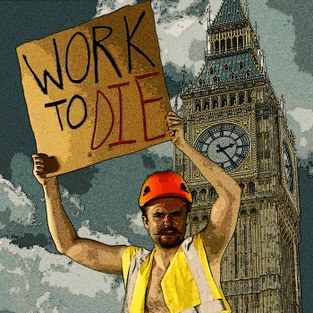
Again, I’m not so much telling a story as I am creating this expressive world, which inherently may be telling you the story of me. I’ll take the video ‘Work to Die’ for instance, the song details my frustrations with the economy and the endless cycle of working so hard for what feels like nothing, and the video is a homoerotic satire based on old USSR propaganda. It’s a tongue-in-cheek response to a reality I am deeply struggling with. The video for ‘Like to Like You’ presents myself as a digital demon trapped in a digital hell, the song is written about the dark side of social media. I’m just trying to express my feelings in the most appropriate and creative way I see fit.
How do you translate musical ideas into visual narratives or imagery?
I actually don’t really know how to answer this question. It’s something of a lightning-bulb moment, really. I have a lot of those. I don’t tend to think too hard about certain ideas; I usually have an idea and jump straight into it. I definitely seize nearly all creative ideas that come into my head, and it usually works out.
Arguably, it helps that in the process of writing material, I am constantly containing myself within my own world of creativity, and I’m usually maybe months into the creative process before I have considered visuals. So I’m usually well ahead of schedule, which leaves plenty of time for ideas to come.
Everything I write has a strong meaning, so it isn’t too hard to come up with a visual, and I have a wealth of material to choose from, so I’m fortunate I have so many great musical ideas to be inspired by.
How do you see music, visuals, and design as interconnected elements of a single artistic expression?
We’re usually not only drawn to music but also by the aesthetic it is marketed to us with. Music, visuals and design are all so intrinsically linked, maybe more so than ever before. To be honest, visual arts can hold their own without the aid of an audio accompaniment, but music always has a visual accompaniment, be it a music video or album artwork. You can’t really present music without some form of visual tied to it. Everyone is seeking an identity, and we rely so heavily on art to help us form an identity, both in our own ideologies and our own physical style. Identity is essentially how we express ourselves from our own lived experience.
In answer to the question, I will go back to this idea of creating this world of expression, this world of retreat. A world where I can express myself freely and use to help me understand myself.
Looking back at the finished project, what are you most proud of in terms of
artistic cohesion?
Well, with ‘Work to Die’, I don’t know if I could have expressed myself any better both musically and visually. The song expresses my feelings of neoliberal fatigue, working so hard and so many hours just trying to get by and build a secure life for myself, whilst being able to enjoy my own intellectual pursuits, but feeling constantly disadvantaged due to the terrible wealth imbalance and the deteriorating state of the economy, which is inherently caused by this massive imbalance. As a working person, ‘Work to Die’ expresses my own struggles trying to navigate a societal structure that is constantly working against me as I continue to work myself into an early grave.
The video ties in quite nicely with this theme. It is based on USSR propaganda that celebrates the working person. I am applying that propaganda imagery (with a hint of homoeroticism) to current neoliberal economic issues, I’m sure well all can relate to.
In brief, everything I had intended for this release actually turned out better than I could have imagined.
If you had to bottle up your sound into just three words, which ones would you choose?
Industrial Dystopian Electropunk
Which artists (not only music-related) or moments have left the biggest mark on your music?
So starting with music, the most influential musical artists to me are Depeche Mode, Nine Inch Nails, Yes, MARINA and Ministry (Ministry’s album ‘Twitch’ had a significantly massive impact on me musically). Film plays a lot of influence in my music, one of the most significant films I have seen would be Panos Cosmatos’ ‘Beyond the Black Rainbow’ (Probably one of my favourite films of all time).
When you hit play on your songs, what kind of feeling takes over?
I actually listen to my own music quite a lot. I love my music, I actually think I am my favourite artist, but it makes sense, I make everything because I want to hear it. I wrote my album ‘Super Creeps & Spooky Beats’ because I had a desire to hear what I thought should have been the follow-up to Ministry’s ‘Twitch’, but with modern-day production. There’s some stuff I’m not too keen on, but I’ve got a lot of material and I don’t hate anything I’ve made so far.
Can you walk us through the story or emotion behind this track?
‘Work to Die’ was written as an anti-capitalist anthem. It comes from a very authentic place. I am working a huge amount of hours a month to be able to live whilst I’m seeing the potential for a future for myself being taken away from me as the super-rich buy up all the assets and force me into a position of financial slavery. I was sold a capitalist lie that if I work hard, I will be rewarded for my efforts, and the idea of even affording my own home is kind of off the cards. Instead, I am working myself to death and in reality, all I really want is to be able to live comfortably and have the ability to focus some of my time on my own creative intellectual pursuits.
‘Work to Die’ expresses my frustrations with the devastating state of the economy and my dwindling hope in a secure future for myself.
If you could team up with anyone in the world—no limits—who would be that dream collaborator?
Oh, this is an easy one, Trent Reznor for sure. He is by far one of my biggest musical inspirations.
And finally, what are you working on now, and what are your plans for the future? Anything exciting you can tell us about?
Currently, I’m just finishing the promotional material for my next single, which will then build up to the release of my fourth album, ‘Somewhere Between Love & Misery’, in December. I have a number of ideas and plans which are quite overwhelming. I’ve just started writing some more heavily political music as a response to the current political climate. I have a longer experimental video project I would like to try and finalise by the end of next year, and try and get some funding to put it into an exhibition space and create an audiovisual art experience. But most importantly, once I’ve finished this year’s releases, I would like to get a set together and take some of my material out live with me towards the middle of next year. Unfortunately, I’m always so busy, and always creating the live aspect always gets pushed back, but it would be nice to get some gigs next year. If anything, I will still be creating, and things are still going to happen in whatever form my creativity chooses to manifest in.