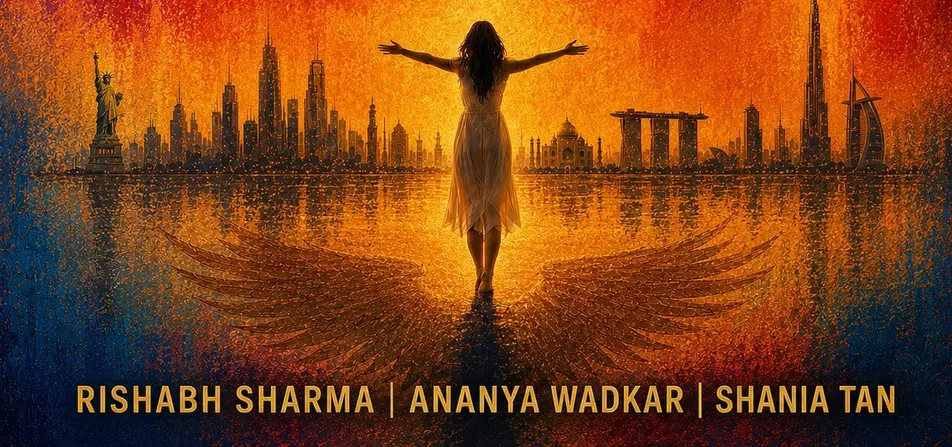
Seema Farswani’s “Born To Fly” puts courage and possibility into a cinematic soft-rock setting, with guitars, sitar and layered vocals building its sound. The song moves between English and Hindi, bringing its message for girls and women into a mix of Western rock and South Asian textures.
The guitars give the track its rock side, while Ananya Wadkar’s sitar and Hindi vocals bring another voice into the arrangement. Shania Tan adds backing vocals around Farswani’s lead, giving the bigger sections more voices to work with. The song keeps returning to the idea of looking beyond the horizon and having the freedom to dream.
“Born To Fly” came from The Voices Unseen charity concert in Singapore, where the original idea connected women’s empowerment with support for people with visual impairments. That beginning grows into a wider message here. The guitars rise, the sitar answers, and the voices move toward the same horizon.
For those who might not know you yet, how would you introduce yourself?
I’m Seema Farswani, an Indian-American independent singer-songwriter, composer and producer based in Singapore. I’m a global citizen, shaped by formative experiences across India, the Middle East and the United States, and those intersecting cultures continue to find their way into the music I make. Before music became my primary creative language, I worked in spatial design, and that sensibility still informs everything I do. I experience songs almost architecturally — through atmosphere, texture, emotion, colour and space. My music is eclectic, genre-fluid and cross-cultural. It moves through shifting shades, sonic palettes and emotional landscapes. At its core, however, I’m interested in honest storytelling: growth, love, identity, courage, vulnerability and the lifelong process of becoming more fully oneself.
If you had to bottle up your sound into just three words, which ones would you choose?
Soulful. Cinematic. Borderless.
Soulful because emotion is always the point of departure for me. Cinematic because I instinctively imagine places, colours and scenes when I write. And borderless because I’m drawn to the meeting point between cultures, genres and musical traditions — without feeling that any of them need permission to belong together.
Which artists — not only music-related — or moments have left the biggest mark on your music?
I’ve always been drawn to artists with a strong and unmistakable sense of identity. Whitney Houston and Christina Aguilera have influenced me through the emotional force and extraordinary range of their voices. I admire Sting for the sophistication and worldliness of his songwriting, Adele for her candour, Annie Lennox for her singularity, Coldplay for their scale and atmosphere, and Lady Gaga for her fearlessness and continual reinvention. My influences, however, extend well beyond music. My years in spatial design taught me to think in terms of balance, contrast, form, proportion and narrative. Travel has shaped me just as profoundly. Growing up in Dubai, living in the United States and Singapore, and continually moving between cultures have made me deeply curious about the ways different musical worlds can converse with one another. There are also certain moments that alter the reason you create. Performing at The Voices Unseen charity concert was one of those moments for me. It made me think more deeply about what a song can represent beyond the artist herself; how music can offer encouragement, solidarity and a sense of possibility.
When you hit play on your songs, what kind of feeling takes over?
It varies from song to song, but I always want there to be a sense of movement. Sometimes that movement is physical — the sensation of travelling, dancing, driving or flying towards somewhere unknown. At other times, it is internal: longing, release, resilience, gratitude or the quiet instant in which something within you finally shifts. I never want a listener merely to hear a track. I want them to enter a world for three or four minutes and, ideally, recognise some part of themselves within it.
If you could team up with anyone in the world, no limits, who would be that dream collaborator?
It would be Lady Gaga. I’m deeply inspired by her artistry, individuality and the fearless way she inhabits her creative life. I admire how she has evolved across music, performance and film while remaining unmistakably herself.
She represents courage, purpose and creative freedom — qualities I value deeply. I would love to discover what might emerge from bringing her theatricality and instinct for reinvention into dialogue with my own cross-cultural musical perspective.
What are you working on now, and what are your plans for the future? Anything exciting you can tell us about?
There is quite a lot in motion. I’m currently shaping the next chapter of my music through a series of releases that will eventually form part of my second body of work. I’ve just emerged from the world of Born To Fly, and the songs ahead explore markedly different emotional territories. I’m working on “Not At All,” a heartbreak record, followed by a Christmas single that is currently taking shape. I’m also creating a love song centred on distance, longing and the emotional complexity of missing someone. What excites me most is that I’m becoming less interested in defining myself through a single genre. The thread connecting these songs is becoming increasingly clear: compelling storytelling, a global musical perspective and the freedom to allow each song to become precisely what it needs to be. In the longer term, I want to continue building an international presence through recordings, live performance, collaborations and opportunities in film and sync, while keeping the creative process deeply personal.
Can you walk us through the story or emotion behind “Born To Fly”?
Born To Fly began in a deeply personal place. I initially started writing it with my daughters in mind, wanting to express the importance of believing in themselves, embracing their individuality and finding the courage to pursue their dreams. The song expanded into something far larger after I performed at The Voices Unseen, a charity concert supporting people with visual impairments and initiatives focused on women’s empowerment. Sharing the stage with Rishabh Sharma, Ananya Wadkar and Shania Tan made the message feel larger than my own family. I wanted the song to speak to every girl and woman who has ever questioned whether she is entitled to dream, grow or take up space. I also wanted to carry the chemistry we experienced onstage into the single itself. Musically, that idea of possibility became an East-West dialogue, created in collaboration with extraordinary musicians from Bollywood, Mumbai who stood in solidarity with the song’s message. Rishabh’s guitars and Ananya’s sitar became two distinct musical voices in conversation, while the Hindi Vocal scat element introduced another cultural dimension to the record. The song was created cross borders between Singapore and India, and I wanted the record to begin with vulnerability rather than triumph, because courage rarely announces itself as fearlessness. More often, it begins quietly: with someone deciding that, despite uncertainty, expectations or limitations, they will take one more step towards who they might become.
That, for me, is what Born To Fly ultimately means. It isn’t really about already having wings. It’s about deciding to use them.