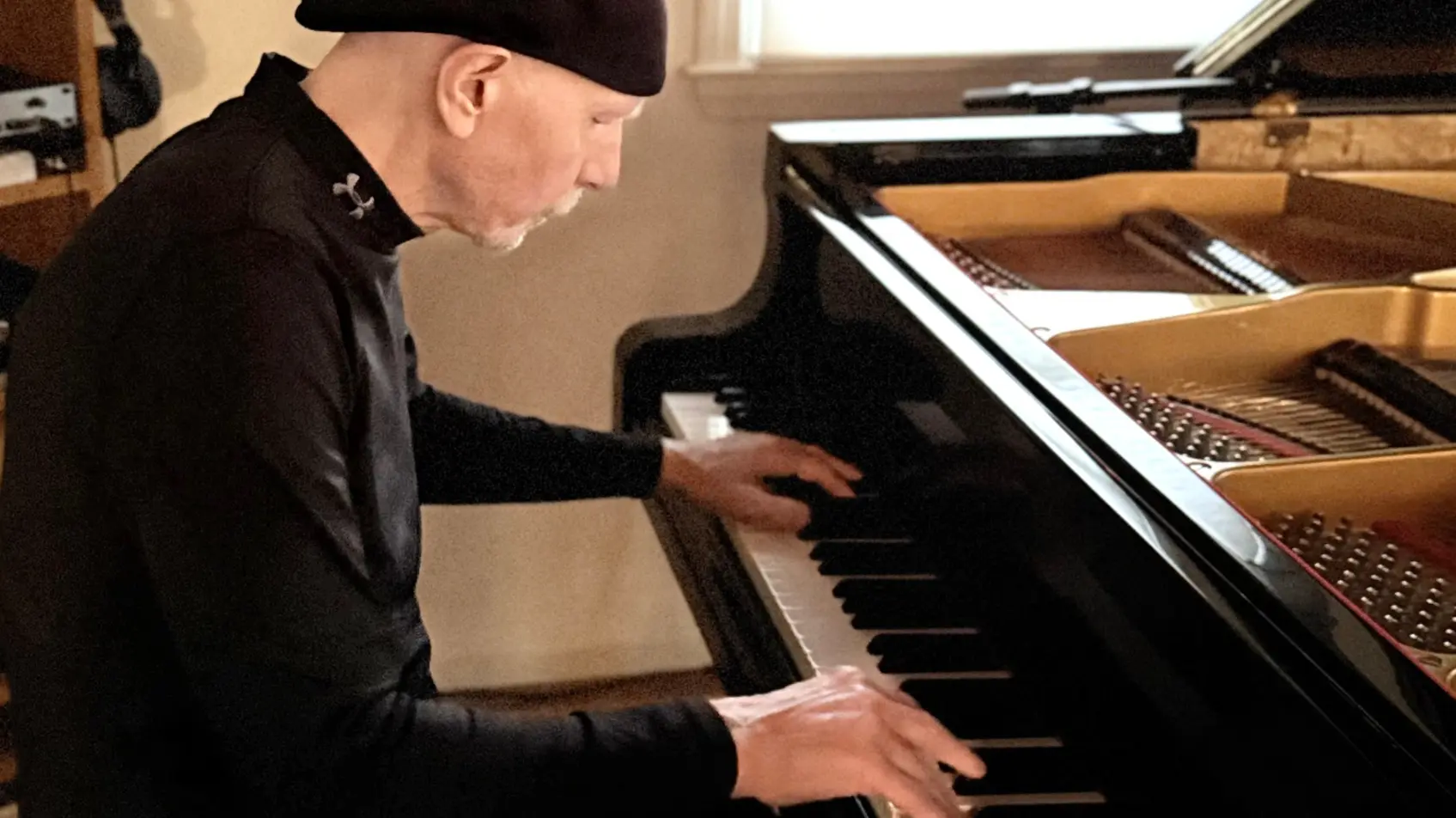
Mario Mattia’s “Hymn” is a quiet solo piano improvisation built from open chords and a melody that never settles into a fixed shape. The notes recall the sound of American hymns, though Mattia does not tie the piece to any particular faith. He plays without a plan, letting each phrase lead to the next.
The music stays close to a few ideas. A chord changes, a melody moves a little further, and the piano returns to open harmonies. Nothing needs to build toward a climax. The title gives the piece a point of reference, but the music leaves room for listeners to bring their own meaning to it. Mattia’s approach suits a piece that asks for attention without demanding it. “Hymn” can accompany a quiet moment, but it also holds up on its own, note by note. The piano continues, and there is no need to look for a final answer in it.
For those who might not know you yet, how would you introduce yourself?
I’m Mario Mattia, a pianist, composer, and longtime music educator based in New England. My background includes study at the New England Conservatory and decades of teaching piano. My creative life centers on improvisation—discovering a piece of music as I play it. I begin without predetermined themes or structures, allowing the music to develop through playing and listening. My work ranges from quiet, meditative improvisations to abstract explorations, often moving freely between those worlds. I also create electronic improvisations, where the character of a sound can open entirely different musical possibilities.
A turning point came in 2000 with an improvisation titled Origin. It convinced me that music created spontaneously could possess its own completeness and emotional depth. After a lifetime in music, that possibility still draws me to the keyboard: there is always something I haven’t discovered yet.
If you had to bottle up your sound into just three words, which ones would you choose?
Spontaneous, evocative, exploratory.
Which artists (not only music related) or moments have left the biggest mark on your music?
My musical touchstones include Bach, Bartók, Ella Fitzgerald, Keith Jarrett, King Crimson, Brian Eno, and many others. Each has expanded my sense of what music can be—from Bach’s structural clarity and Bartók’s rhythmic daring to Fitzgerald’s phrasing, Jarrett’s spontaneity, King Crimson’s adventurousness, and Eno’s sensitivity to atmosphere and space.
Beyond music, among so many, Jackson Pollock, Buckminster Fuller, and Tolstoy have left their mark. I’m drawn to Pollock’s gestural energy and the way movement becomes form; to Fuller’s expansive imagination and thinking about structure; and to Tolstoy’s emotional depth and questioning of how we live. These influences connect with different aspects of my work: its freedom, its search for coherence, and its emotional character. They also remind me to remain curious—to allow an unfamiliar direction to develop long enough to discover what it might offer.
When you hit play on your songs, what kind of feeling takes over?
A mixture of recognition and surprise. I recognize something of the emotional state I was in, yet I also hear connections and details I hadn’t consciously noticed while playing. The feeling depends on the piece. Some bring stillness, tenderness, or longing; others carry tension, restlessness, or exhilaration. Listening afterward allows me to experience the music from a different perspective. There is something deeply moving about hearing a moment of my life preserved in sound—and discovering that it still has something to tell me.
If you could team up with anyone in the world, no limits, who would be that dream collaborator?
Keith Jarrett. His ability to give spontaneous music such emotional depth and continuity has been an enduring inspiration. I would love to sit at two pianos and discover where a musical conversation might lead—through lyricism, abstraction, silence, or intensity. The prospect of listening and responding to one another, allowing the music to find its own direction, would be extraordinary.
What are you working on now, and what are your plans for the future? Anything exciting you can tell us about?
I’m currently recording in both my acoustic piano studio and at my electronic workstation, exploring the different possibilities each offers. I’ve also been asked to share more performances that show me improvising in real time. Much of my music has been presented with accompanying imagery, so I’m now developing videos that bring viewers directly into the act of creation—the playing, the pauses, and the decisions as they happen. I like the intimacy of that approach. Looking ahead, I want to continue developing both the acoustic and electronic sides of my work while giving listeners a closer visual connection to how the music comes into being.
Can you walk us through the story or emotion behind “Hymn”?
Hymn is an older, quite simple improvisation from July 2003. Its spacious harmonies and lyrical melody carry echoes of American hymnody, with a feeling of quiet reverence and reflection. Despite these musical echoes, the piece bears no relation to traditional religion of any kind. The music naturally took a classic ABACA form, with the main theme returning between two contrasting sections. Those returns give it a comforting sense of familiarity and continuity. A score transcribed from the recording is available to download from my website for anyone who would like to play it.