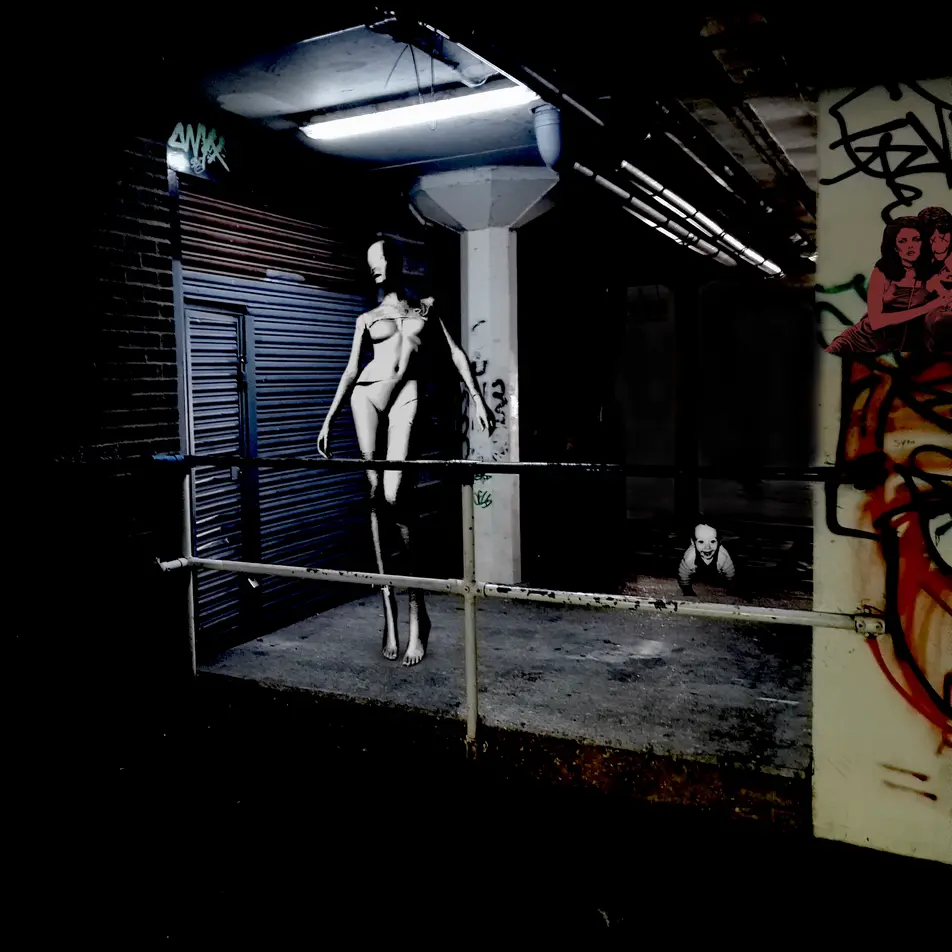
Butchered Blues approaches “Eudaimonia” through the early excitement of discovering philosophy, when the promise of knowledge can seem like a way to put life in order. Written in 2017 and completed years later, the song began with an infatuation and a rejection, then took a different direction as its author turned to philosophy. The Greek title points toward a search for a good life, though the song’s starting point was much more personal.
That change in direction matters. Late nights in the library began as a way to deal with disappointment, but the reading opened up a new interest that outlasted the original heartbreak. The songwriter describes the lyrics as an attempt to capture the naive confidence of someone encountering ideas about self-improvement and certainty without yet grasping their full complexity. There is affection in that recollection, but also an awareness of how much the early enthusiasm simplified what it was trying to understand.
“Eudaimonia” holds onto that first encounter with philosophy, before experience has had time to complicate it. The years between the original composition and the finished lyrics give the song its own history of change, from a young person’s disappointment to the beginning of a different way of thinking.
For those who might not know you yet, how would you introduce yourself?
Essentially, I am a 33-year-old estranged philosophy academic, failed political commentator, and failed HGV driver who was born and raised in the heart of ‘middle England’.
My life story, so far, is one of the forsaken millennial generation that was indoctrinated and ultimately put out to slaughter socially and economically by Tony Blair’s “education, education, education!” mantra. After being unable to secure a graduate position upon completing my Commercial Music BA in 2014 at what most recruiters regard as a very average university, I parted with my life’s savings two years later to pursue an academic career. Over the next nine years, I completed two Master’s degrees, one in music education and the other in philosophy, and a PhD thesis in philosophy on Hegel immediately after, only to find myself systematically exiled by the academic bureaucracy at the end of it. Suffering financially, I pivoted to HGV driving, proving myself practically inept at all aspects of the job, and an easy target for Health and Safety Officers on power trips, before realising that continuing was coming at too heavy a cost to my health and what little self-esteem I had beforehand.
After walking away from the haulage industry, I returned to the job market chronically overeducated, underexperienced, psychologically damaged, lonely, and subsequently broke. Now, I am struggling to resist the overpowering intuition that my whole life was designed to be a humiliation ritual from the very start.
As such, in desperate search for meaning, fulfilment, and a renewed sense of purpose, this year I resurrected my oldest pastime as a coping mechanism: writing music. That outlet naturally evolved into the Butchered Blues studio project.
I started recording music again for two reasons: first, out of a deep-seated psychological need to process my frustration and pain; and second, because I like to believe these songs—both lyrically and musically—offer something genuinely different in an increasingly banal playing field saturated by incessant shallowness.
If you had to bottle up your sound into just three words, which ones would you choose?
Heavy (thematically), cathartic, tornadic.
Which artists (not only music-related) or moments have left the biggest mark on your music?
Philosophy and modern struggle are the main sources of creative inspiration for the project. For the lyrics, I draw on the writings of various thinkers including, but not limited to, Hegel, Marx, Adorno, Marcuse and Mark Fisher, often referencing theological themes as well. My sonic palette is extremely broad, but Oasis, Radiohead, Pink Floyd, Queens of the Stone Age, Kasabian, The Doors, The Beatles, Arctic Monkeys, Black Sabbath, Massive Attack, Burial and ambient music are among the most essential ingredients for the sound itself.
When you hit play on your songs, what kind of feeling takes over?
That depends almost entirely on the song you select. But despite the vast differences, spiritual homelessness is a common theme across all of them. This involves the listener being severed from a familiar place, taken somewhere by something that comes out of nowhere, and thrown by that thing into somewhere different entirely. The possibility of return exists, but only to tease them with the illusion that what’s lost was theirs in the first place. The tragedy climaxes at the realisation that ‘home’ itself was merely a historical event constructing something else all along, and sweeping everyone and everything along with it. That nauseous feeling of endless transience, and being constantly remoulded as if in a liquid state, is the alienating sensation I’m trying to communicate.
If you could team up with anyone in the world, no limits, who would be that dream collaborator?
Josh Homme, preferably at Rancho de la Luna.
What are you working on now, and what are your plans for the future? Anything exciting you can tell us about?
I’m working towards a twelve-track album, which I’m aiming to release in Spring or Summer next year. This EP, “When We’re Turned into Stone”, contains six of them. As soon as the mastering is done, I’ll set myself to the task of putting an actual band together to play live.
Can you walk us through the story or emotion behind “Eudaimonia”? About the video, can you tell us about the storytelling and the visual approach to it.
The song was written in the summer of 2017, when I was living in student halls accommodation in Clerkenwell, London, while undertaking my Music Education MA at UCL. Originally, it was about a developing infatuation I had with a girl from the Mediterranean, hence the Greek title. However, I didn’t complete the lyrics until this year, which are mainly inspired by the newly acquired love of philosophy I acquired in the aftermath of the inevitable rejection. This pivot to philosophy and spending late nights/early mornings in the library may have started as a coping mechanism, but it changed my life forever. Eudaimonia intends to capture the naive sensation of indulging in the possibilities of knowledge, self-certainty and self-improvement while engaging with the concepts at the shallow end.
There isn’t a video for Eudaimonia (yet). But if/when there is, you’ll know what inspired it!