Inspired by Dasha Plesen
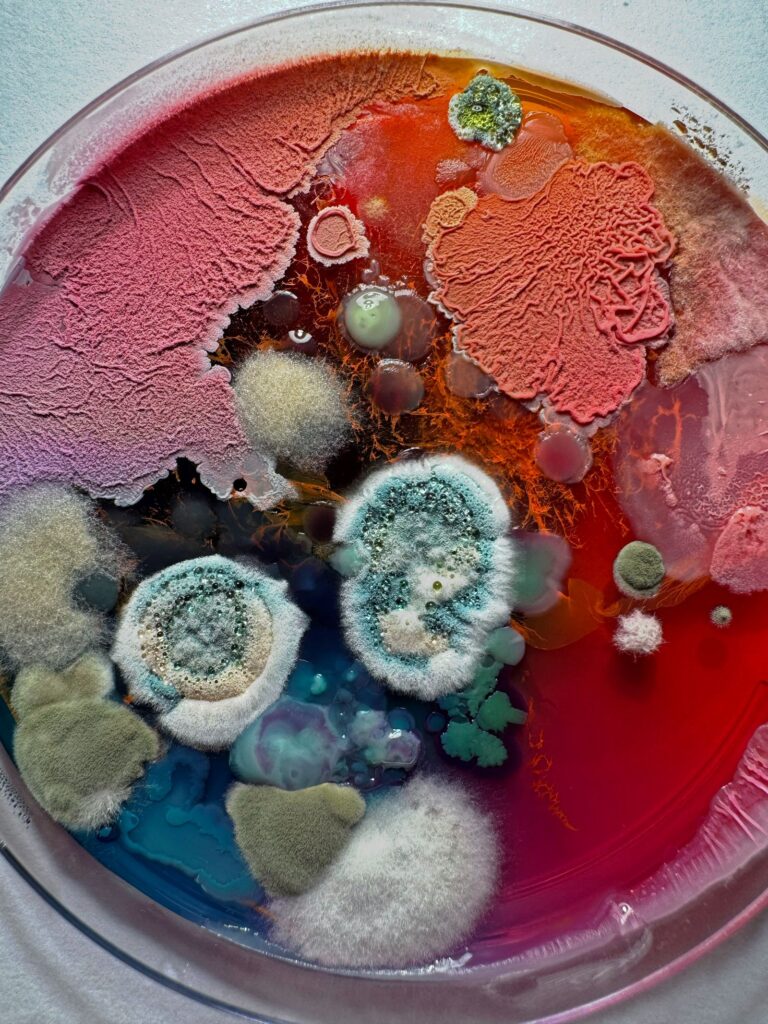
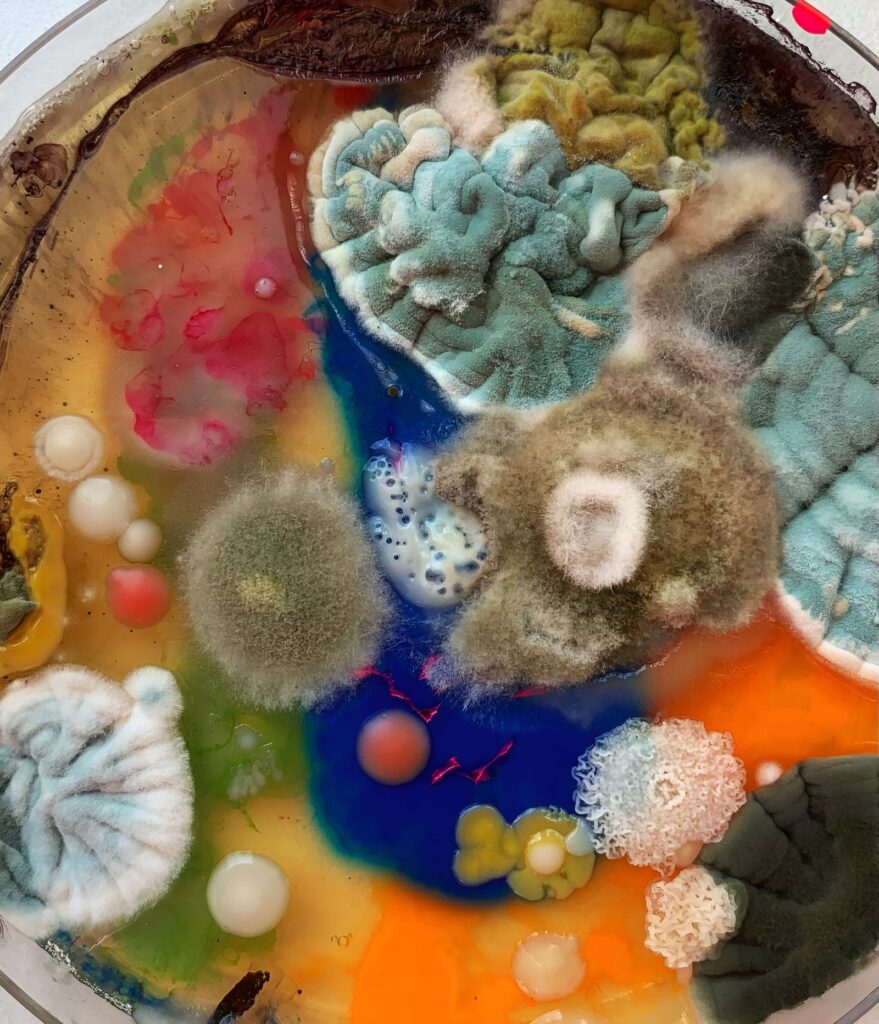
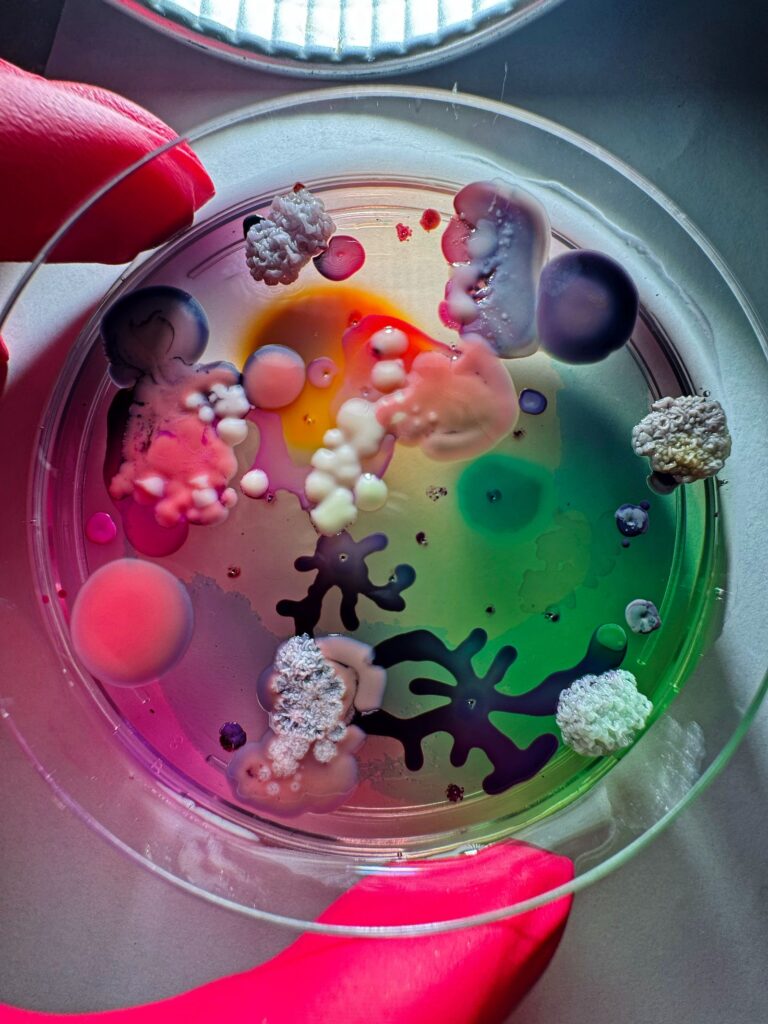
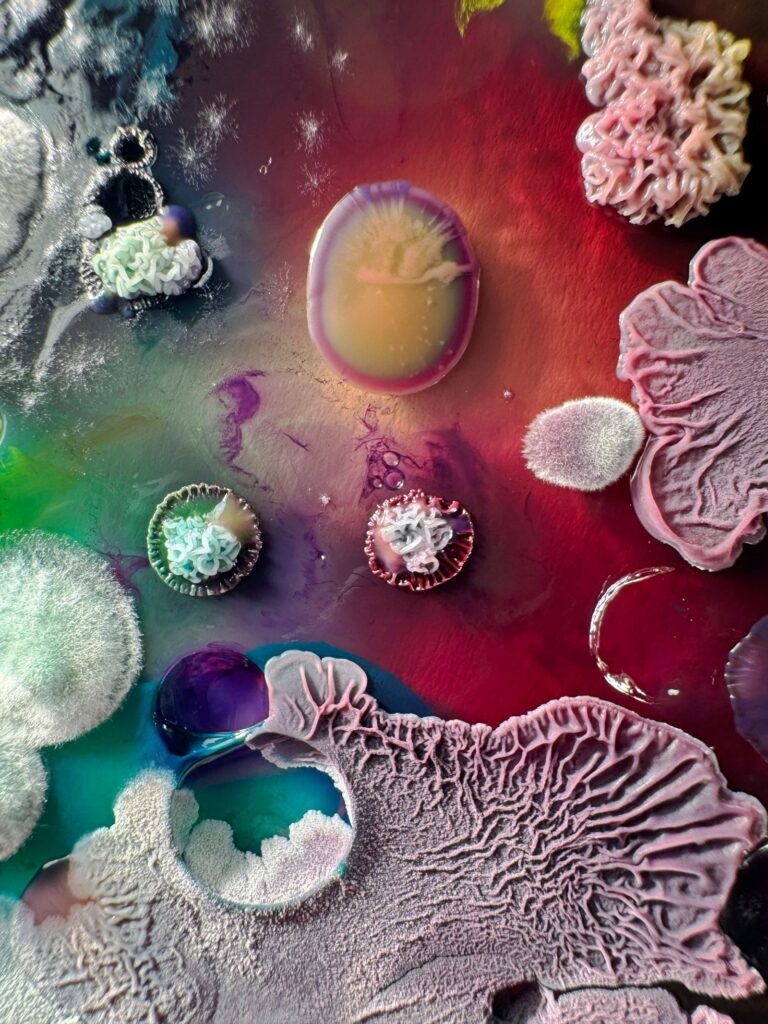
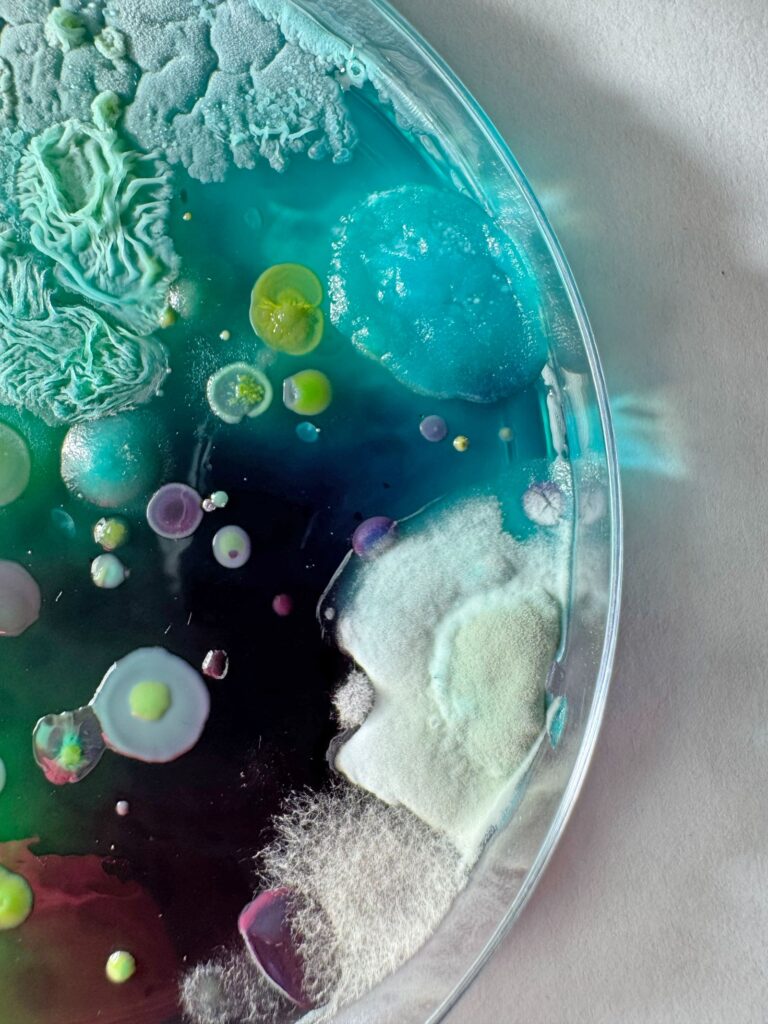
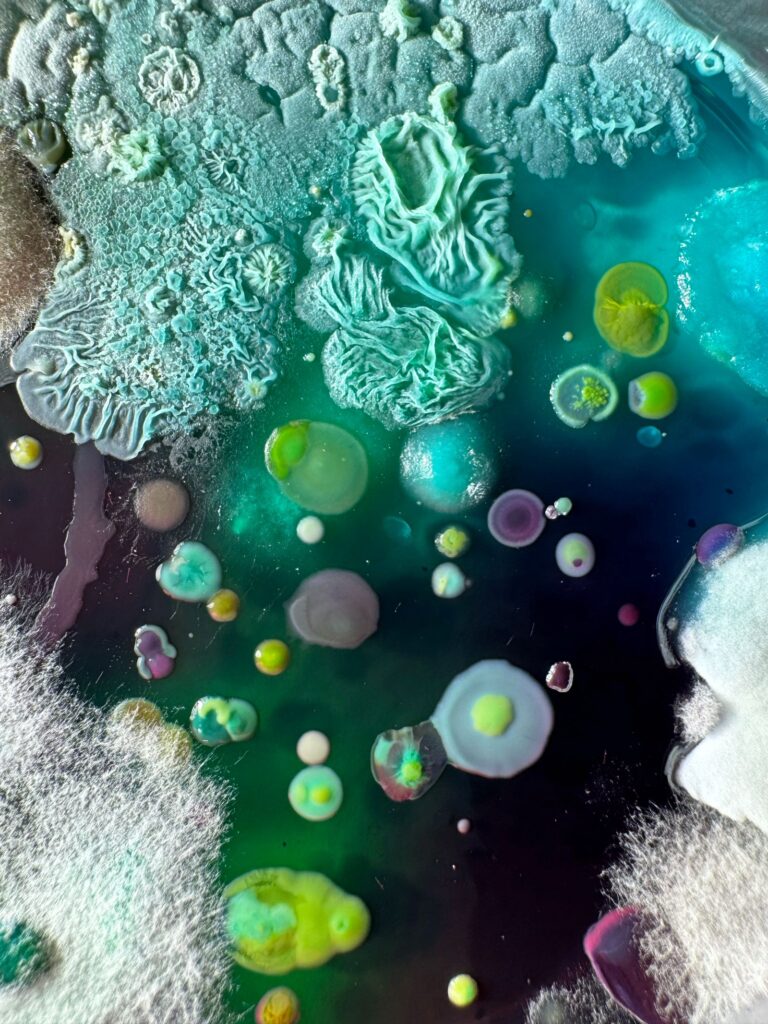
For more than a decade, bioartist Dasha Plesen has worked with mould, microorganisms and biological samples to create images that exist between art, science and living matter. Developed through experimentation in Petri dishes, her works are never fully predictable. They grow, transform and respond to environmental conditions, leaving the artist to decide when a piece should be preserved and when it should be allowed to continue evolving.
Dasha Plesen’s practice examines beauty, decay, identity and control through materials that are usually associated with contamination or decomposition. By presenting microbial growth as colour, texture and composition, she asks viewers to reconsider the cultural boundaries that define what is beautiful, harmful or acceptable. Her works also incorporate personal biological material, turning the body into both medium and subject.
In this interview with Visual Atelier 8, during OFFF Barcelona, Dasha Plesen discusses the origins of her practice, the role of chance in working with living organisms, the tension between control and collaboration, and the importance of preserving mystery in her work. She also reflects on criticism, gender, artificial intelligence, spirituality and the freedom required to build an unconventional artistic career.
You have been working as a bioartist for more than a decade. How did you first begin experimenting with microorganisms and unconventional materials?
The idea emerged during my first year at university, while I was meditating. I suddenly imagined collecting samples from my daily life, from early morning until night, and placing them in Petri dishes. I was interested in discovering alternative ways of seeing reality. We can observe the world with our eyes, photograph it or scan it, but I wondered whether there could be another kind of lens, one that would allow us to look behind the visible surface, almost behind the scenes of the creator.
My first experiments were unsuccessful. Nothing grew, and I was extremely disappointed. I began researching microbiological techniques and discovered that I could start with an existing recipe and gradually adapt it to my artistic needs. I have continued refining that method ever since. The foundation is microbiological, but the way I use it has developed through years of experimentation.
Were those first experiments carried out at home? How did you respond when nothing happened?
Yes, and at first nothing grew. I was frustrated, but I decided that I would do whatever was necessary to see a result. I repeated the experiments dozens of times, and that is still how I work today. I begin again from the start until I am satisfied with the process, the final result and the work as a whole. Repetition and failure have become essential parts of my practice.
Your artworks continue to change as the organisms grow. How do you decide when a work has reached its final state?
This is one of the most difficult decisions in my practice. If I stop the growth at a particular moment, I lose the possibility of seeing how the organisms might continue to evolve over the following days. At the same time, if I wait too long, unwanted contamination may appear, and that can determine the final stage of the work. There is always an element of risk. The decision is based partly on experience, but also on chance and intuition. It can be an adrenaline-filled process because I know that every choice closes off another possible future for the artwork.
How much of the final result can you plan when you begin a new piece?
Around 20 per cent. The rest develops through the behaviour of the material, the environment and the process itself.
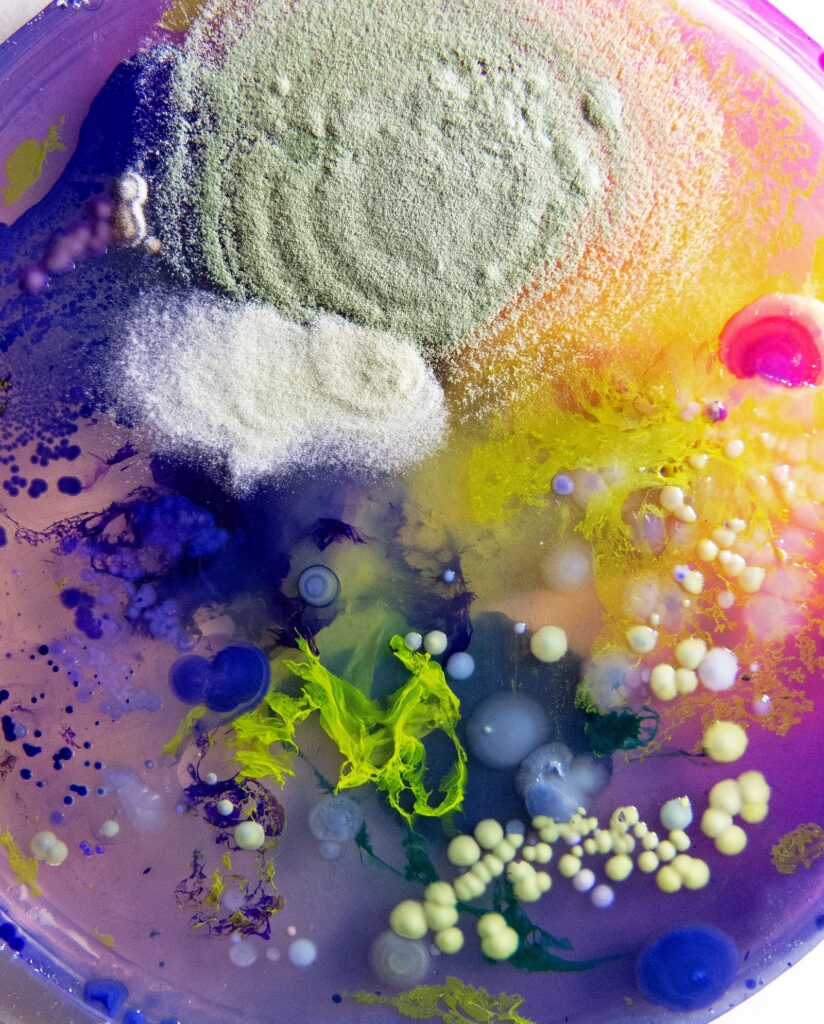
Are you usually satisfied with the outcome, or do the works continue to challenge your own sense of beauty?
The work constantly activates my inner critic. I have produced an enormous number of Petri dishes, so naturally I compare them. I may decide that one is beautiful and another is not, but two days later my opinion can completely change. In reality, they are all expressions of the same universal matter. The judgement comes from my own perception, experience and psychological state. A work can appear beautiful to me one day and unattractive the next, before becoming beautiful again later. It creates an infinite dialogue between the work, my inner author and my changing emotional state. In that sense, looking at and evaluating the artworks can also become a therapeutic process.
You have spoken about communicating with microorganisms in different emotional states, sometimes with tenderness and sometimes more aggressively. Since the works contain both biological and emotional traces of you, how comfortable are you with sharing something so personal with an audience?
I always preserve a small percentage of privacy. Opening myself to the audience has been a gradual process. At the beginning of my practice, I felt like a dry spore at the earliest stage of cultivation. Over the years, I added water, changed the light and moved through different incubators. Slowly, I witnessed my own growth and expansion as though I were a spore developing inside the planet. However, there are still areas that remain completely private. Nobody has access to that space. The work can reveal many things about me, but it does not reveal everything.
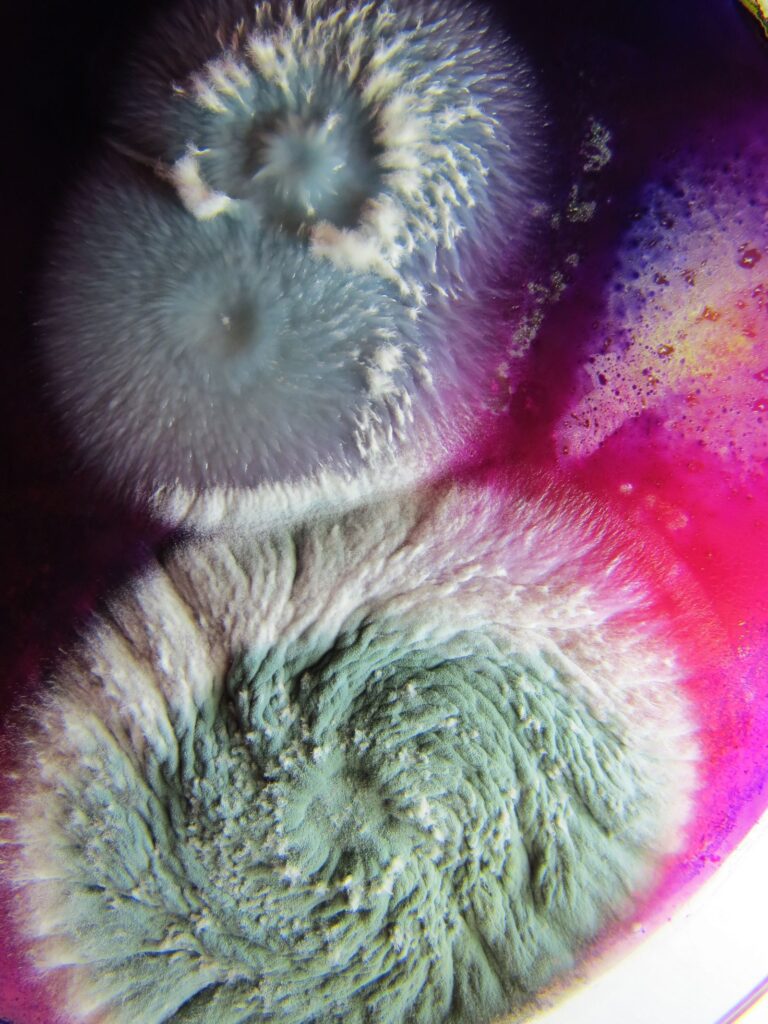
You also choose not to disclose every ingredient or technical detail behind an artwork. Why is it important to preserve that mystery?
I want the process to retain the quality of a myth or a legend. When every detail is explained, some of the interest and magic can disappear. It is similar to reading a book. If the entire story were written on the cover, you might no longer feel curious enough to open it. Curiosity is one of the forces that drives creativity and inspiration. I want viewers to ask how the work was made, what it smells like, why I created it and what its purpose might be. These questions can initiate an inner dialogue. Some of my works are direct, and in those cases I want to communicate a clear statement or context. Others are deliberately free from explanation. With those pieces, I am interested in how viewers absorb and interpret what they encounter. The act of finding an explanation within themselves becomes part of their journey through the work.
Your works can appear beautiful while also provoking discomfort, particularly because mould is often associated with decay, contamination or disgust. How do you want people to respond to this tension?
My main intention is to encourage people to free themselves from conformist and traditional frameworks of understanding. I want them to respond sincerely, through their own hearts, minds and experiences. Society often tells us that mould is harmful, ugly or disgusting. A person might look at one of my works and genuinely perceive something beautiful, yet still say that it is horrible because they have been taught that this material must be rejected. The work becomes a form of training in intellectual and emotional freedom. It asks whether you are brave enough to move beyond the boundaries created by society, your family or your education, and whether you can trust what you truly perceive.
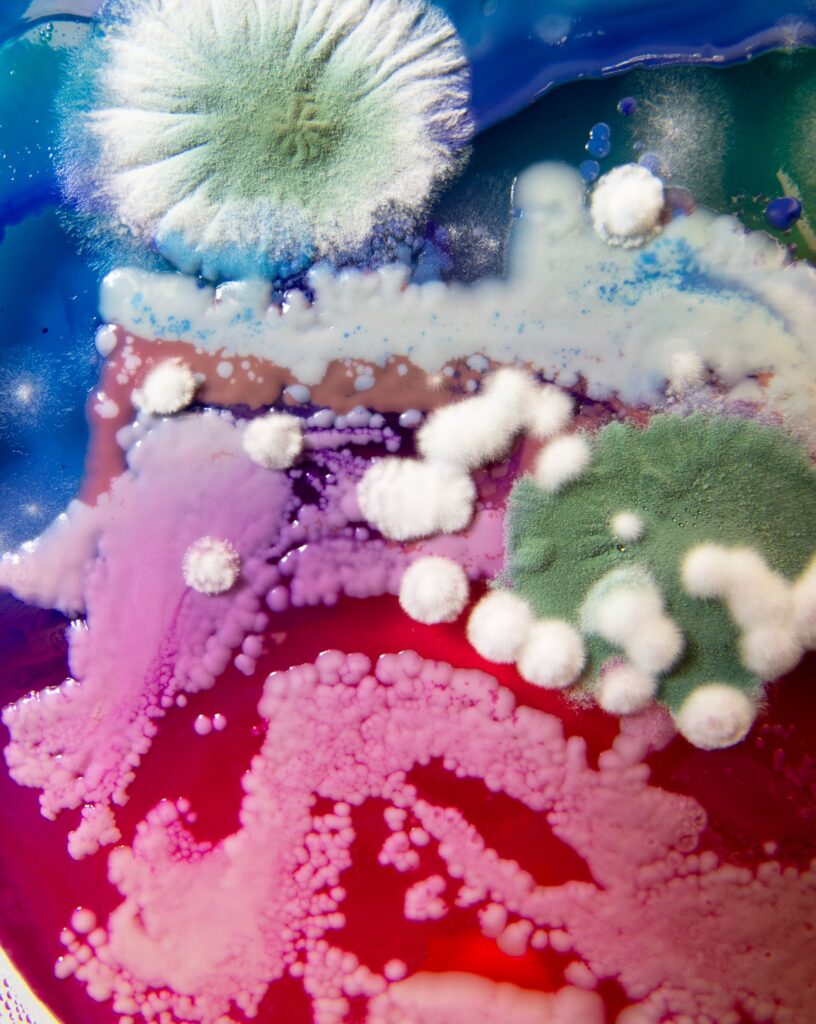
How has your relationship with negative criticism changed over the years?
Negative comments affected me at the beginning, particularly when I started sharing the work on social media. People would write that it was disgusting, horrible or something that should be thrown away. At first, I wondered why they reacted so aggressively. Later, I understood that these responses could become an instrument for analysing society. They reveal how different social groups think, how they live and what exists inside their minds. Through the language people use to describe my work, I can temporarily enter their experience and attempt to see through their eyes. Criticism therefore became another source of information. It allows me to examine the viewer as much as the viewer examines the artwork.
Because you work with living organisms, you have a certain ability to guide or interrupt their development. Does that sense of control ever make you feel powerful?
It is important to maintain a balance between believing that you are greater than nature and believing that you are nothing. If I think of myself as nothing more than a piece of meat, that is not healthy. But believing that I am the best and most important piece of meat in the world is equally unbalanced. Both positions create a disruption. Of course, when I successfully guide the organisms, one part of me feels excited and thinks, “I did it.” But this is more about improving my techniques and developing my skills with the material. It is not about considering myself greater than nature or the universe. The process continually trains my ego. It teaches me how to exist as an artist, entrepreneur, blogger and public figure. The material helps me understand how I want to live, what I want and how I want to expand into different fields. For me, it feels like a gift from above.
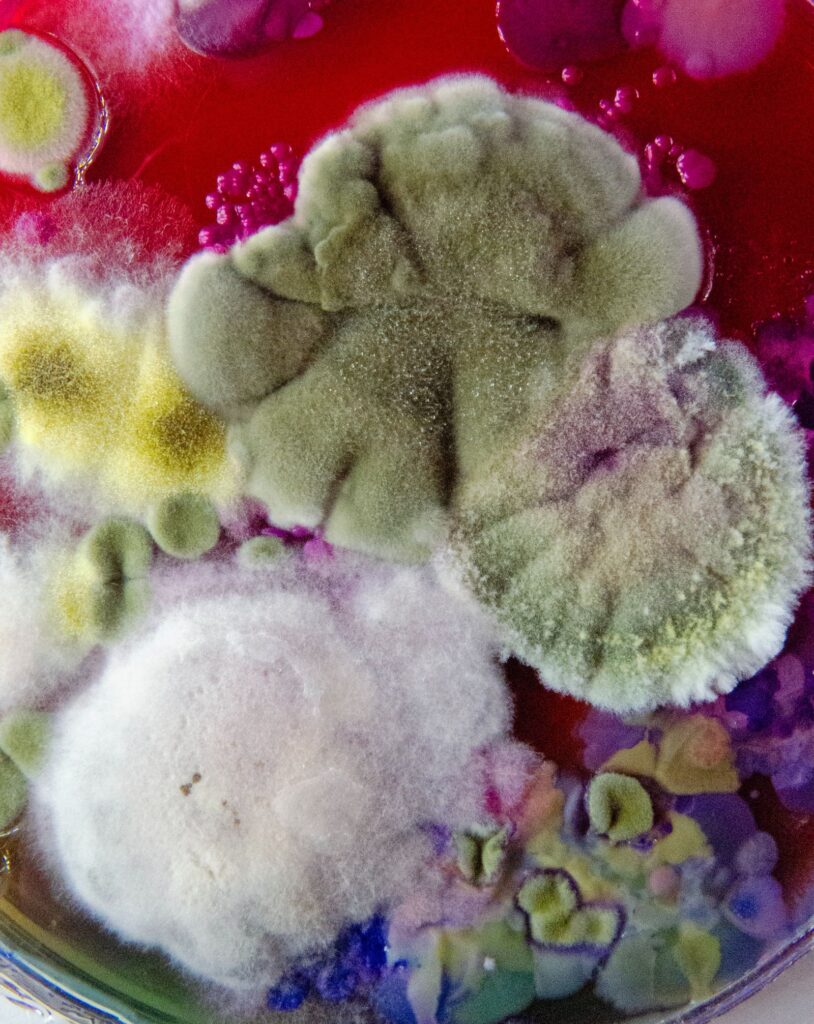
Some of your works incorporate biological material collected from your own body. Has this changed the way you understand your body or personal identity?
Working with microorganisms and my body gives me a sense of a genderless structure. During the moment of interaction, I can feel like a spirit or soul without the categories of woman or man. At the same time, presenting my body as part of the project is connected to my identity as a female artist. I cannot hide that, and I do not want to. I want to empower it, and at times I also use it to provoke the audience. But beneath those identities, the process allows me to experience something more universal. I believe the soul and spirit have no gender. The work gives me access to a state in which those social and physical categories temporarily disappear.
How can people collect your work, and how do your commissioned bioportraits operate?
I create commissioned bioportraits for individuals, couples, families and groups. They can be made for weddings, birthdays or other personal occasions. The final commission can include an original biological work preserved in resin, a microscope image set and a high-resolution scan of the Petri dish. The client can then use the digital file to produce a large-scale image locally on glass, acrylic, textile or another surface. This allows someone to display a magnified biological portrait in their home and explain that it represents them in macro form, developed through a collaboration with the artist. People can also collect prints and sculptures, and I work on commissions for brands and private clients. The form of the final piece depends on the person, context and initial idea.
Your collaboration with Uncommon Creative Studio for the Culture campaign led some people to assume that the imagery had been generated with artificial intelligence. How did you react to that response?
I loved the campaign and the public reaction. Some people believed the visuals were digitally generated, but everything was organic. The material was living, evolving, producing smells and continuously changing. I found the misunderstanding interesting because it showed how difficult it has become for people to distinguish between a living image and an artificially generated one.
You have spoken publicly about your family initially struggling to understand your decision to become an artist. What helped you continue, and what advice would you give to younger artists facing similar pressure?
We enter this world alone, and we will eventually leave it alone. You are the person who must live your own life. Your hours and days are limited, so it makes no sense to abandon your desires simply because a relative tells you that you cannot follow them. When people stop being afraid of old traditions and conformist expectations, they can begin to experience greater freedom. Before committing to art, I worked in many different roles. Then one day, I decided to pursue this work. I had no guarantee and no special support. I had only my desire. Now I am here, giving this interview after completing another project. It proves that creating your own path is possible.
Bioart is still a relatively specialised field. Were there particular artists who helped you understand that this type of practice was possible?
When I began researching science art and bioart at university, I discovered the work of Joe Davis and Eduardo Kac. They were the first artists who truly shocked and inspired me. Discovering that bioart and science art already existed gave me a framework for understanding the direction I was beginning to follow.
Do you see yourself primarily as an artist or as a scientist?
I like maintaining a balance, but I always introduce myself first as an artist. Sometimes I say that, in my free time, I conduct secret scientific research. My research is free from formal protocols and conventional rules. I work in ways that would not be possible inside a traditional laboratory. The way I communicate with microorganisms, for example, would probably make many scientists think that I had completely lost my mind. That freedom is important to me. Scientific knowledge supports the practice, but I do not want scientific conventions to determine the limits of the artwork.
After more than a decade of working with microorganisms, what kind of environment do you now use to produce your work?
I have a private space dedicated to working with organisms. Journalists and cameras are not allowed inside because the space has its own microbiome, and the presence of other people could alter it. I also believe in energy and in the way a person’s emotional state can affect growth. When I create a bioportrait, it is important for me to establish a connection with the person before beginning. We create an emotional bond from the earliest stage. My works are deeply connected to psychological states, relationships and the vibrations between people. For projects that require strict sterility or a specific type of colony, I work with a colleague in a medical institution. The working environment therefore changes according to the needs of the original idea.
Mould often grows through processes of decomposition, transforming material that is no longer living. Has working with it shaped your wider understanding of life and death?
I believe that spirits travel through the planet, moving between bodies as though those bodies were avatars. In this life, I am a woman and an artist. In another, perhaps I will be a piece of mould growing inside someone’s refrigerator. After that, I might be a dog, a cat or something completely different. For me, the spirit and soul are fundamental, while the physical body is a temporary covering. Mould and microorganisms operate as connectors between this world and another one, between physical and non-physical matter. Through microorganisms, our bodies dissolve and transform. They consume physical matter and return it to time and to the universe. Eventually, that matter enters another cycle and becomes something else. Life is therefore not an isolated event but a continuous process of transformation and return.
Artificial intelligence appears far removed from the physical and biological nature of your practice, yet you occasionally use and discuss it. How do you see its role in art and creative work?
Whenever I post something involving AI on Instagram, hundreds of people immediately criticise me. They say they trusted me as an artist and cannot understand how I could use it. Many claim that AI is stealing artists’ jobs. I find that argument curious. If a person is talented, hardworking and understands what they are doing, I do not believe a tool can simply take their career away. Artists must also take responsibility for developing their own skills and direction. AI can be useful for analysing large quantities of scientific information, supporting medical work or managing complex technological and mechanical systems. Personally, I use it as an assistant. It can help me organise long texts, prepare summaries or deal with repetitive tasks. That does not erase me. It gives me more time and freedom. I still review everything, rewrite it and add my own voice. For me, AI can handle part of the less creative labour, while the final judgement and authorship remain human.
What did it mean for you to speak at OFFF Barcelona, and what did you hope the audience would take away from your presentation?
I was extremely nervous. Recording a video and posting it online feels very different from standing in front of a large audience that is physically present and watching you in real time. I think anxiety is a normal human response in that situation. I decided to see it as another experience and as part of an ongoing process of learning how to communicate with people, translate my artistic statements and speak about the work more clearly. My main intention was to show that it is possible to continue developing a medium even when other people describe it as limited or restrictive. More broadly, I wanted to communicate the importance of living freely and creatively, without allowing boundaries and established frameworks to determine everything. The central message was to find happiness in being alive and in spending our limited time on this planet in a way that feels authentic.
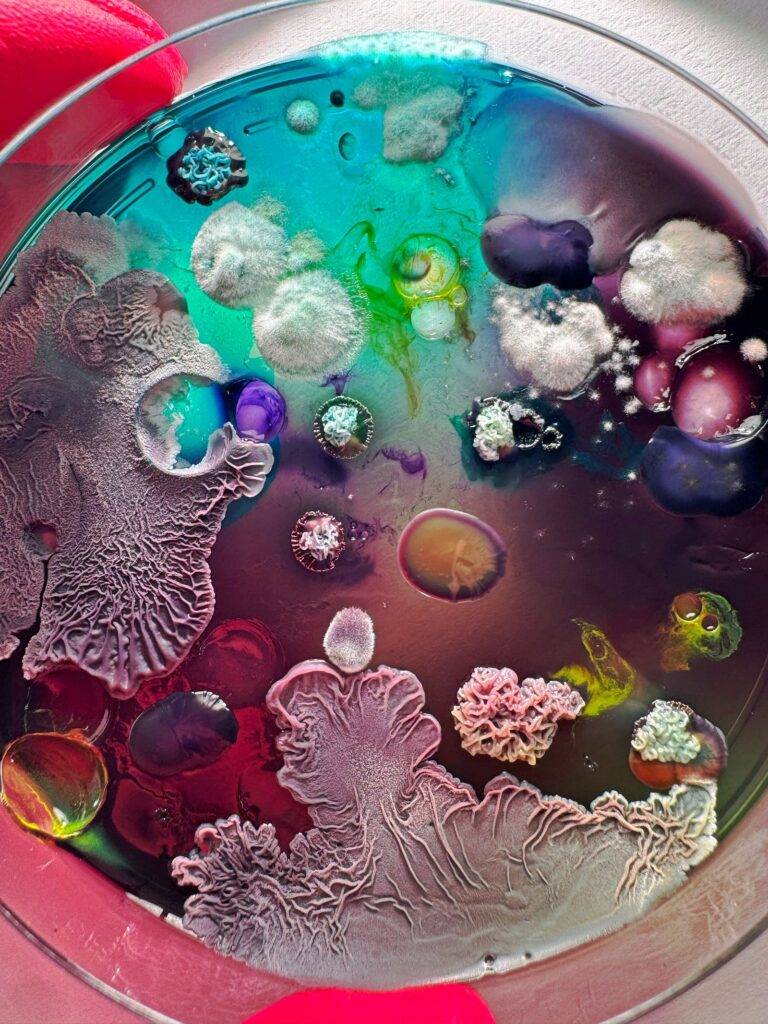
Photo credit: Dasha Plesen