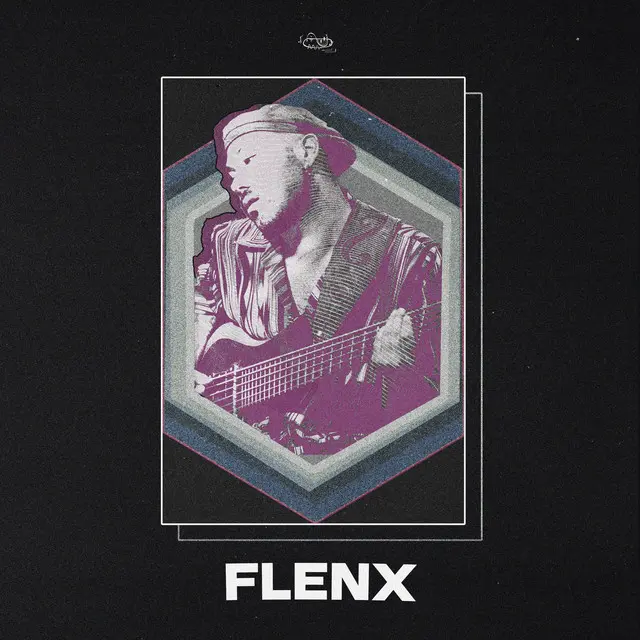
Diego Alejandro’s “Flenx” brings South American folk rhythms into an aggressive jazz fusion piece driven by a 6/8 pulse. Cueca, zamacueca, and chacarera provide the rhythmic foundation, while brass, Hammond organ, and collective improvisation give the composition a denser, more unpredictable character. The groove has the feel of a ritual dance, with the ensemble pushing forward as a single force.
Written during a period in Flensburg, the piece began with guitar patterns and experiments with South American rhythmic cycles. That circular movement remains central to “Flenx,” even as the arrangement moves into more complex rhythmic groupings in the B section. The music keeps building and releasing before returning to its main pulse. There is a sense of order in the repetition, but the brass and improvisation give the ensemble room to move toward something more volatile.
The connection to Chilean fusion traditions such as Los Jaivas and Congreso places the composition within a musical lineage, while its heavier approach gives those rhythms a different setting. The energy is celebratory, but never entirely settled. “Flenx” keeps the ritual moving, somewhere between a collective march and a dance that could break loose at any moment.