Inspired by William Guillon
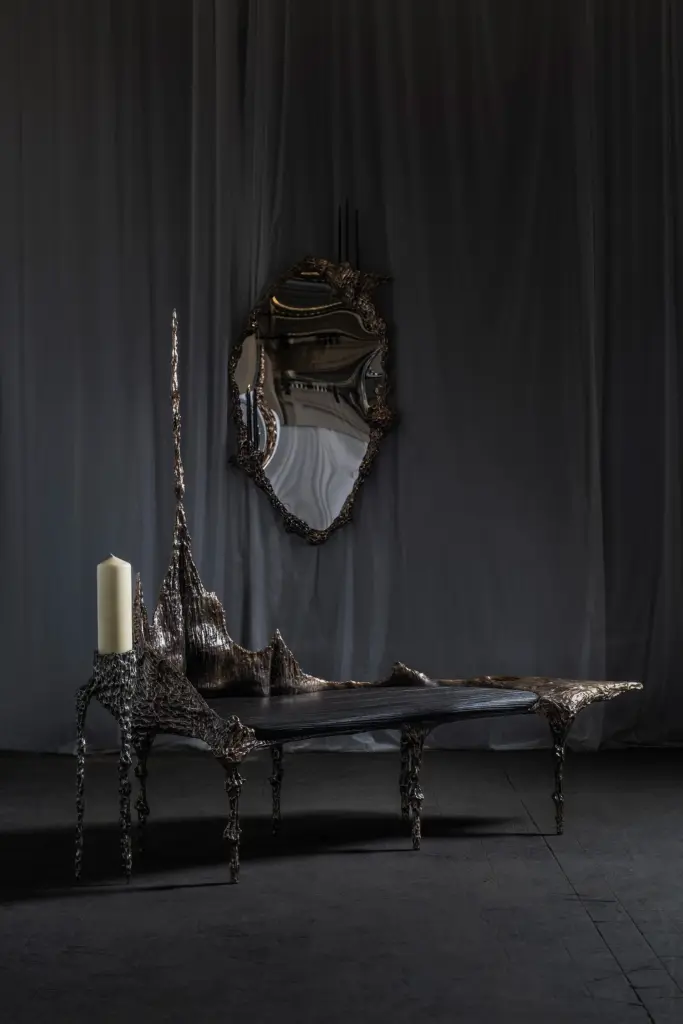
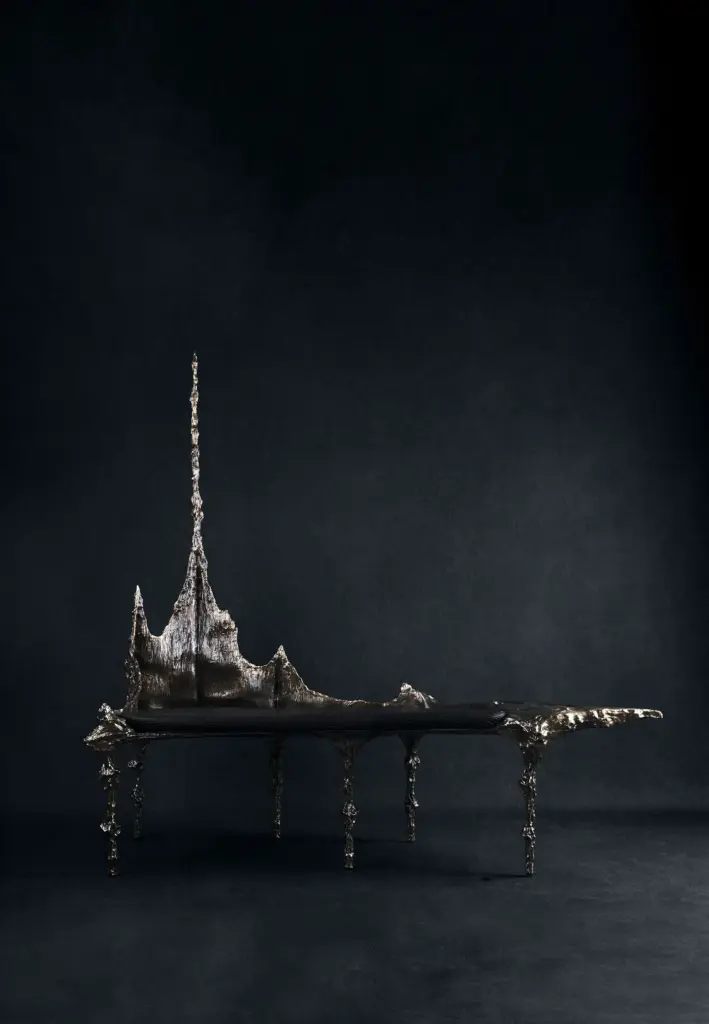
William Guillon has built a distinctive design practice around cast bronze, transforming the material into sculptural lighting and functional objects marked by tension, imperfection and time. Based in Bordeaux, the French designer approaches beauty through contradiction, creating pieces that appear at once fragile and resilient, refined and raw. His work draws on mortality, transformation and the emotional weight of materials, while the Gothic architecture of Bordeaux and his early experiences in metal workshops continue to inform its dark, neo-romantic language.
Each piece is sculpted individually in wax and cast through the lost-wax process, without using molds or repeating a fixed form. This demanding method makes every object unique and turns its production into an ongoing creative performance. In this interview with Visual Atelier 8, William Guillon discusses bronze, craftsmanship, function and the influences that shaped his practice.
We are pleased to welcome William Guillon in this exclusive interview. We will be dissecting and discussing what makes this body of work truly exceptional. Your work is deeply rooted in an exploration of what might be termed an ‘unorthodox aesthetic.’ Could you elaborate on your philosophical approach to beauty and how it manifests in your creations?
Thank you, it’s a pleasure to be part of this conversation. I’ve always been drawn to the idea that beauty can exist in contradiction, in tension, and sometimes in what might appear disturbing or imperfect at first sight. For me, beauty isn’t about harmony or perfection, it’s about truth, emotion, and the traces left by time or experience.
My work is rooted in the idea that something can be both fragile and powerful, elegant and brutal, refined and raw. I like when an object carries that ambiguity, when it feels alive, charged with presence and meaning. The materials I use, especially bronze, naturally embody this duality. It’s a noble and eternal material, but it also speaks of weight, decay, and transformation.
So my philosophical approach to beauty is not about chasing ideals, but about revealing a form of poetry within imperfection. It’s about embracing darkness as much as light, and allowing the emotional and existential dimensions of a piece to take precedence over the purely decorative.
Your journey from Toulouse to Bordeaux, where you studied graphic design, suggests a narrative shaped by place and education. In what ways have these environments informed the evolution of your creative lexicon?
As in many creative and entrepreneurial journeys, the people you meet and the places you inhabit play a huge role in shaping your path. I’ve been lucky to be surrounded and supported by incredible people from the very beginning. It all started with my grandfather, who was the first to introduce me to the world of creation. He wasn’t an artist or a craftsman himself, but he was very resourceful and loved working with his hands. When I was sixteen, I used to spend hours in his garage, asking him for advice on the pieces I wanted to make. He taught me how to think through a project, how to use my hands, and how to look at the creative process.
Then there was my uncle, a metalworker, who also played a big part. I used to spend my free time in his workshop in Toulouse, using leftover scraps of metal to create my first design pieces. Later, when I moved to Bordeaux at eighteen, I met other people who helped me along the way, including a friend who worked with metal and supported me technically on many projects. Being self-taught, that kind of help was essential to build confidence and move forward.
If I had to name one person who truly changed my trajectory, it would be Agnès from the Yndo Hotel. She was like a guardian angel and commissioned my first bronze pieces for her hotel. That moment gave me both visibility and validation. And maybe it’s not a coincidence that for the past fifteen years, I’ve walked almost every day past the Gothic cathedral of Saint-André in the center of Bordeaux. Its architecture, its verticality, its darkness and light, all of that has definitely left a mark on my aesthetic universe.
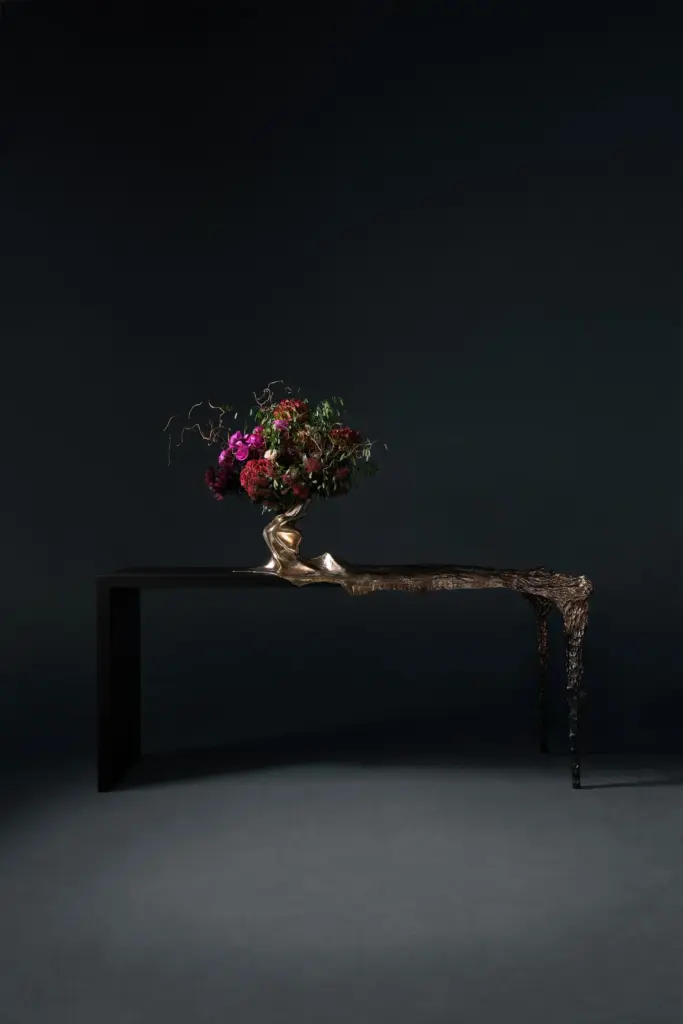
Themes of mortality, temporality, and existential inquiry are recurrent motifs in your work. How do these philosophical underpinnings translate into the material and sculptural language of your practice?
Those themes are at the core of everything I create. I’ve always been fascinated by the fragility of existence and the passage of time, by the way beauty can emerge from what is fading or imperfect. My work often begins with that awareness, the feeling that every material carries its own memory, its own mortality.
Bronze, for example, is both eternal and perishable. It can last for centuries, but its surface changes, oxidizes, transforms. I like that tension, that dialogue between permanence and decay. When I sculpt in wax, I know the form will disappear, that it will be consumed in the process of casting. There’s something profoundly moving about creating through destruction, about losing the original to make space for the final piece.
My pieces often exist in a state of tension, caught between strength and vulnerability. They might look scarred, fragmented or barely standing, yet they still hold a sense of power, as if they were warriors who have survived time and remain standing. That balance between resilience and fragility is something I constantly seek, both in form and in meaning.
So these philosophical ideas naturally shape the way I work. Each object becomes a meditation on time, transformation, and the beauty hidden in impermanence. It’s not about death itself, but about the fragile, luminous moment that exists right before it.
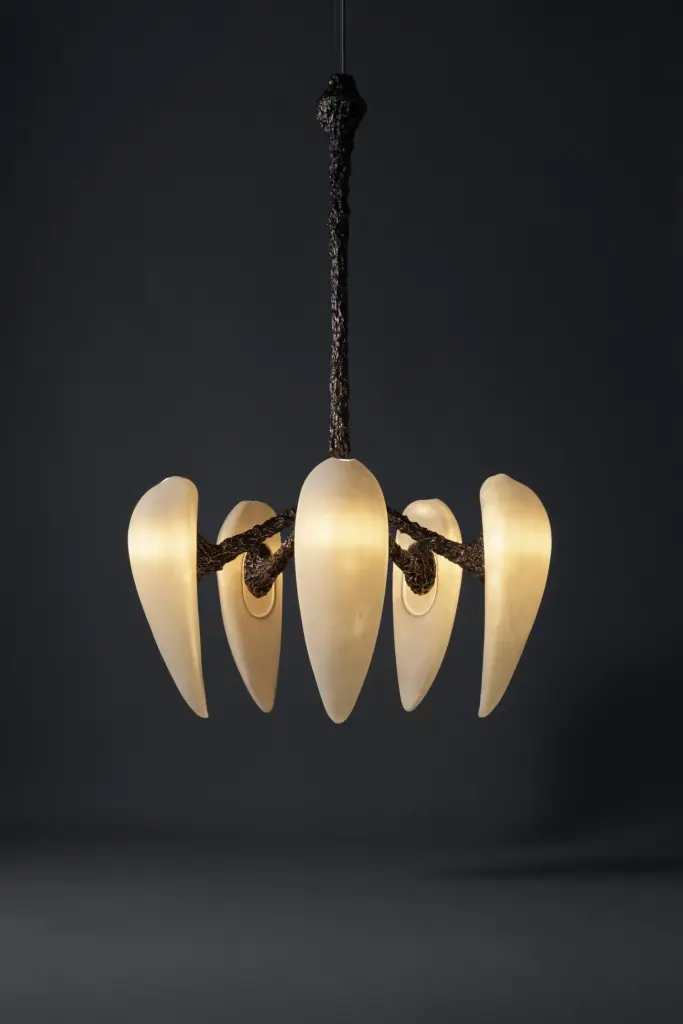
Much of your work is produced in limited editions or as singular, unique objects. What is the significance of exclusivity in your practice, and how does it shape the relationship between your work and its collectors?
To be honest, this is one of the most important aspects of my work, and something I like to insist on because I feel people often don’t fully grasp what a truly one-of-a-kind piece means, or what it involves on our side. We don’t use any molds in our process. Every piece is hand-sculpted in wax by me from scratch for each order, whether it’s a commission piece or part of the catalog. That means there is no time saved, no repetition, no automation, every time we have to recreate the magic from the beginning.
From a business perspective, it doesn’t make much sense, but for me it’s a kind of performance. The meaning lies not only in the final object, but also in the act of creating it. I often compare it to what a chef does in his kitchen. Every night, he cooks the same dish, but each time it’s a new creation, never frozen, never mechanical. It evolves with time, with the people, with the moment. That’s exactly what happens in the studio.
This process is also a commitment I make to my collectors. I dedicate time to every single piece, ensuring that each order receives the same care and attention as the first one. There are no shortcuts, no delegation of intention, only passion, patience, and consistency. I believe this is what makes each object special, it carries a part of that living process within it.
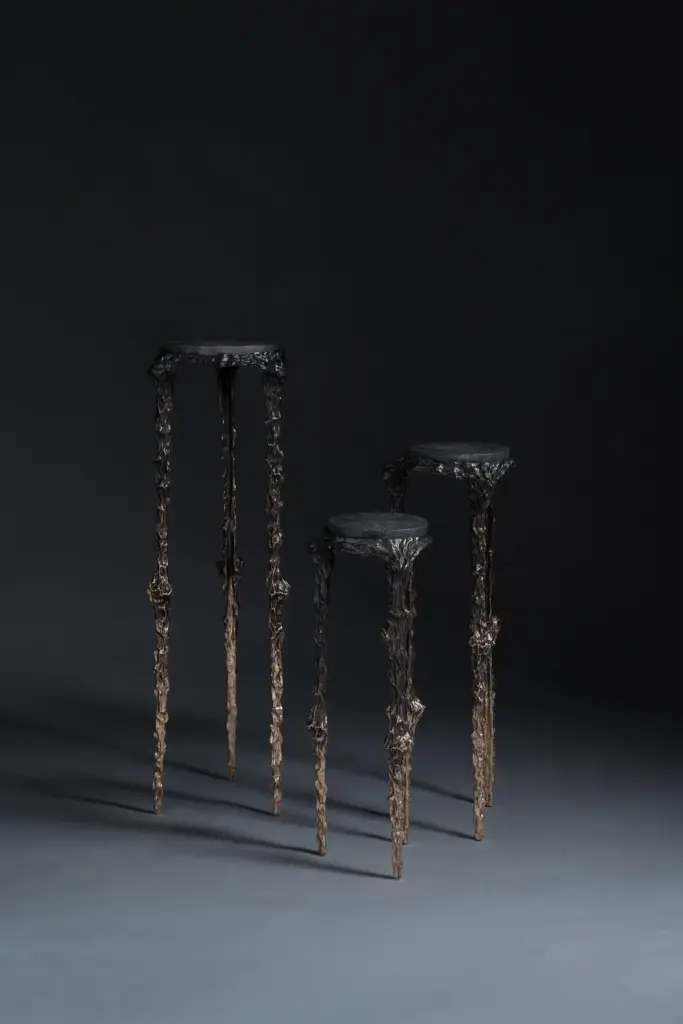
What is your personal mindset when it comes to the idea of bringing functionality to art?
For me, bringing functionality to art is not about compromising its poetic or emotional nature, it is about extending its meaning. Function gives purpose, but it does not take away the mystery. I like when an object is both a sculpture and something that can be lived with, touched, used.
When I create, I think of function as a way to connect the viewer with the work on a daily basis. It becomes part of someone’s life, not just something to look at from a distance. In that sense, function becomes a form of dialogue between art and life.
I see it as an equilibrium between the spiritual and the utilitarian, between contemplation and action. My goal is to create pieces that hold presence, that feel powerful and emotional, even when they serve a practical role.
You often work with materials like cast bronze and rare alloys. What draws you to these materials, and how do they influence your pieces?
The way and the moment bronze entered my life were quite unexpected. In the early years of my project, I had to work various jobs to support myself and invest in my practice. None of them were related to art, but each one taught me something essential. One of my last jobs was selling skincare for a British company. My manager, who knew I was already creating functional art, kept telling me about a foundry nearby that I should visit because she thought I might like it.
After months of hesitation, I finally went. The owner showed me the entire process of bronze casting, handed me a small piece of wax, and simply said, “Now you can try.” That moment changed everything. Bronze became a revelation for me. All the shapes and visions I had imagined suddenly felt possible.
Bronze grounds my work in history and gives it a kind of tragic soul that no other material could bring. It carries both weight and nobility, decay and eternity. Even though my universe is often inspired by underground and alternative worlds, bronze gives it legitimacy, depth, and a certain sense of beauty.
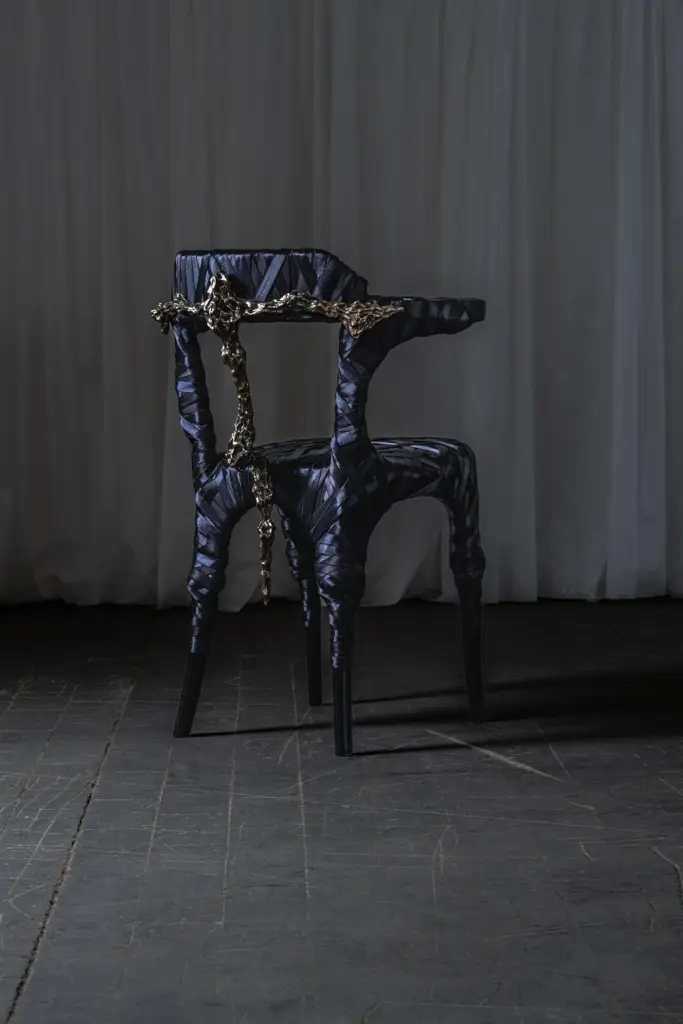
How do you balance traditional craftsmanship with contemporary innovation in your work?
For me, tradition and innovation are not opposites, they are parts of the same movement. I have a deep respect for traditional craftsmanship and the people who have kept these techniques alive through centuries. The lost-wax process I use is one of the oldest sculptural methods in human history, and working with it feels like being part of a long line of makers who transmitted their knowledge through gesture and time.
At the same time, I want to keep this heritage alive by giving it new possibilities. I use 3D printing in my process, not to replace the handmade, but to expand it. It allows me to explore new forms, new proportions, new balances that would be almost impossible to achieve by hand alone. The fusion of these two worlds, the ancestral and the digital, keeps my work rooted in history while projecting it into the present.
What matters to me is to preserve the soul of the technique. The wax is still sculpted by hand, the bronze still carries the marks of fire and transformation, but technology becomes a new tool in the dialogue. It is a way to honor the past while embracing the future, and to channel a kind of primitive energy through contemporary forms.
As you continue to push the boundaries of material, form, and meaning, what emerging ideas or collaborations excite you most for the future of your work?
My sketchbooks are always full, and I’m incredibly excited about the new collections to come, which we call Mythologies. We’re starting to work with new materials such as blown glass, cast glass, and different forms of paper. What’s funny is that many of these pieces were actually drawn four or five years ago, and now they’re finally coming to life.
I’m not someone who’s naturally very confident, but one thing I’m sure of is that I have ideas. I can’t help it — creating is the way I breathe, the way I understand the world. I’m always thinking about new forms, new materials, new ways to express something deeper. It’s what gives meaning to everything I do.
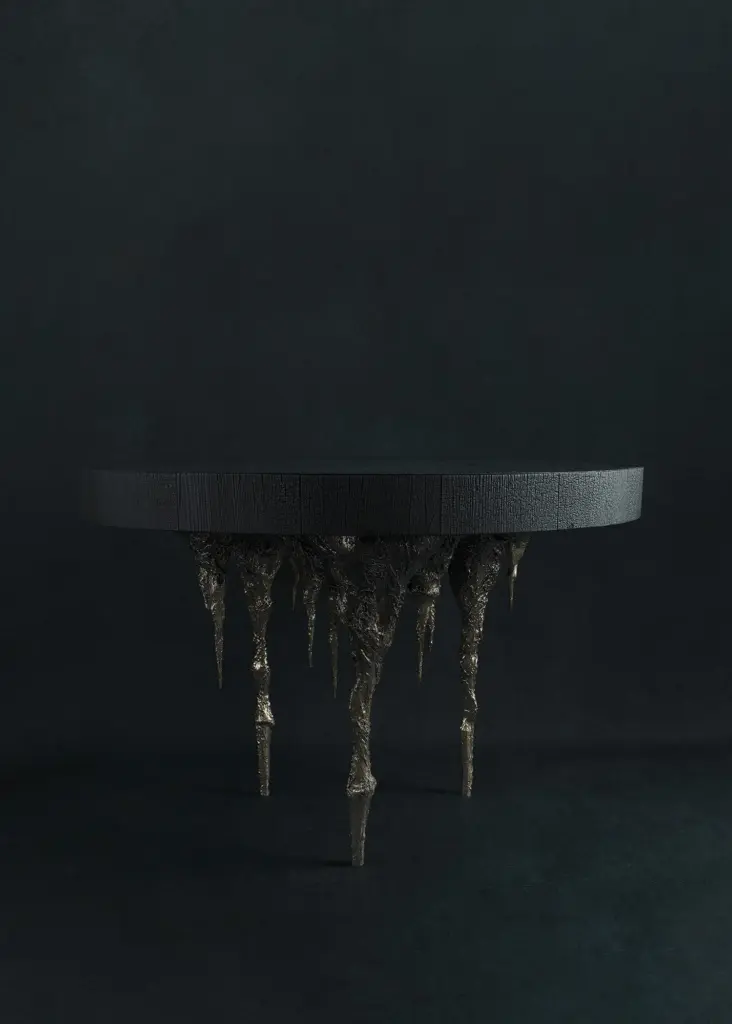
All images courtesy of William Guillon, shared with permission