In conversation with Jan Kaláb about his exhibition at KodlContemporary in Prague
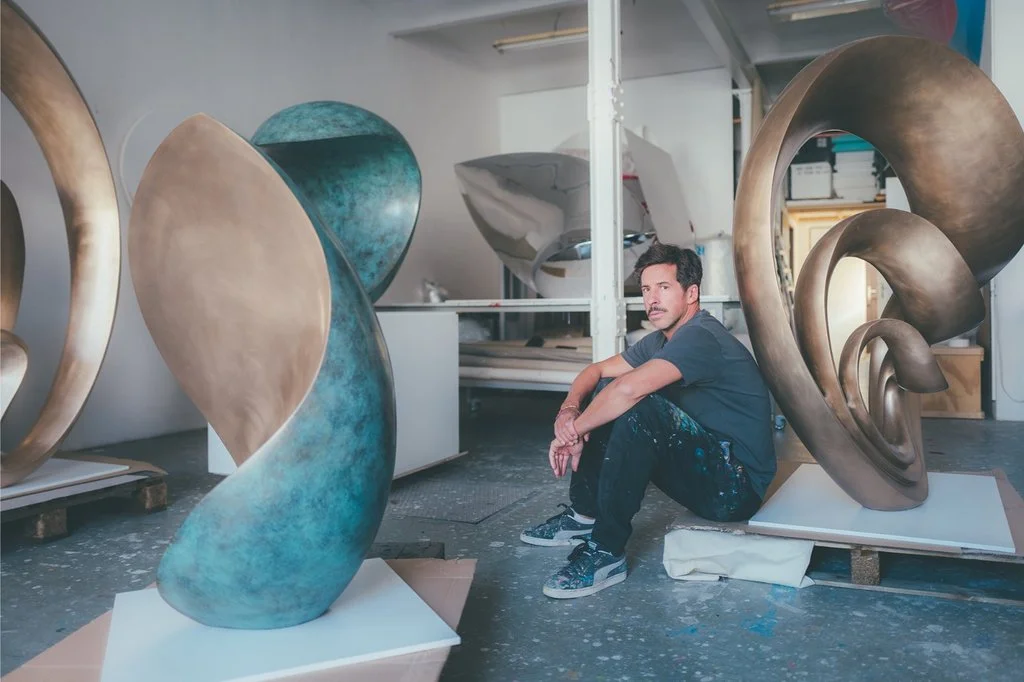
For Jan Kaláb, the distance between a painting and a sculpture has never been particularly fixed. A form might begin on canvas, acquire depth through colour and eventually find its way into physical space. This curiosity has accompanied the Prague-born artist since his early years in the city’s graffiti scene, when the urban environment offered his first opportunities to experiment with scale and movement. Today, his work has developed into a distinctive language of abstract forms, where colour can suggest volume and empty space becomes an essential part of the composition.
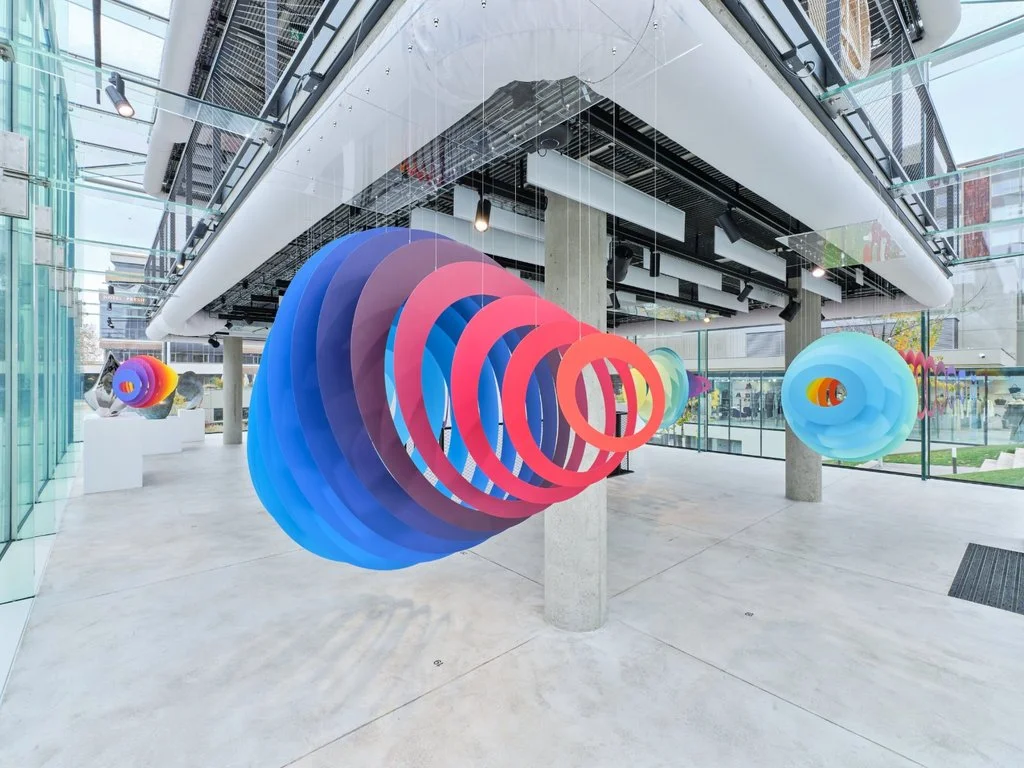
Returning to Prague for his first solo exhibition in the city in more than eight years, Jan Kaláb approaches the occasion with a different perspective. At KodlContemporary, the gallery’s glass-cube architecture becomes an active part of the exhibition, with suspended works and sculptures occupying the space around a central concrete structure. It is an opportunity to see how far his practice has travelled, but also how much remains open to experimentation. In conversation with Visual Atelier 8, Jan Kaláb reflects on his evolving relationship with his hometown, the influence of architecture on his work and the possibilities that emerge when painting moves beyond the canvas.
This is your first solo exhibition in Prague in more than eight years. What feels most significant about showing in your hometown again?
Prague is where everything started for me. I grew up here, started doing graffiti here as a teenager, and gradually developed my own artistic language. So coming back with a solo exhibition after eight years feels quite special. During that time, I had many exhibitions around the world and my work evolved quite a lot, both technically and conceptually. I think I needed that time to develop further and to reach a point where I genuinely felt the desire to present my work in Prague again. It is also an opportunity to show the local audience where my artistic journey has taken me.
How has your relationship with Prague changed over the course of your career?
My relationship with Prague has probably become more relaxed. When I was younger, I was much more connected to the local art and graffiti scene. Later, as my work started travelling internationally, my perspective naturally became broader. I began to see my work in different cultural contexts and meet people with very different ways of looking at art. But Prague has always remained my home and a place I feel connected to. I don’t feel the need to prove anything here. I can simply come back and show what I am doing now.
What question has this exhibition opened up that you still want to explore?
I think the exhibition opens up the question of how far I can take my work beyond the traditional boundaries of painting and sculpture. Over the years, I have gradually moved from the flat surface of the canvas into three-dimensional space, experimenting with reliefs, suspended objects and freestanding sculptures. For me, these are not separate disciplines but different ways of exploring the same visual language. I am interested in what happens when a form leaves the picture plane and becomes part of the space around us. I feel there is still a lot of unexplored territory there.
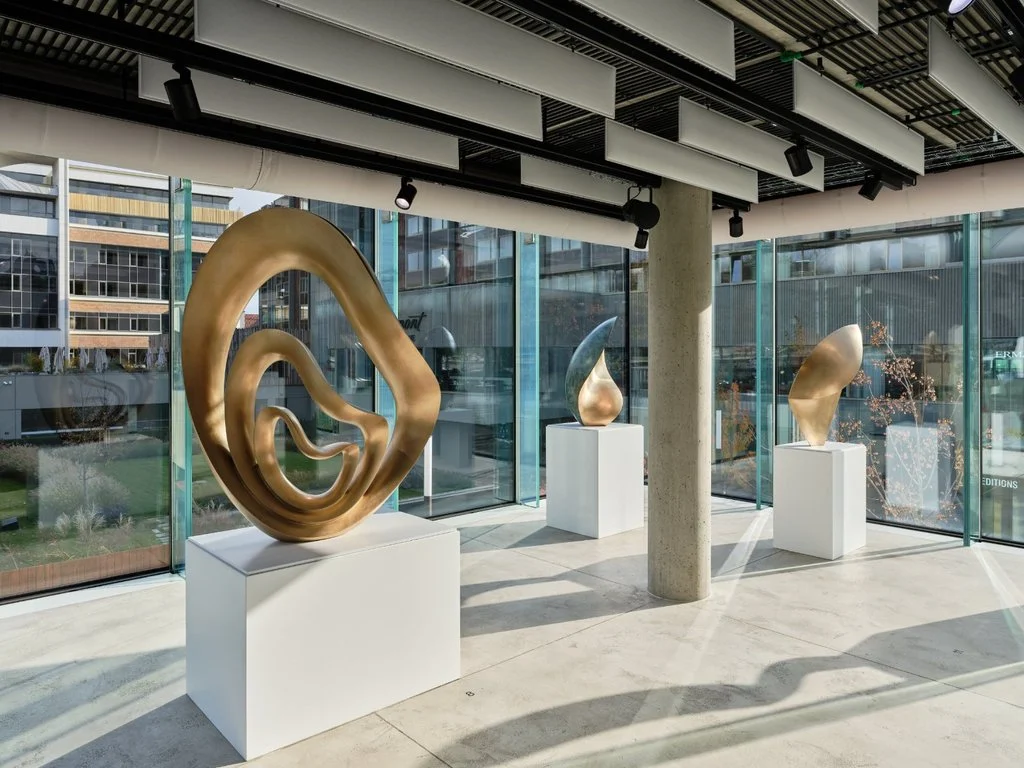
How do you build colour relationships that make a surface appear to have depth?
Colour is probably one of the most important elements of my work. I don’t really think about individual colours in isolation, but rather about the relationships between them. It’s all about subtle transitions, contrasts, gradients and how one colour influences the perception of another. I often work with colours that seem to dissolve into each other, creating an illusion of depth and movement on an otherwise flat surface. I also observe colour transitions in nature, especially the changing light at sunset, when colours can become incredibly intense and almost unreal. In a way, I try to capture something of that experience in my paintings.
What role does negative space play in your compositions?
Negative space is just as important as the physical form itself. Sometimes I feel that what is missing or empty can be just as expressive as what is actually there. This is especially true in my recent relief paintings and sculptures, where I work with voids, overlaps and intersections. The relationship between the positive and negative shapes creates tension and gives the work its spatial character. I am interested in how a form can define the space around it, rather than simply occupy it. In that sense, emptiness is never really empty.
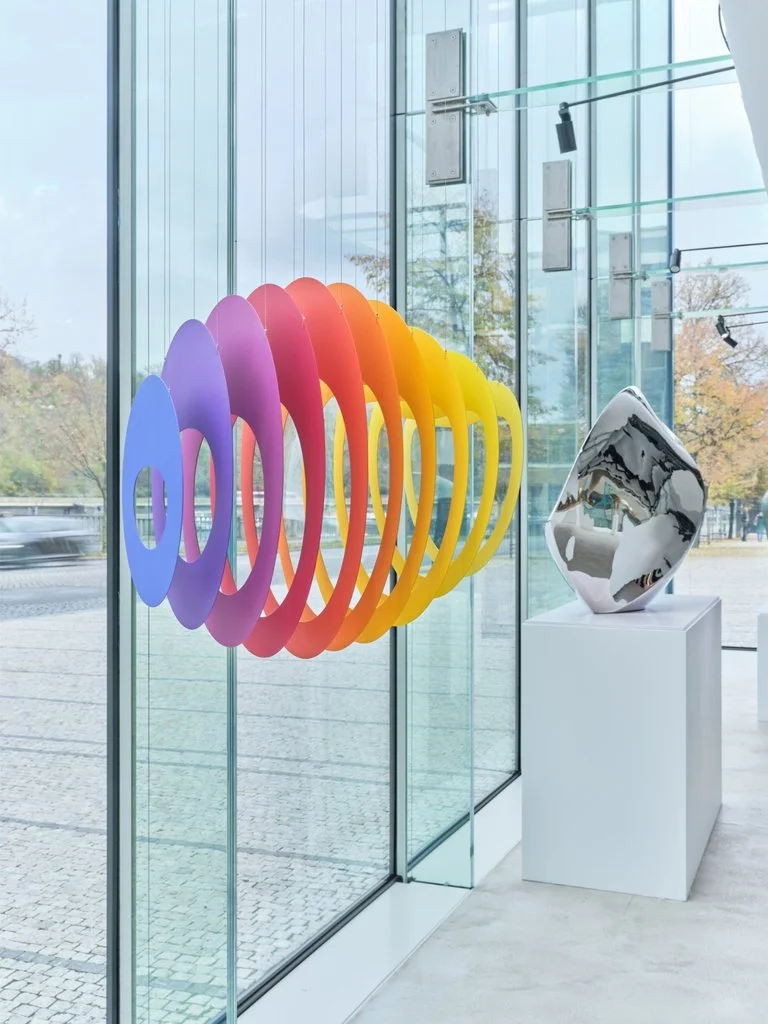
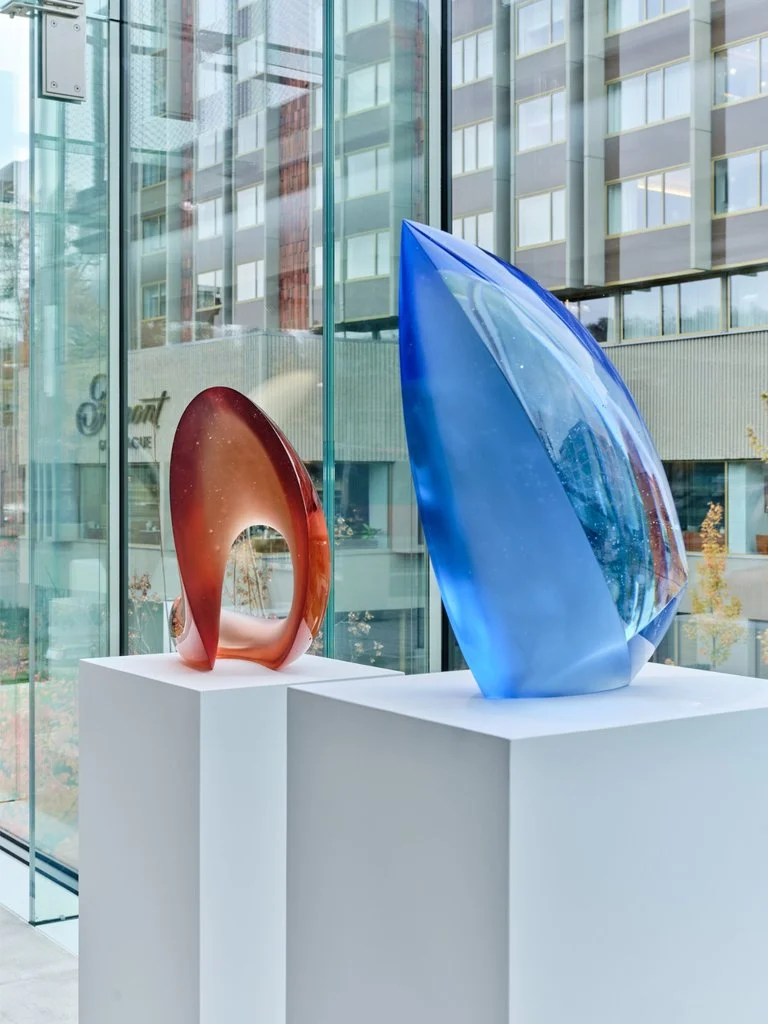
How do you determine whether an idea should become a painting, a suspended object or a freestanding sculpture?
I don’t usually make that decision in advance. It often starts with a particular shape, a colour combination or a spatial relationship that I want to explore. Then I try to find the most natural form for it. Sometimes the idea works best as a painting, where I can concentrate on colour and optical depth. Other times I feel the form needs to leave the canvas and interact with real space, light and gravity. Suspended objects allow me to explore movement and weightlessness, while freestanding sculptures give the form a completely different physical presence. I see all these approaches as different possibilities within one continuous artistic language.
How did KodlContemporary’s glass-cube architecture influence the works you developed?
The architecture influenced practically every decision I made for this exhibition. The glass cube is not a typical gallery space, and I saw that as a great challenge. Rather than treating it as a neutral container for my work, we decided to make the architecture an integral part of the exhibition. We divided the space into four sections across two floors, creating contrasts between colourful suspended objects and monochromatic bronze sculptures on the ground floor, and between relief paintings and vivid kaleidoscopic paintings upstairs.
One of our key decisions was not to hang any paintings directly on the walls. Instead, we extended the central concrete core of the building visually all the way up to the roof, where the six-metre sculpture Gesto stands. This transforms the core into a kind of monumental pedestal, with the artworks appearing to float around it. I wanted the exhibition to feel like a spatial composition in which architecture and artworks are in a constant dialogue.
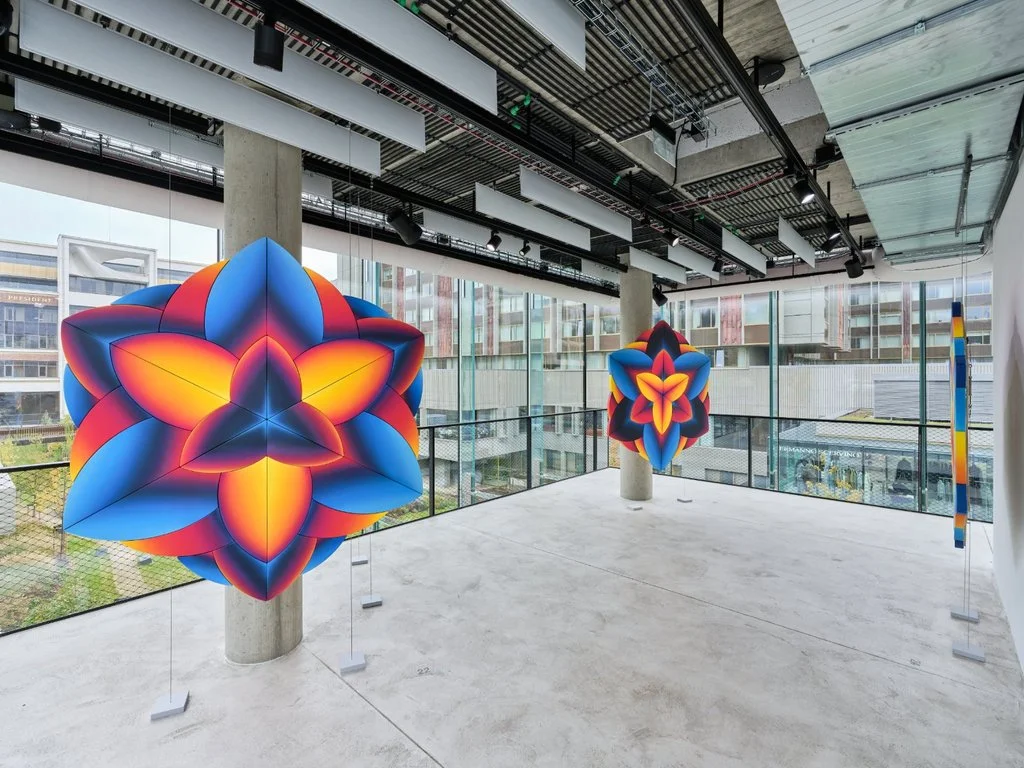
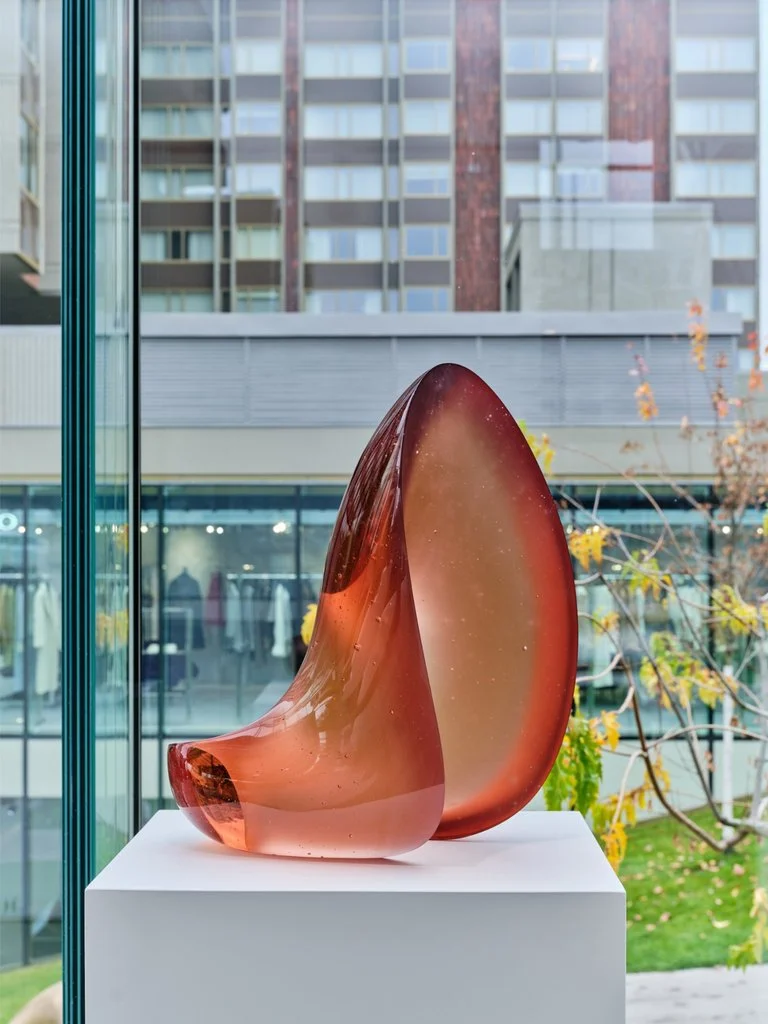
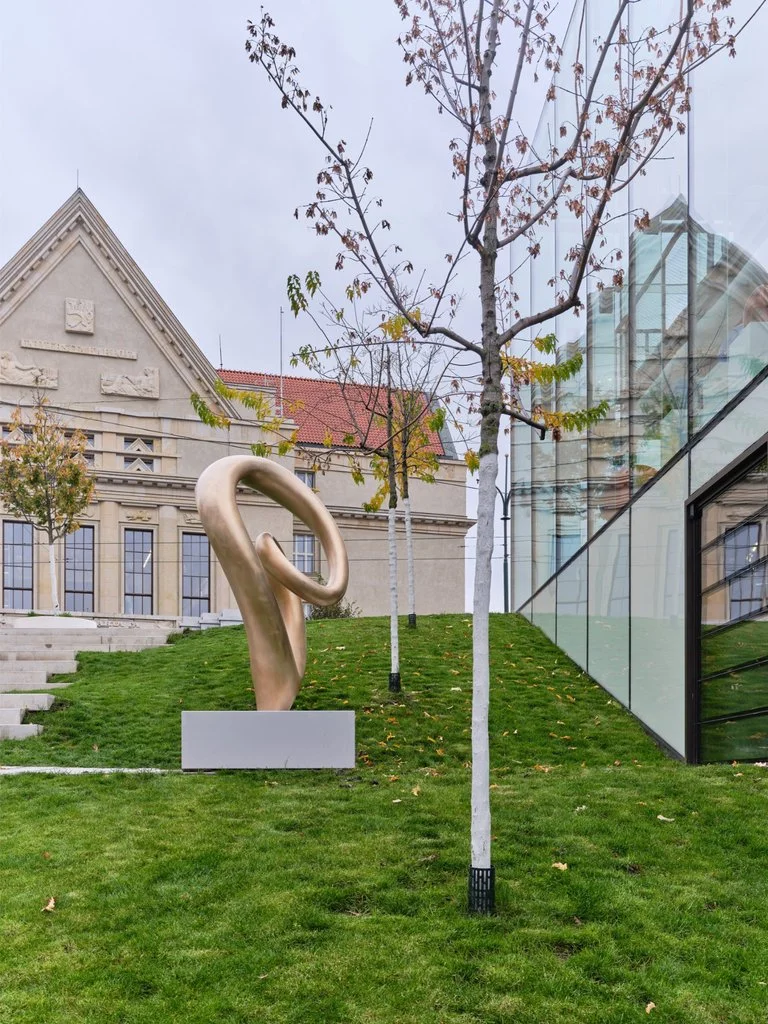
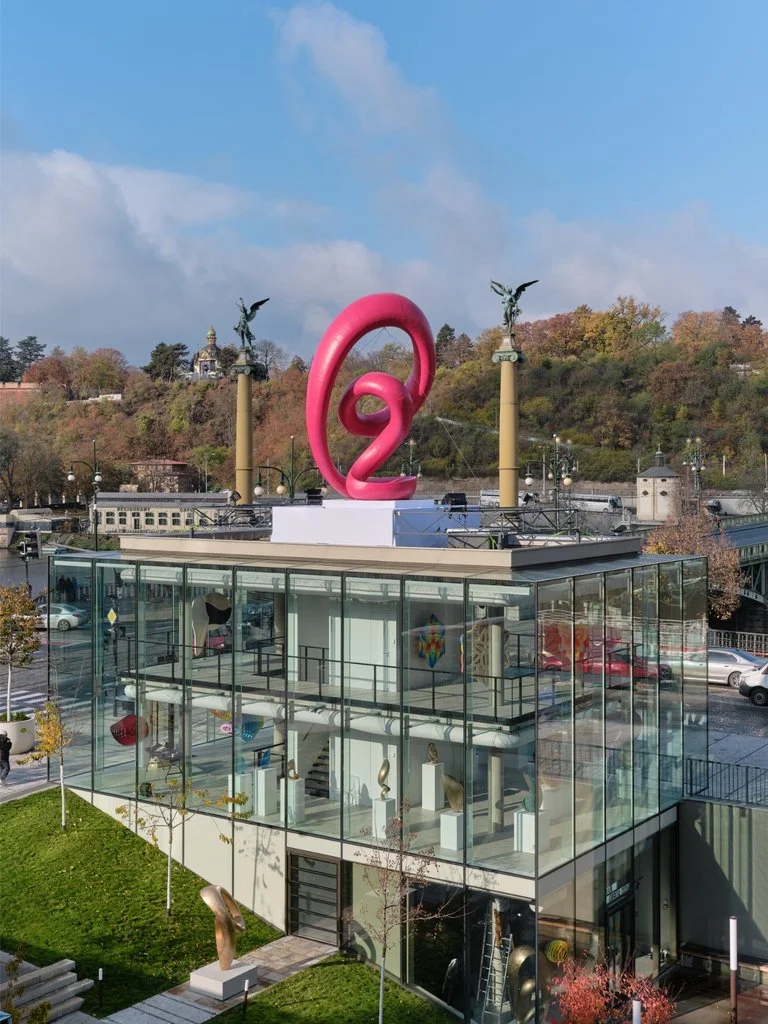
Photography by Vojtěch Veškrna, with courtesy of Jan Kaláb, shared with permission
Jan Kaláb: https://www.jankalab.com
KodlContemporary: https://www.kodlcontemporary.com/