Studio Bright applies passive design and layered garden systems to a Melbourne house
A generous hedge and arbour condition form the public face of Hedge and Arbour House by Studio Bright. The composition positions the suburban frontage as an instrument of privacy and choreography rather than a conventional façade.
The property stands on a Melbourne street lined with familiar double-fronted homes and ornamental gardens, yet this dwelling asserts a different order. A tall green boundary rises at the footpath with a carved opening marking arrival, relieving the house from presenting a formal elevation and instead allocating attention to landscape and movement across the site.
The terrain acts as a hinge between the domestic suburb and the native bushland descending from the creek below. Rapid metropolitan sprawl has placed these two conditions in uneasy adjacency, prompting the architects to consider the house as a mediator between the regulated geometry of subdivision and the looser wilderness. Similar to how Carazo Arquitectura’s biophilic residential project LTR1 immersed in Central American forest topography around dense natural topography, this dialogue highlights the delicate balance between domestic comfort and wild ecology.
This mediation occurs through a replicable framework that prioritizes garden systems, modest envelopes, and ecological performance rather than stylistic theatrics.
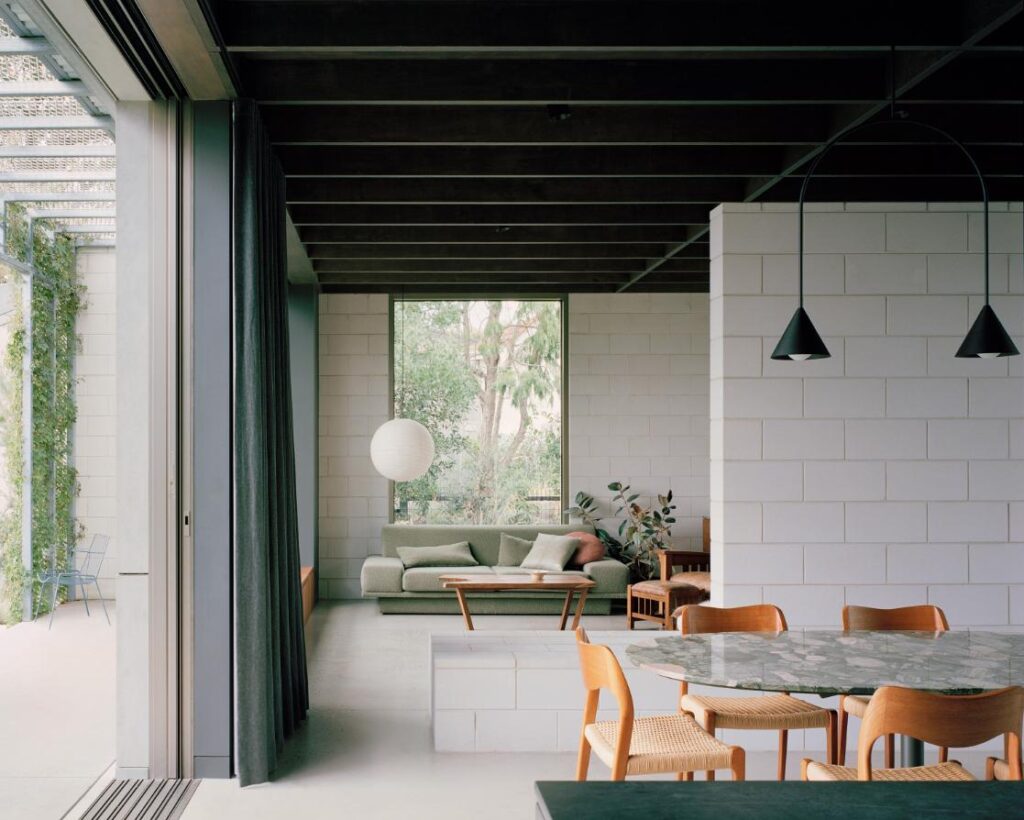
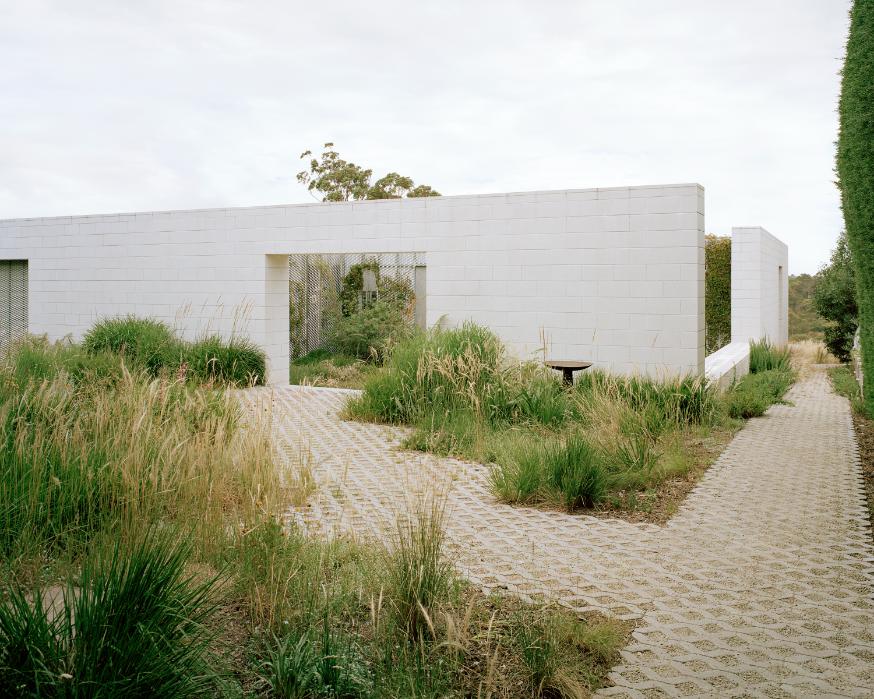
Once inside the boundary, the path dips into a quiet threshold buffered from the street. Solid blockwork defines the two principal gardens east and west of the primary volume, producing a new datum that sits slightly below the street yet lightly above the tree canopy beyond.
Living spaces occupy this intermediate realm, receiving daylight from the north and venting toward the vegetation. Passive strategies and ceiling fans remove the need for active conditioning while sliding doors open children’s rooms to a shared study corridor that encourages communal activity.

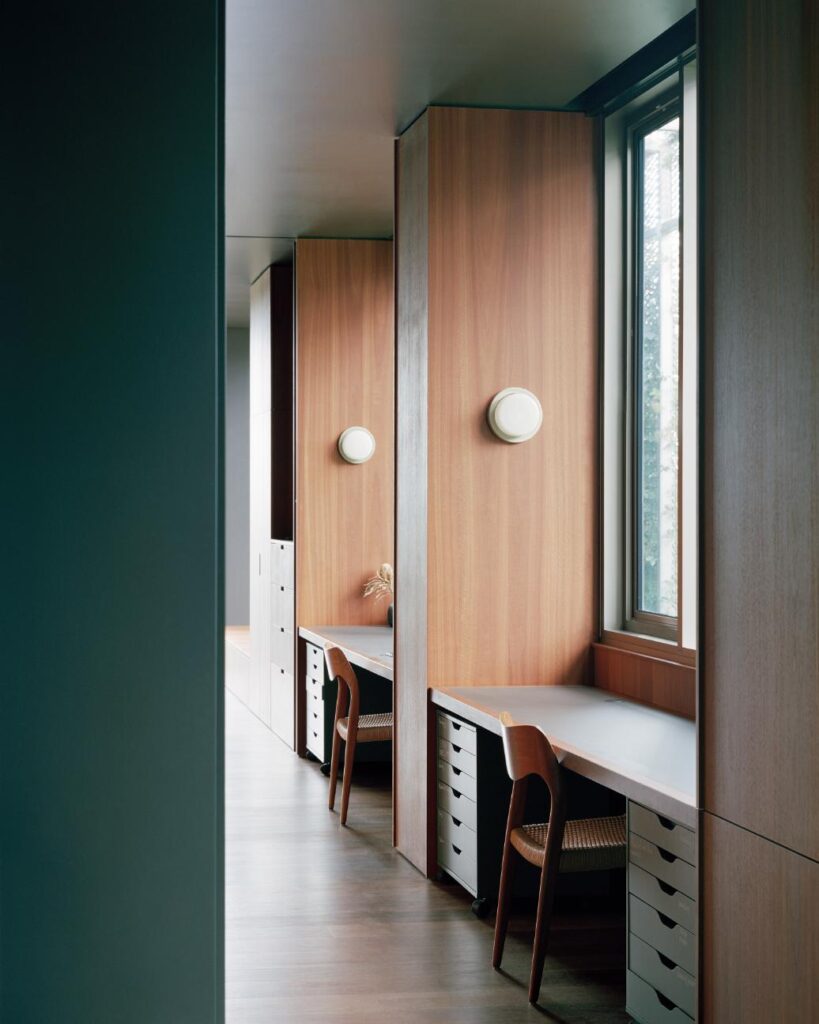
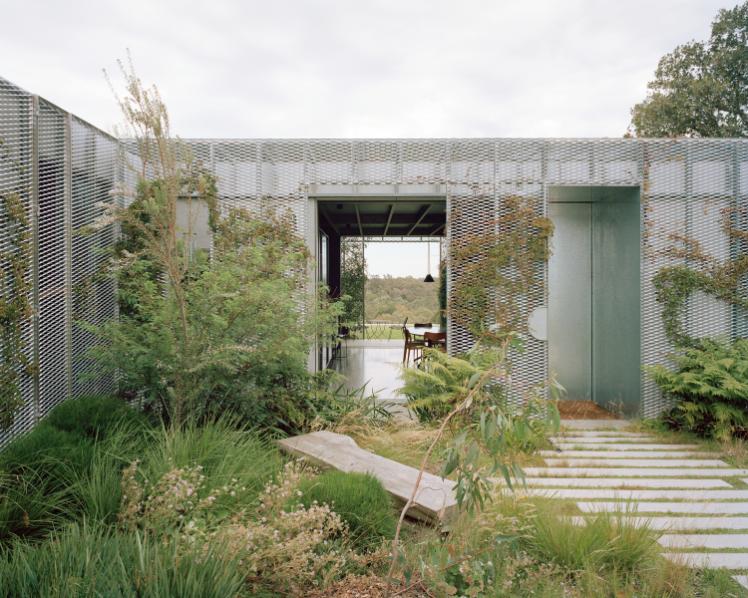
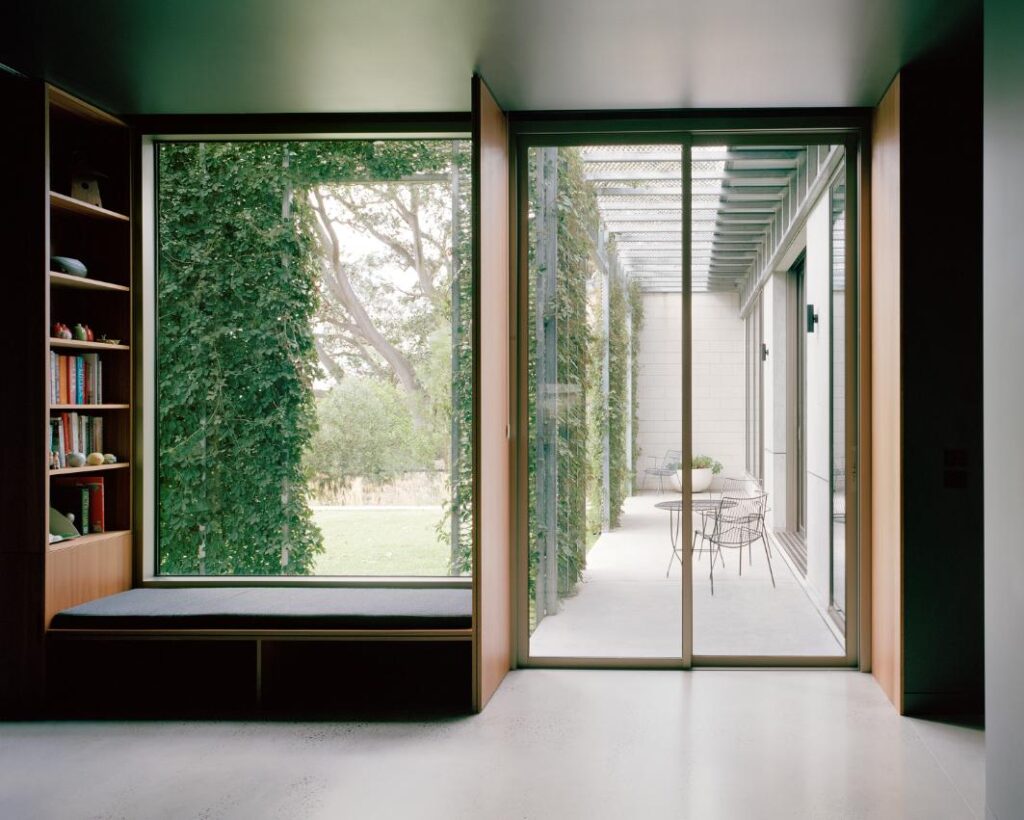
A slender steel arbour encircles the main volume, later clothed by vines to temper winds and summer sun. The delicacy of this screen contrasts with the robust garden walls, establishing a layered sequence from street to interior.
The arbour acts as another landscape layer rather than decorative addition, positioning the building as part of the horticultural system that structures the site.
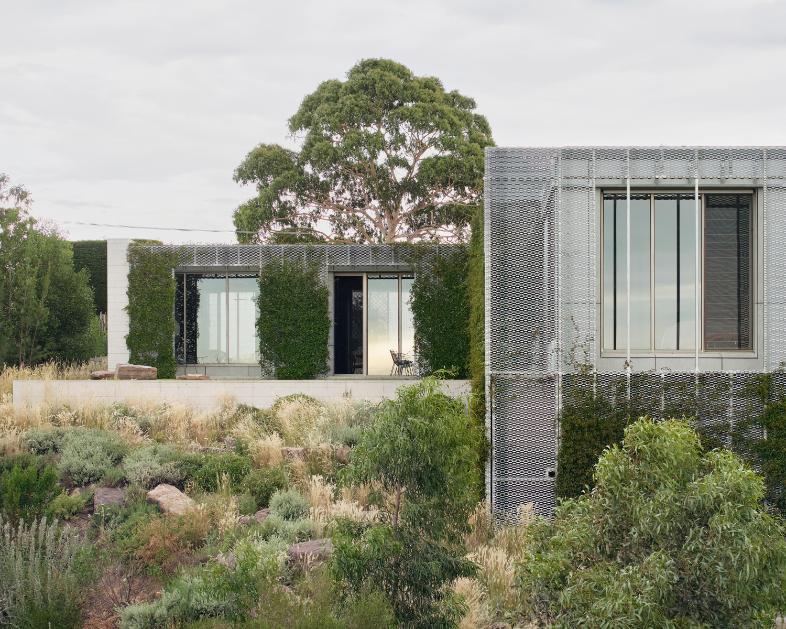
Planting developed with landscape architect Sarah Hicks distributes native species toward the street and more traditional suburban typologies toward the western edge. The former introduces a relaxed meadow-like condition at the point of arrival, while the latter offers a modest lawn terrace where ground drops steeply toward parklands.
Instead of raising the structure in cantilever, the team allowed the landscape-wrapped envelope to descend and reconnect with terrain, acknowledging the adjacent wilderness with quiet respect. In this way, the house reads less as object and more as landscape apparatus calibrating the meeting of suburb and bush.
Photography by Rory Gardiner with courtesy of Studio Bright, shared with permission