Inspired Series: Ememem
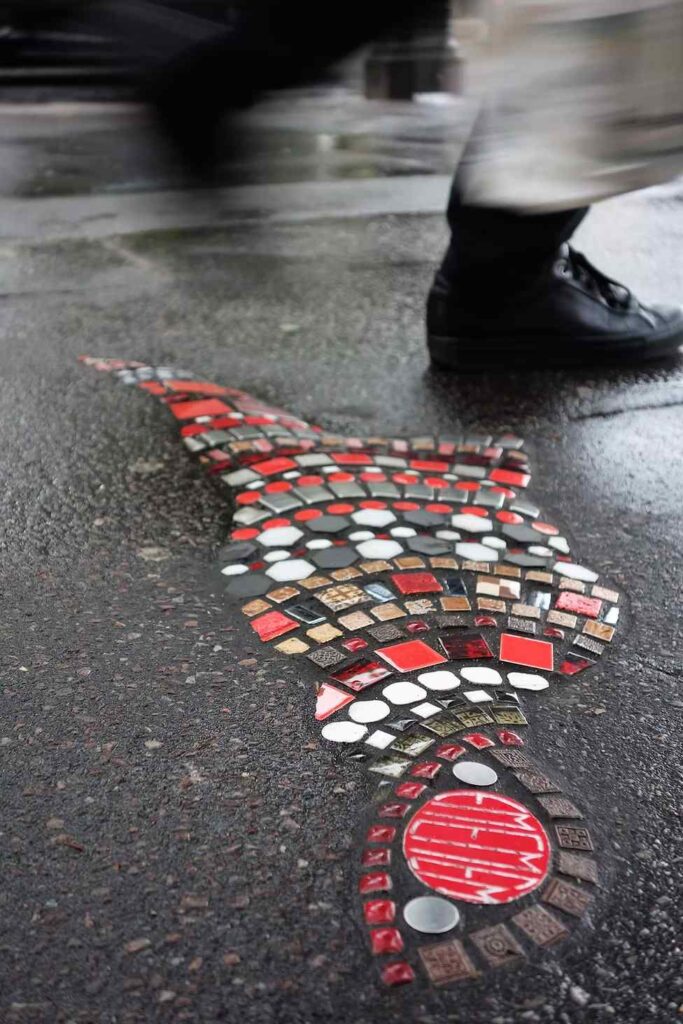
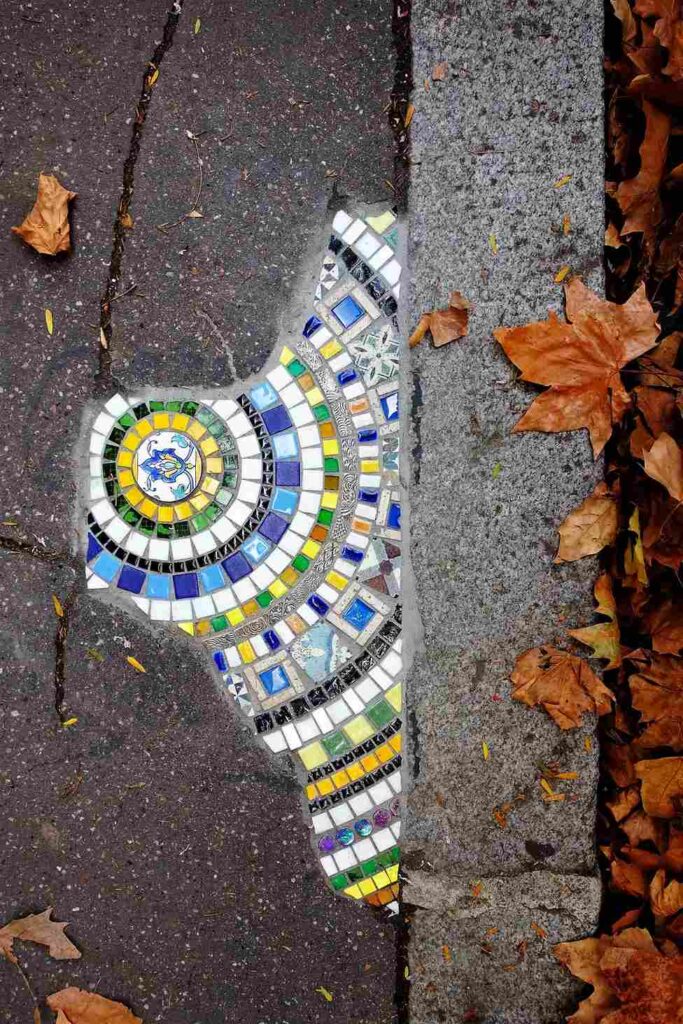
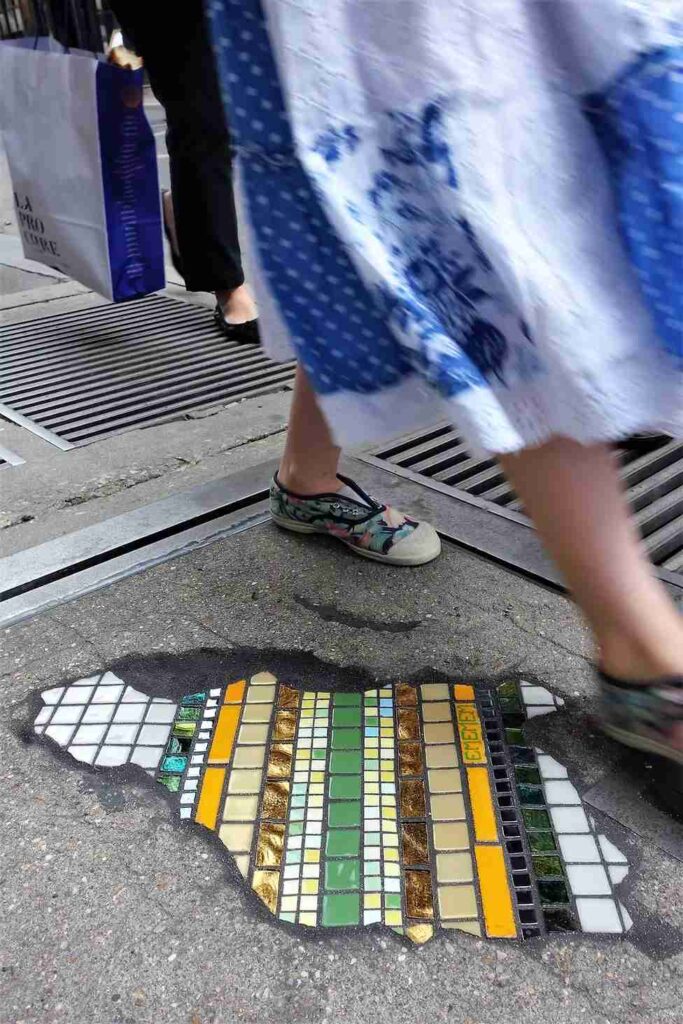
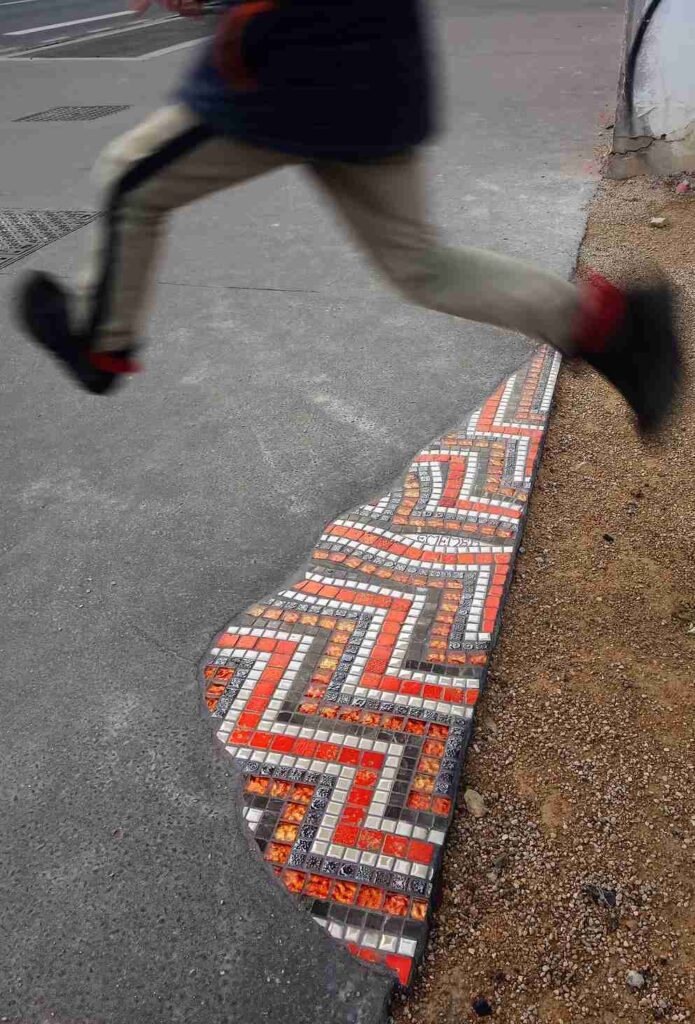
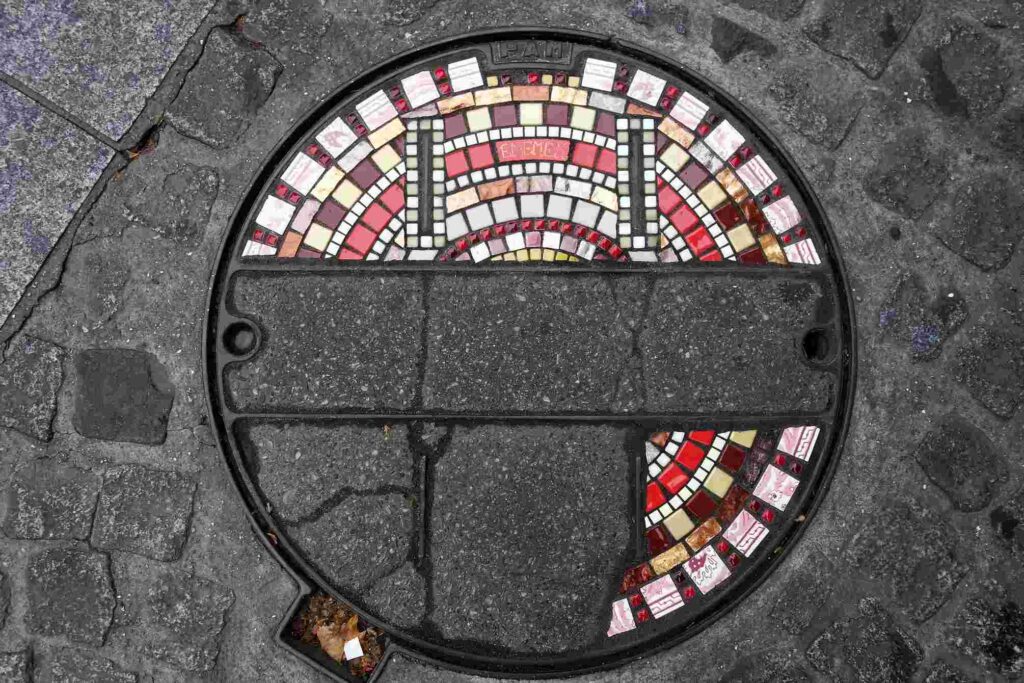
Ememem is a French artist who transforms potholes and street fractures into vivid ceramic inlays. His interventions feel both accidental and inevitable, like color rising from beneath the pavement. Active since 2016 and intentionally anonymous, he coined the term “flacking,” from flaque (puddle), to describe an urban gesture that doesn’t conceal damage but reframes it, turning repair into a quiet form of attention.
Neither mural nor monument, each intervention is intimate and site-specific, made from reclaimed and industrial fragments assembled with the care of a craftsman and the instinct of a street artist. The works echo ancient mosaic and the spirit of kintsugi, yet feel unmistakably contemporary. Found in passing, they’re hard to forget and impossible to own, because they belong to the street. In this interview, Ememem reflects on anonymity as a deliberate artistic choice, on the city as a shared responsibility, and on why mending what’s damaged can be one of the most quietly radical forms of poetry today.
Your authorial absence feels a significant element of your practice. Because rather than focusing on a persona, it forces publics; to confront your interventions per se. Can you discuss how your purposeful anonymity is meant to shift focus from who made it (meaning the artist as a fully known identity) to the what and where of the act of repair? Because I know this detail is important to you.
Yes, you’re right, anonymity is something essential for me. It’s a tool, just like the trowel I use to repair holes. It’s a deliberate choice to shift all the attention onto the work itself, not onto the person who made it. I want the piece to speak louder than my face. Anonymity prevents the work from being “contaminated” by identity, leaves more room for interpretation, and allows stories to grow around the interventions with greater freedom and agility.
It is also a way to lighten the weight of identity, to avoid locking the creative gesture inside a fixed biography. Maybe sometimes it is also a form of escape, but not to hide — rather to dissolve into the crowd, to blend into a human mass. Anonymity is another way of creating, an extension of the creative act itself. It adds narrative layers, activates the viewer’s imagination, and opens up additional storytelling possibilities.
It is also a position taken against a society where, if you don’t show yourself, you are considered not to exist. A society where you are expected to constantly display your image, your activity, your happiness, even what you eat. I feel the need to move in the opposite direction. I don’t feel at ease in this culture of excess and permanent self-exposure.
For me, anonymity is almost a militant gesture. A way to stand against the lack of love and poetry I perceive around us. A way to remind people that what matters is not who speaks, but what is done, repaired, cared for. It is a form of poetic resistance.
What was your life like as a child, and did you always use art as a means of communication, or was it just at that moment when you saw light refracting in the glass that you were inspired to leave your figurative and literal mark on history?
As a child, my relationship with art was somewhat ambiguous. I grew up in the home of a poet who wrote in dialect and produced his own small poetry booklets. He took part in gatherings where poems were recited and sung. I often went into his studio, he was almost like a second father to me. I loved being there: there was the smell of fresh paper, which I found wonderful. It felt like a magical place, a kind of factory of words. For me, it was where beautiful and important words were born and revealed to the world. That was one of my very first encounters with art, although at the time I did not know it was art.
We also had some original paintings at home. I especially remember a portrait of my parents painted by an uncle. It always intrigued me because it wasn’t completely realistic, but artistically interpreted. It raised many questions for me: I couldn’t tell whether the painting was successful or not, because the resemblance was not exact. That tension between reality and interpretation stayed with me.
Apart from these experiences, art otherwise felt distant and almost unreachable to me, as if it were reserved for an elite. I grew up in a working class family, with both my parents working, in a neighborhood that was far from bourgeois. As children we lived in the street: we played football, hide and seek, we had many outdoor experiences, sometimes even risky ones. That is why, in my story, it is not surprising that I eventually returned to the street, to the sidewalk, and made this element, so present in my childhood, into a central space for my adult creative work.
At that time, art and poetry were not really things people talked about. At least, I did not talk about them with my friends. We didn’t talk about art or poetry. The word “artist,” as often happens, referred to the strange one in the family, the different one, a bit isolated, the one nobody fully understands. The artist was the one with supposedly odd or impractical ideas. People would say, “Yes, he’s an artist, you know…,” as a way of explaining someone eccentric. That was more or less the place of art in my childhood.
Art, in one way or another, has always been there. As a child I was always drawing. At other moments in my life it passed through words and writing, almost like a return to that poetic workshop of my childhood. It also passed strongly through music. The visual and plastic arts came later, but with great force and importance.
Flacking has given meaning to many aspects of my life that perhaps had none before. It brought together many small scattered pieces, much like I now do with my interventions. Today, art is something fundamental to me. It is like breathing. It may sound banal to say it, but it is truly so.
Your work can be read as a form of guerilla maintenance, it being a quiet critique on municipal neglect. In a world prizing the new and disposable, your practice seems to insist on the value of care and attention. Based on what you have stated publicly in other interviews, you don’t simply view your interventions as primarily aesthetic gestures, but they also function as forms of social commentary about human life and finding value in the imperfect. Can you discuss this concept of resilience and finding love for the imperfect from within your own life experience?
Yes, you’re right: my work can be described as a form of guerrilla action. But it is never meant to be a direct criticism of municipalities. It is not about pointing at a hole and saying, “you are not doing your job properly.” Absolutely not. That is not my intention.
Flacking is a poetic, social, political, and artistic form of guerrilla action, yes, but it is not created to expose the supposed inability of administrations to take care of the city. Maintaining a large city is complex and difficult. Urban maintenance is probably one of the main concerns of any municipality. Of course, sometimes money is spent on questionable things, but the real priority should always be people, especially the most vulnerable. Before fixing every hole in the sidewalk come human beings, including those who are suffering or even sleeping on those sidewalks because they have nowhere else to go. Human needs come first.
My gesture is, above all, a poetic one. It is a way of bringing poetry back into places where it has disappeared. Over time, we have adopted a way of building cities and homes that is too pragmatic and purely functional. Money has played a major role in this shift. At some point we convinced ourselves that beauty was unnecessary, something extra. We chose what is clean, fast, and efficient, and forgot that we can also create beauty.
Today this is very visible: to obtain remarkable architecture you need famous architects and monumental budgets, and even then the results are not always convincing. In the past, beauty was more widespread in everyday construction. There were decorative facades, ceramics, mosaics under arcades, details designed to accompany urban life. Where have these elements gone? My work is also a way of reclaiming that forgotten beauty in the way we build our cities.
It is also a political gesture because it deals with the sense of belonging. When something belongs to everyone, people often feel it belongs to no one. The city belongs to all, yet many people do not feel responsible for it and therefore do not take care of it. I want to affirm the opposite: this city is also mine, and I can take care of it.
I often think of my grandfather. When there were construction works in the street in front of his house, he would go outside, talk with the workers, ask how things were going. He would bring them something to drink, a coffee, a glass of water. It was a deeply human gesture. In summer he would clean the courtyard and also the piece of street in front of his home. He took care of it because he felt it belonged to him too. That gesture has always stayed with me. In a way, through flacking, I am continuing that same gesture: taking care of one’s environment, one’s context, one’s city.
There is also a dimension of resilience. We live in a society where broken things are replaced rather than repaired. We produce objects with planned obsolescence, designed to last only a limited time so they must be bought again. This is an absurd system, and today we clearly see its limits. Flacking goes against this logic. It shows that things can be repaired, and that beauty can emerge from what is damaged and imperfect. It is above all a matter of love and energy. What is missing is love, and we often put our energy in the wrong places, that is what I believe. As I said in my first answer, there is a lack of love and poetry in the world, and this lack makes us harder and leads us to make the wrong choices.
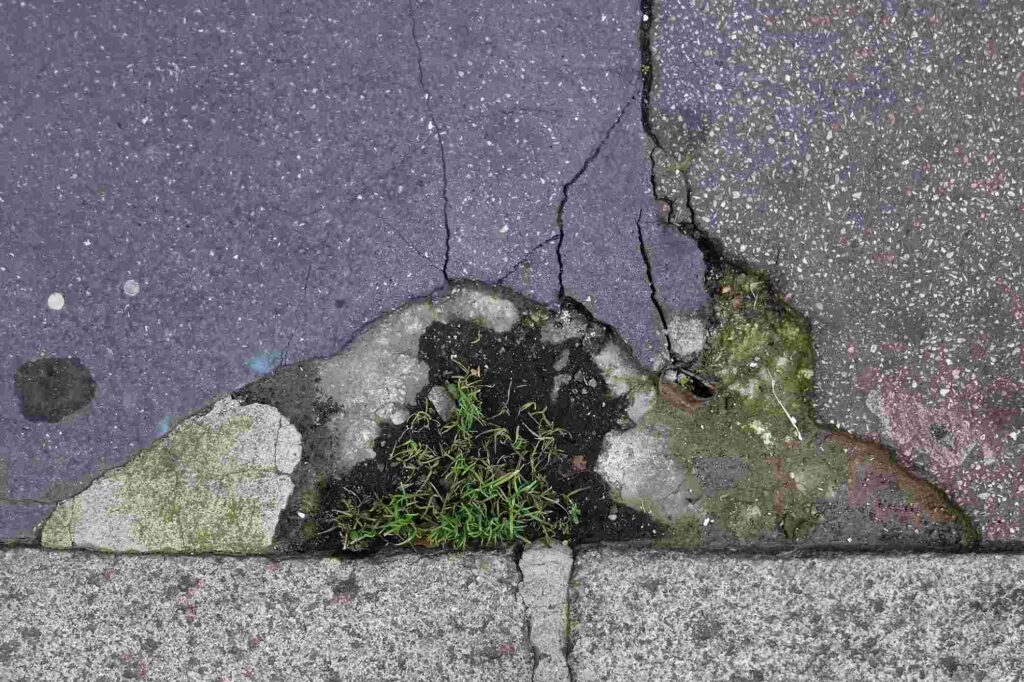
Street art holds an innate irony because its process is usually illegal while it simultaneously is beautifying structures that can be argued have a negative impact on society whilst remaining undignified. What are your views on unsolicited street art and graffiti laws and how said artworks often benefit whilst being banned?
Street art raises many questions. I’ll answer honestly: I don’t always have all the answers. These are issues I still reflect on, and I’m still searching for my own position. What I can say is that there is street art and street art — there are very different ways of intervening in public space. I believe all these forms have a right to exist. For me, that is undeniable.
I also think that certain practices, such as tagging, partly arise from the fact that many areas of our cities are not beautiful or well maintained. When a place is neglected, people feel more entitled to do whatever they want there. If there were more beauty present in urban spaces, there would probably be fewer tags and random inscriptions. It’s similar to the broken window theory: what is ugly and poorly maintained tends to invite further neglect.
I remember a small house near a friend’s place in the city center, surrounded by large buildings. Its facade was constantly covered with tags. The new owner kept cleaning it, but after a few days new tags would appear. In the end he invited an artist to paint a large mural on the facade. After that intervention, no one dared tag it again. I think this says something meaningful about certain dynamics of street art in big cities.
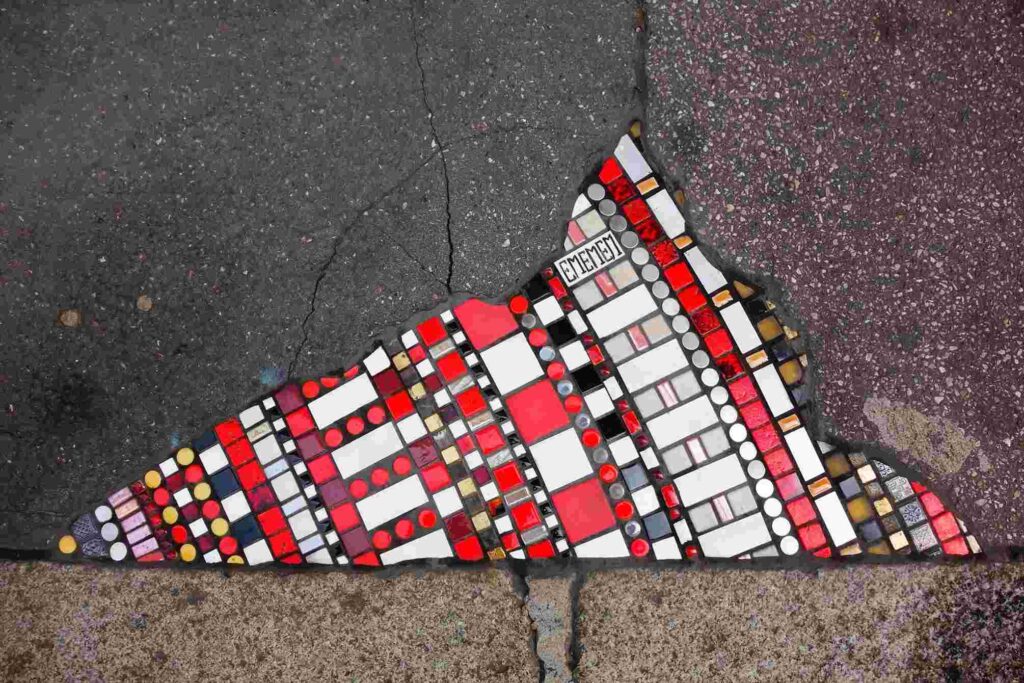
That said, I am sometimes critical of certain street art practices. There are interventions that are very powerful and beautiful, but others that make me wonder whether it might have been better to do nothing at all. Perhaps we should more often ask a simple question: would this place be better with or without this intervention? Sometimes emptiness and cleanliness are stronger. Some works feel out of context or difficult to justify in terms of meaning. Of course, this is my personal opinion.
In any case, street art has always existed. We find inscriptions in public spaces dating back to Roman times, for example in Pompeii. It is a form of human expression, and when the need to express exists, people will find a way. If tagging and street art exist, it means they answer a real necessity.
However, I believe that if we returned to building our cities with beauty as a central value, we would see a more meaningful kind of street art emerge, and more meaningful cities as well. I believe there is also such a thing as objective beauty. Not everything is purely subjective. The beauty of the sea or of a starry sky is something no one can truly deny. If someone cannot perceive it, perhaps they have not been given the tools to do so, and maybe it is partly our role to transmit them. Bringing beauty back into urban space would also deeply change the quality of spontaneous artistic interventions.
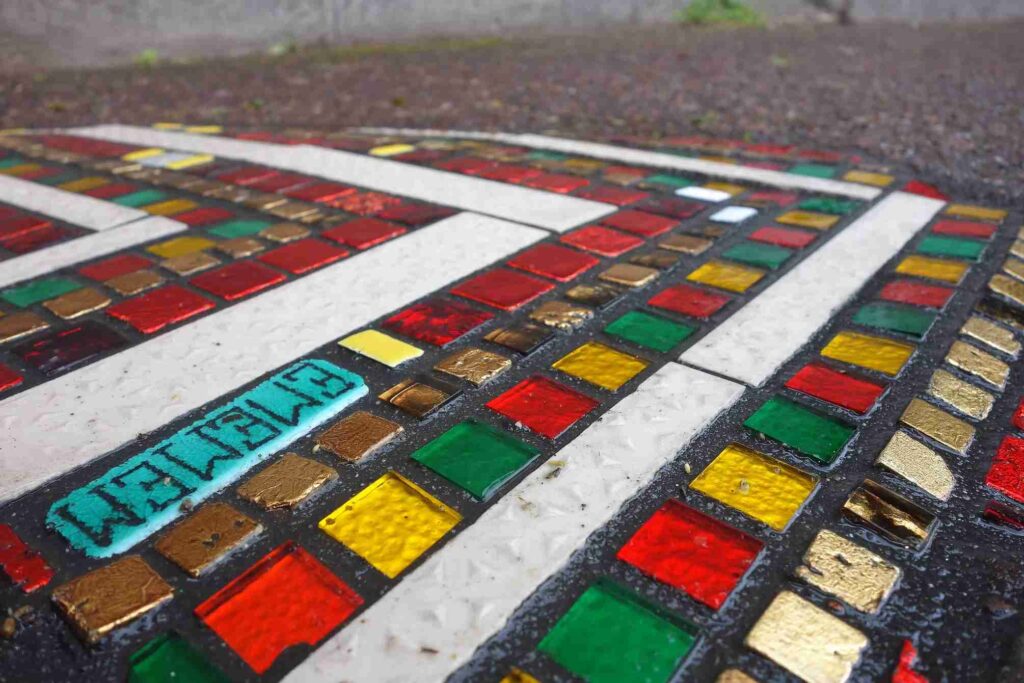
Mosaics are a medium with deep and often sacred or luxurious genealogies. By transposing this historically “high” craft into the everyday of damaged urban infrastructure, a powerful conceptual dissonance is made. Do you place your work in dialogue with, or in opposition to, the historical narratives of the mosaic? and how does the “common” context of the broken, activate or subvert this history? Note, I do acknowledge that mosaics did exist in ancient aristocratic homes etc, but that they were never used specifically as “Flacking”, a now famous term that you’ve coined.
Yes, you’re right: the mosaic is a very ancient medium, often associated with aristocracy and luxury in antiquity. Not everyone had mosaics at home, that’s for sure. I consider my work, yes, as a sort of modern continuation of this tradition, because mosaics have always existed… even if, to be honest, talking about mosaics is complicated for me. I don’t consider myself a mosaicist, and I don’t even consider my flaking as true mosaics like those of antiquity.
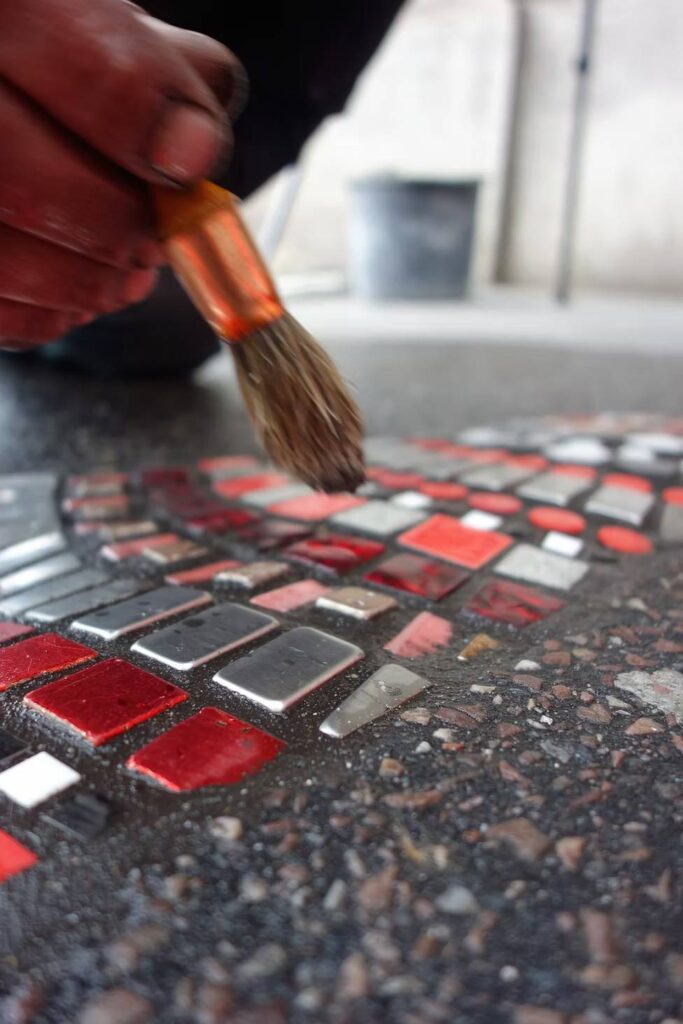
I use industrial materials, but also artisanal or semi-artisanal ones, often recovered. My goal is to give these materials a new life and new meaning. In this sense, flacking can be seen as a modern and contemporary continuation, but different because it is offered to everyone: to the public, to the street, available to anyone, rich and poor, transforming it into something popular rather than elitist.
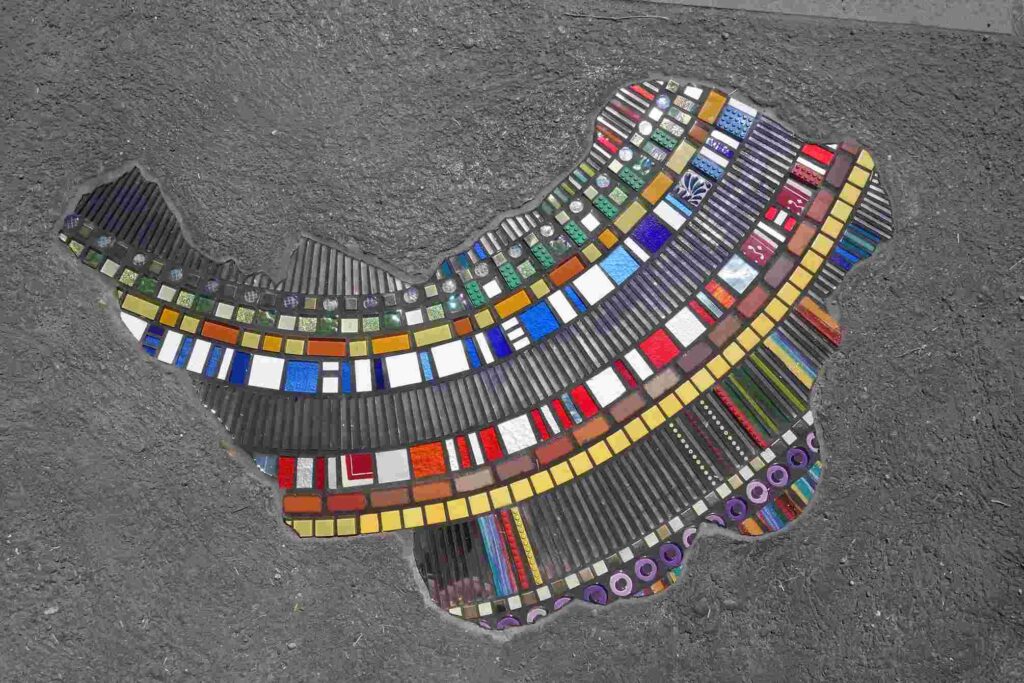
I believe the strength of flacking lies in conceptual dissonance, in being out of context: I bring something familiar into a place where it does not belong. In a way, I try to transfer the intimacy of our homes into public space, almost as if the street becomes an extension of our living room. At the same time, in gallery works I do the opposite: elements typical of public space, like asphalt, are brought into the intimacy of our homes.
So, continuity lies in the care and attention I put into each work, in the pursuit of precision and perfection. Ceramic material is also practical: I can recover it in large quantities, it offers a wide range of colors, it is durable in public spaces, and does not require enormous resources for installation. If I could recover other materials in sufficient quantity, like aluminum or iron, I would gladly use them for flacking.
But I emphasize again: I don’t consider myself a mosaicist, and flacking is not a mosaic in the historical sense — it is contemporary art. Ceramics are just a pretext, a medium to carry out the repair, nothing more. What do you think about this?
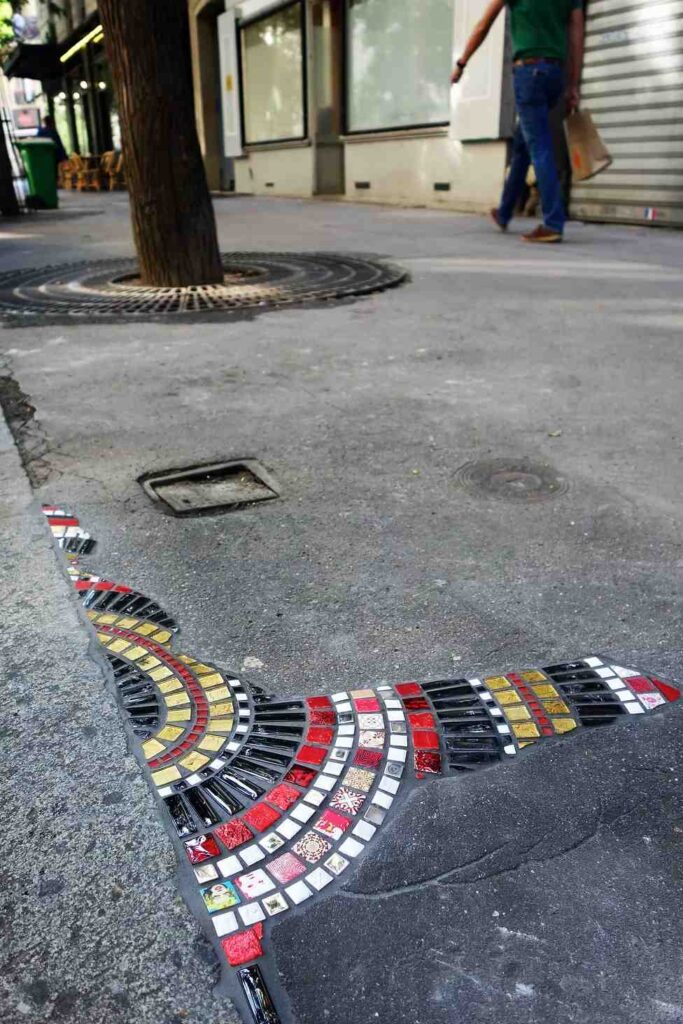
Could you describe your technical process? Do you ever make casts or drawings of the cracks, creating pre-built pieces in your workshop to fit later? Or is your work always done on-site with raw materials? And on that note, is your love for the work also linked to the addiction to adrenaline from almost being caught?
Regarding technique, I prefer not to talk too much about the technical act itself. I find it more interesting to leave space for people’s imagination, so they can think that the work is created on-site or elsewhere. Let’s leave a little mystery, if you agree.
Certainly, going out at night to repair a hole in a somewhat wild way, without authorization, is very exciting. This year marks the tenth year I’ve been practicing flacking, so I have accumulated experience: I’m not really afraid of being caught, because I don’t feel like I’m doing anything wrong, even without official permits. I feel legitimate in my poetry, I feel legitimate in public space.
And yet, it remains exciting to intervene at night, to work while everyone sleeps, to experience life with the night people. It is a very beautiful and stimulating experience, without a doubt.
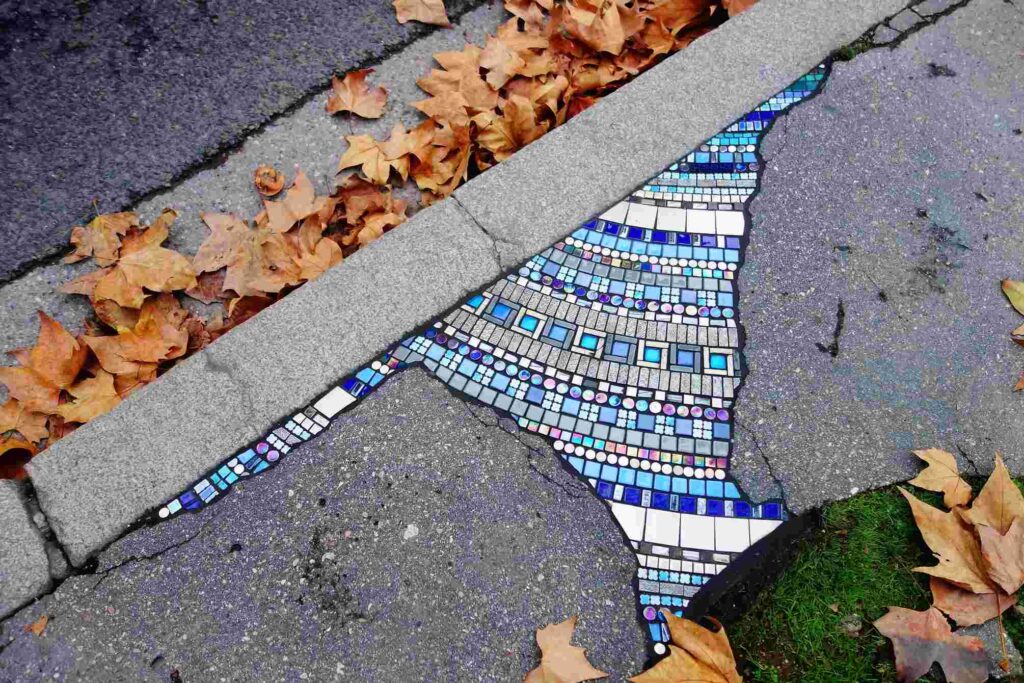
Your anonymity affords you the unique position of being able to be an observer of your own work’s reception by the public without them knowing. Can you share an observation of such an interaction that fundamentally informed or altered your own understanding about what your work achieves in the world?
Anonymity is a true luxury in this sense, because it allows you to observe people’s reactions from a unique point of view. Once, I created a large work on the pier of a seaside town in southern France, Sète. The pier was entirely concrete, and at some point, the concrete began to break, causing the plaster to swell. Part of the plaster had fallen, while another part remained intact but bulging. I created a work there, repairing the missing section and continuing the flacking under the swollen plaster. It was a piece I really liked, made for a festival called klive.
Two or three years later, I returned with a friend to see the work. While we were observing the pier, an elderly man, a sailor, came down from his boat and approached us. He greeted us and asked, “Do you like it? Beautiful, isn’t it?” We said yes. And then the show began: he told us the whole story, explaining that the pier had originally been decorated in a similar way. Over time, the decorations had been covered with plaster, but a few years ago, as the plaster deteriorated, the decorative work reemerged.
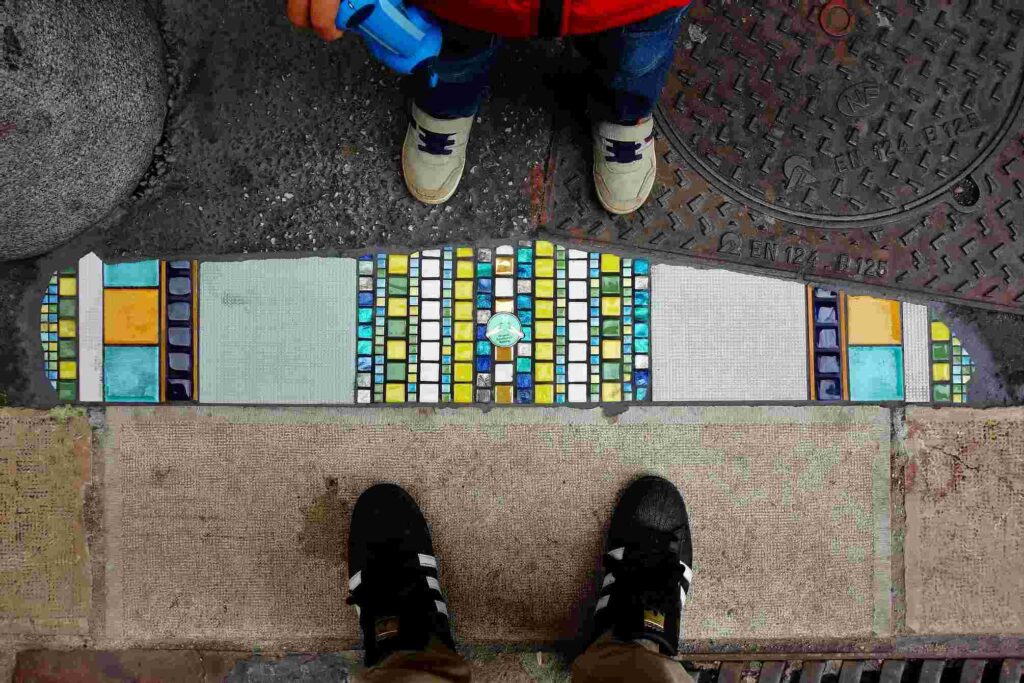
The sailor was telling us this story without knowing, of course, that I was the creator of the work. It was fantastic. At that moment, I realized that I could transport people elsewhere, like to Wonderland, make them follow the White Rabbit. It was magical. We let him tell his story, pretending surprise and interest. That man gave me one of the greatest gifts of my artistic life.
This episode made me truly understand the creative and imaginative power my work can have, and the importance of continuing to tell stories, of making people dream, and of carrying forward this narrative. It is a memory I will never forget.
You’ve been called “the Banksy of ceramics,”. But where his work often relies on reproducible images and direct satire, yours is rooted in unique, site-specific materiality and poetic abstraction. How do you position your creative output within this landscape of institutional or famous street art, and what unique contribution does a practice centered on poetic repair offer to a genre often defined by overt messaging?
Well, I would like to feel like a pioneer. I would like to be someone who opens the way to new techniques, who opens the way for repair within the world of street art. I want to be an artist who contributes poetic messages to urban space, without necessarily making them explicit.
But I know I am not the only one: street art has diversified greatly in recent years. There are not only murals; there are many different techniques. I think, for example, of Jan Vormann, a friend, who repairs walls with Lego. I also think of Isaac Cordal, who creates his small figures and places them in cities. There are many different forms of street art today, and that’s fantastic because it brings so much diversity. If I can contribute a small grain to this world, showing a new path, then I am proud and extremely happy.
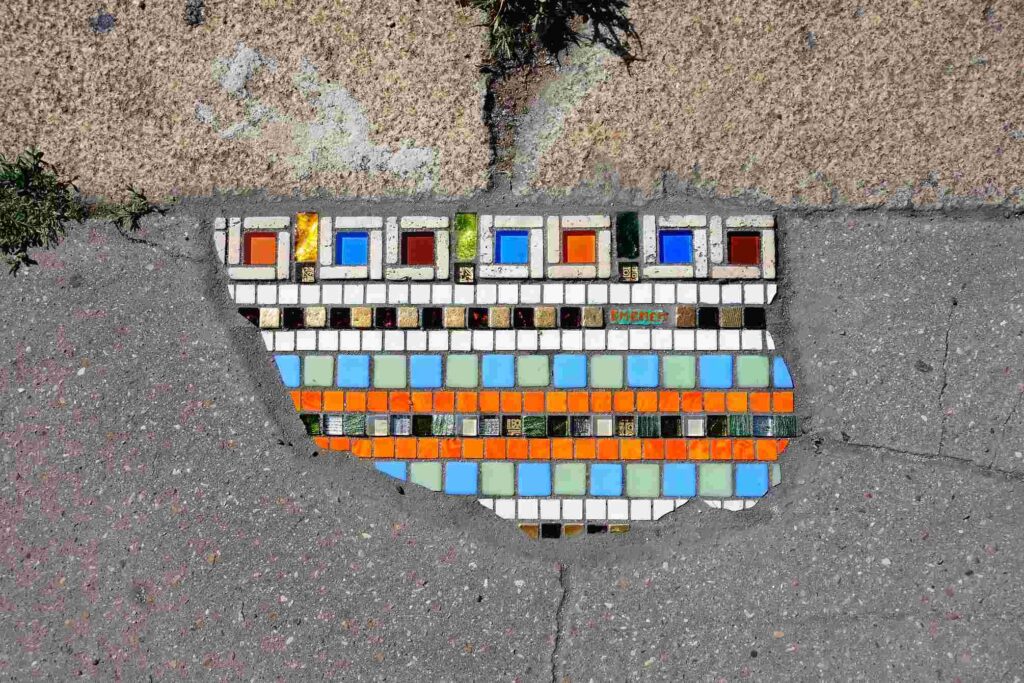
When you make reproduction pieces for a gallery, the outcome is necessarily re-contextualized into a transportable expensive artifact. What are your feelings on this conceptual transfer? And does the artwork’s meaning fundamentally change when it is divorced from the urban “wound” that it was meant to heal? How does such a re-contextualization affect you?
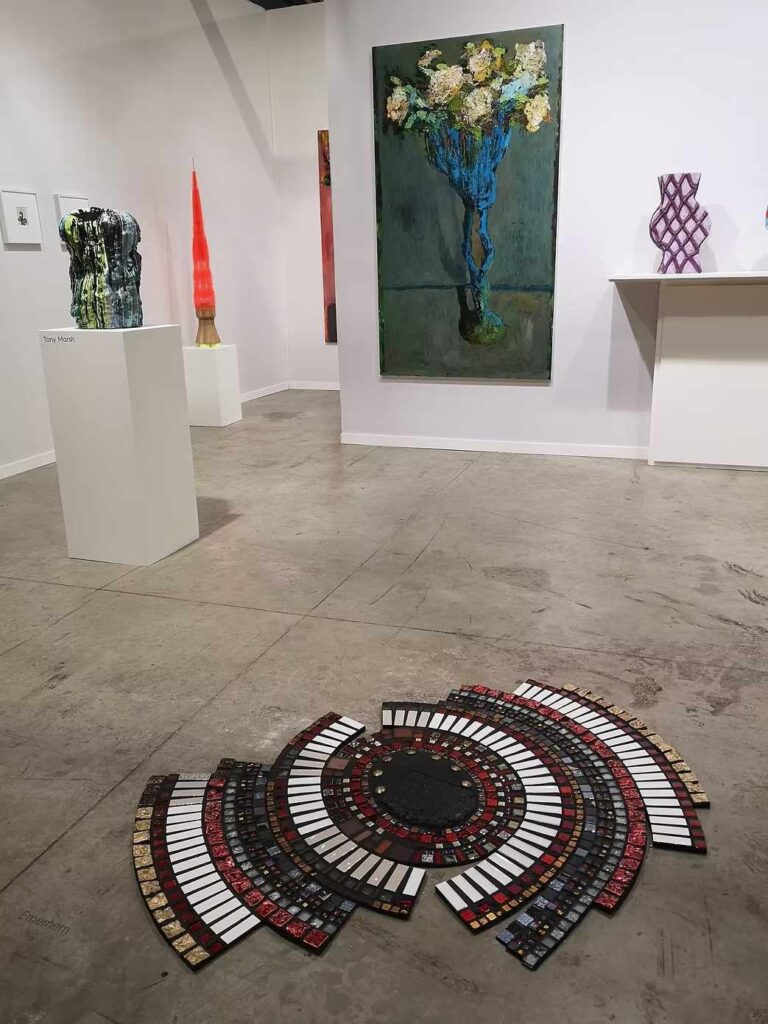
Regarding gallery works, you’re right, it’s not always easy, because I realize that a gallery piece never has the same strength as a work in public space. When I create a mosaic, a flacking, the work is only half complete: the other half is the street, and without it, it almost has no meaning. It doesn’t take on full significance until I place it on the sidewalk, until it is in its proper place.
Separating the two is difficult, but what I try to do in gallery works is bring an element from the outside space, like asphalt, and transform it into something precious that can enter the intimate space of people. This is the way I have found to give meaning to these works.
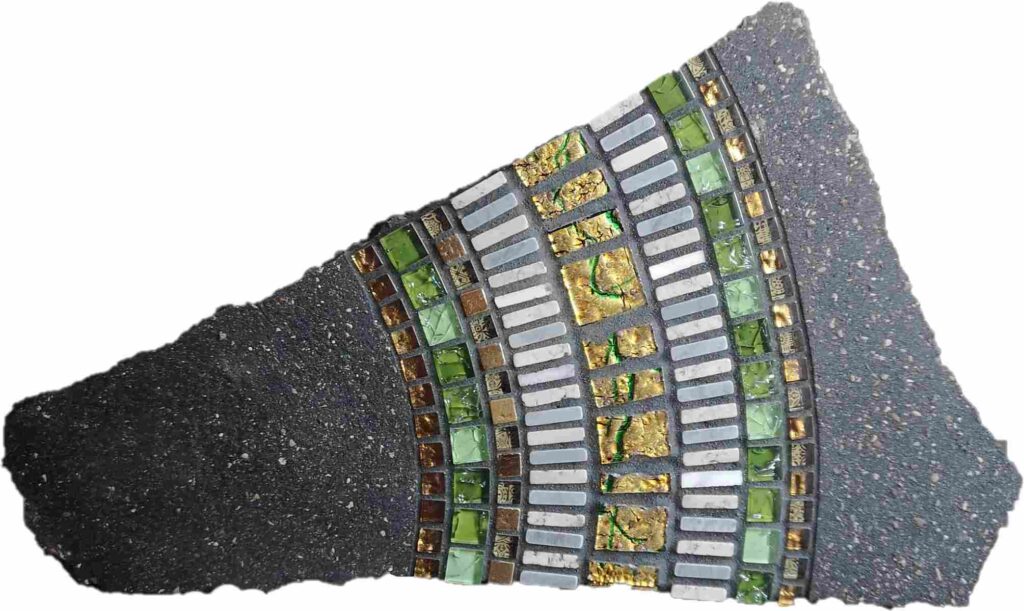
Then there are works where I don’t use asphalt: some are very painterly, others focus on composition or on contrasting materials. These are two different parts of my artistic practice, but they share common points: it’s always the same person creating them, and often there are ceramic materials, mosaics, or asphalt.
I am always exploring within each piece, and I believe that even these works are part of my history, of my overall artistic journey. My work is not just flacking or a gallery piece: I am not always seeking perfection or a masterpiece. I believe that my work is the sum of all my creations, and in this perspective, gallery works also find their place.
All images courtesy of Ememem
https://www.ememem-flacking.com