Zhiyu You turns domestic spaces into psychological visual narratives
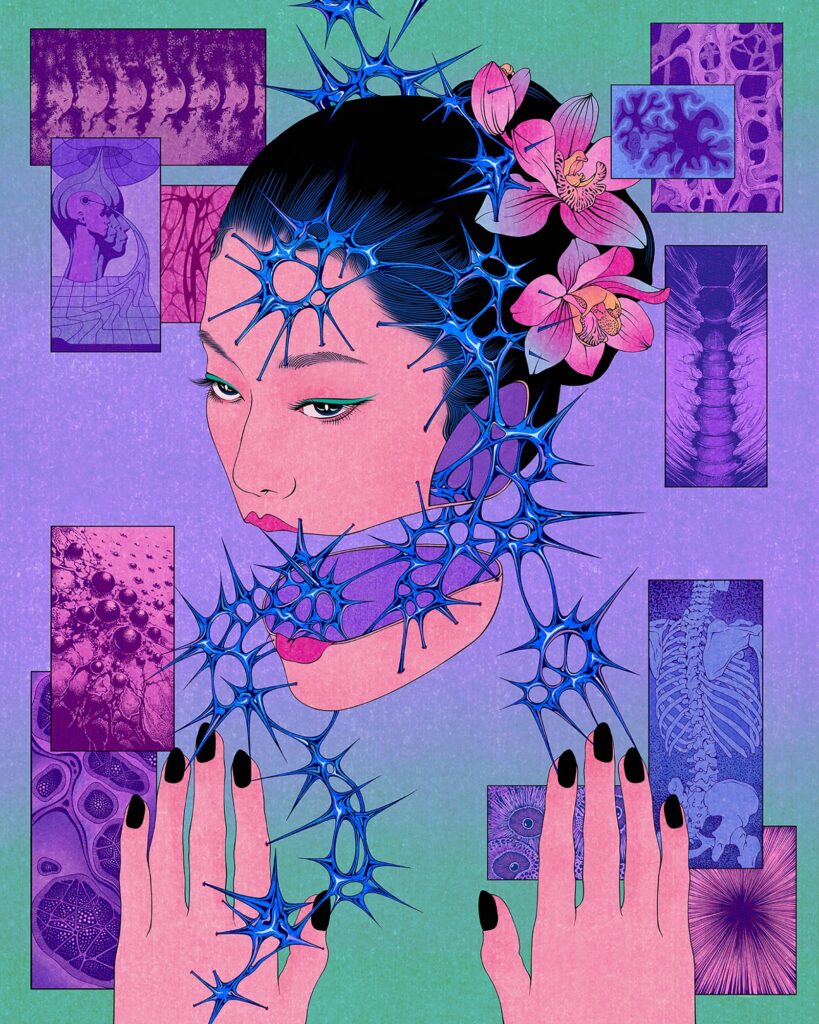
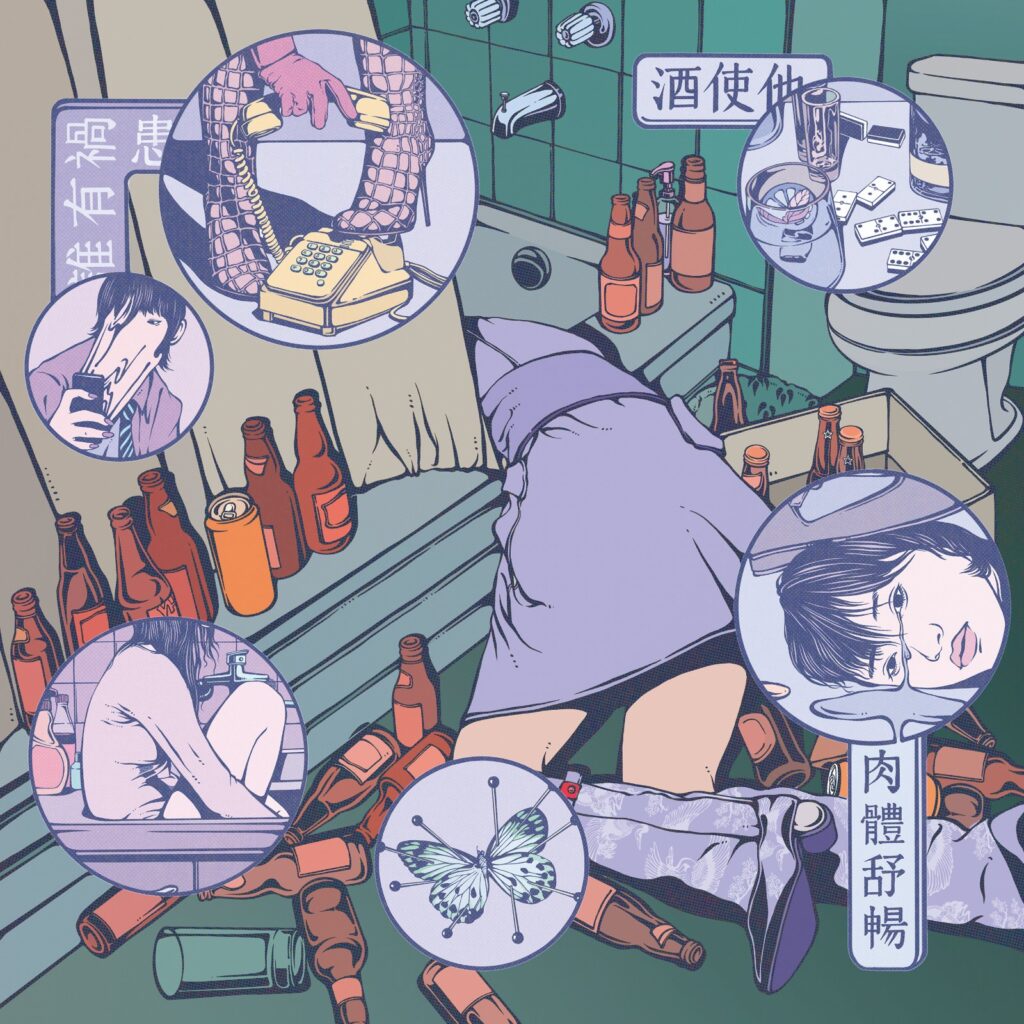
Zhiyu You’s work translates the emotional pressure of contemporary life into intimate, psychologically charged images. Through kitchens, bedrooms, screens, and fragmented domestic scenes, the Chinese-born illustrator and tattoo artist reinterprets familiar symbolic themes through the quiet language of everyday experience.
Based in New York, Zhiyu You brings together digital illustration, fine art sensitivity, and subtle narrative tension. While exploring personal psychological spaces, her graphic sensibility connects with the darker speculative energy explored in the futurism of Dirty Robot. Her precise line work and soft atmospheric palettes create images that feel delicate at first glance, yet reveal deeper reflections on identity, inner conflict, and the emotional complexity of modern life.
Your practice moves between illustration and tattooing, shaped by experiences in Beijing and New York. How would you define the space your work occupies today, both culturally and visually?
My work exists in a space between disciplines, cultures, and visual languages. Growing up in China and later living and working in New York has shaped how I think about image-making, not as something fixed, but as something constantly shifting between contexts.
Culturally, I’m navigating an in-between space. I’m influenced by Eastern visual traditions and philosophies, but also deeply shaped by Western contemporary art and illustration. Rather than trying to separate them, I let them coexist and subtly inform each other.
Visually, my practice moves between the flatness of illustration and the dimensionality of the body in tattooing. I’m interested in how images translate across these surfaces—how something intimate and quiet in a drawing can become something that lives and moves with the body. That tension between stillness and movement, control and adaptation, is where my work sits today.
Looking back at your transition from fine art to illustration, which visual, literary, or cinematic references have remained most present in the way you think and construct images?
Looking back, I think what has stayed with me most is not a single reference, but a way of seeing. My training in China gave me a strong technical foundation, with a focus on classical drawing, anatomy, and a disciplined approach to form and composition.
Visually, I’ve been deeply influenced by artists like Moebius and Käthe Kollwitz. Moebius for his expansive, imaginative visual worlds, and Kollwitz for her ability to hold emotional weight and psychological intensity through restraint and line. From illustration, I’ve learned to think more about composition, clarity, and how to communicate a feeling or narrative with precision. My time studying illustration, especially under instructors like Yuko Shimizu, Marcos Chin, and Sam Weber, has deeply shaped how I construct images and think about visual storytelling. More importantly, they taught me to ask why I am making these images, rather than only focusing on the technical part.
Literarily, writers like Mo Yan and Gabriel García Márquez have had a lasting impact on me. I’m drawn to the way they weave together reality and the surreal—where the everyday can quietly shift into something strange or symbolic. That sensibility often appears in my work, where subtle distortions or unexpected elements emerge within otherwise familiar, intimate scenes.
I’m also influenced by cinematic language, particularly in the use of pacing and stillness. I’m drawn to filmmakers like Yorgos Lanthimos, whose work carries a sense of quiet tension and subtle unease beneath controlled, composed scenes. That sensibility often finds its way into my work, where I try to build images that feel still on the surface but hold a kind of internal tension.
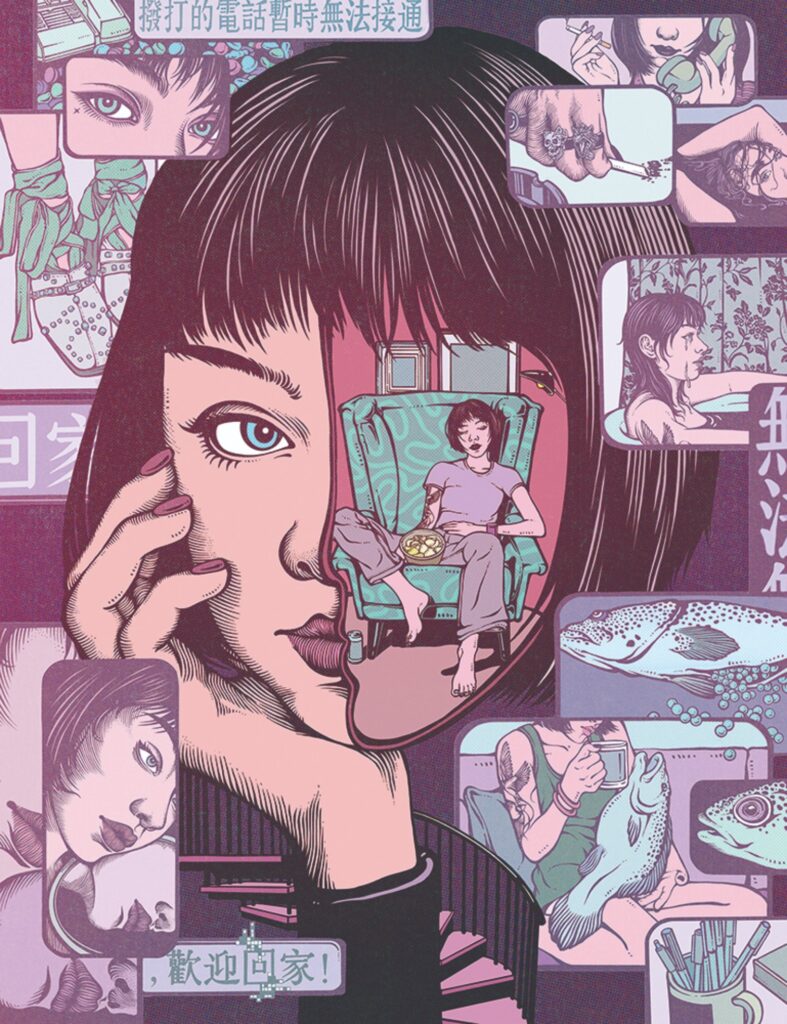
Your interiors feel very specific but never fully personal, almost as if they belong to no one and everyone at once. Are they drawn from real spaces you’ve lived in, or are they entirely constructed?
They often begin with fragments of real spaces or places I’ve lived in, passed through, or quietly observed. But I’m not interested in documenting them as they are. Instead, I reconstruct them, combining different memories and details into something slightly displaced.
I try to remove anything too specific that would tie the space to one person or myself, while keeping enough familiarity for it to feel recognizable. In that sense, the interiors become more like emotional spaces rather than literal ones, somewhere between personal memory and a shared experience.
You revisit themes such as the Seven Deadly Sins through contemporary settings. What guides your selection of objects and environments when translating these ideas into present-day life?
When I started working with themes like the Seven Deadly Sins, I was less interested in their original religious meanings. I see them more as a structure of human desires, rather than “sins” in a moral or religious sense. They continue to exist in our daily lives, but in more subtle and normalized ways.
I wanted to take that framework and bring it closer to my own life, and to the everyday experiences of people around me—especially how these ideas exist in the lives of young people today.
So instead of using traditional symbols, I look at ordinary objects and domestic environments—things like food and daily routines. These choices come from observing how desire, indulgence, or avoidance quietly appear in contemporary life, often in ways that feel normal or even comforting.
I’m drawn to scenes that feel familiar and intimate, but also slightly off. By placing these elements together, I try to create a space where something subtle starts to shift, where everyday life begins to reflect something more complex underneath.
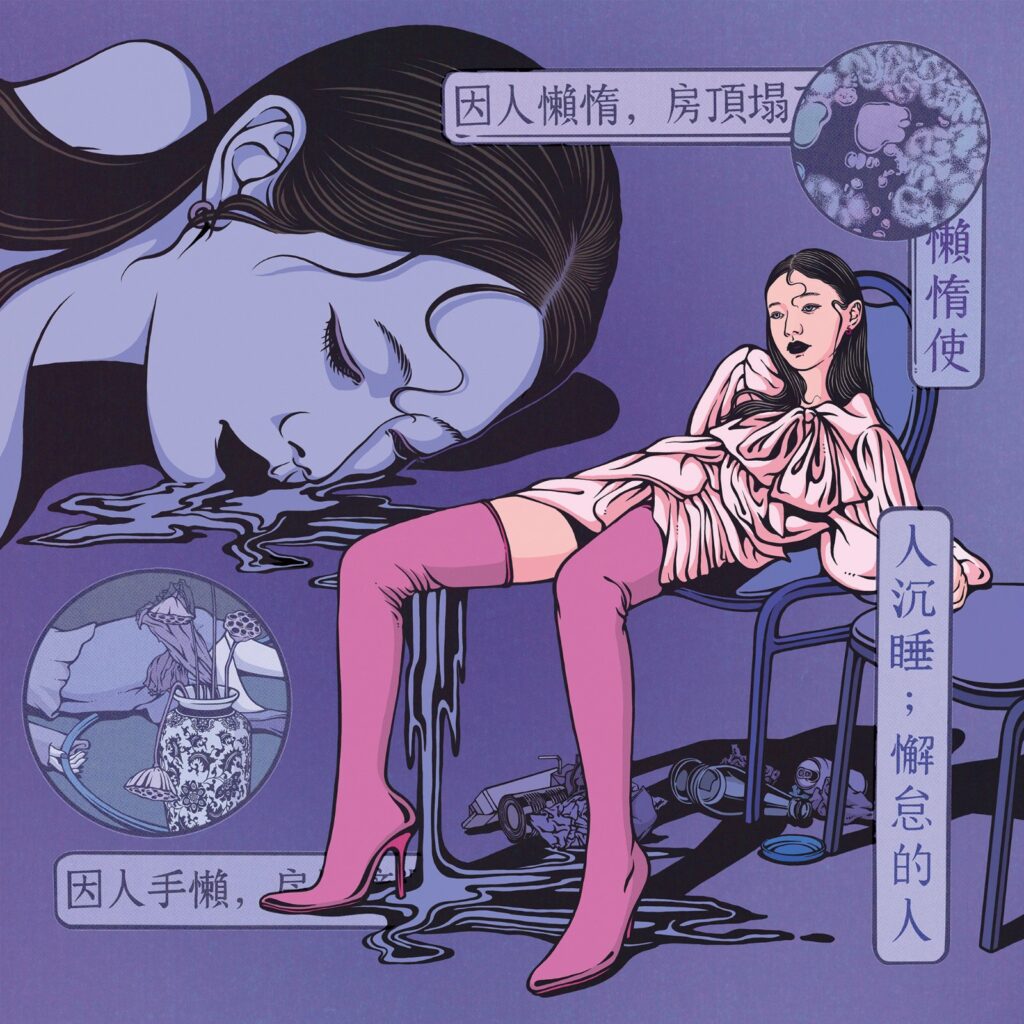
How long does a piece usually take from the first idea to the final image, and which phase of the process demands the most from you?
It really varies depending on the piece, but usually the process from the first idea to the final image can take anywhere from a few days to a couple of weeks. The initial idea often comes quite quickly, sometimes just from a note, a quick sketch from my sketchbook , but developing it into a complete image takes much longer.
At the beginning of the process, I often need a lot of references to support both the concept and the visual direction. I spend time going through readings and looking at art history, which helps me build a stronger foundation for the image.
The most demanding part for me is the middle stage, where I’m translating that vague idea into a clear composition. It’s a process of constant adjustment, balancing elements, refining the structure with digital tools, and deciding what to keep or remove. I often go back and forth during this phase.
The final stage is more about resolution and control, but the middle is where most of the uncertainty and decision-making happens, also where the work really takes shape.
There is a precise relationship between line and color in your work, where controlled drawing meets a softer tonal atmosphere. How do you technically build this balance throughout your process?
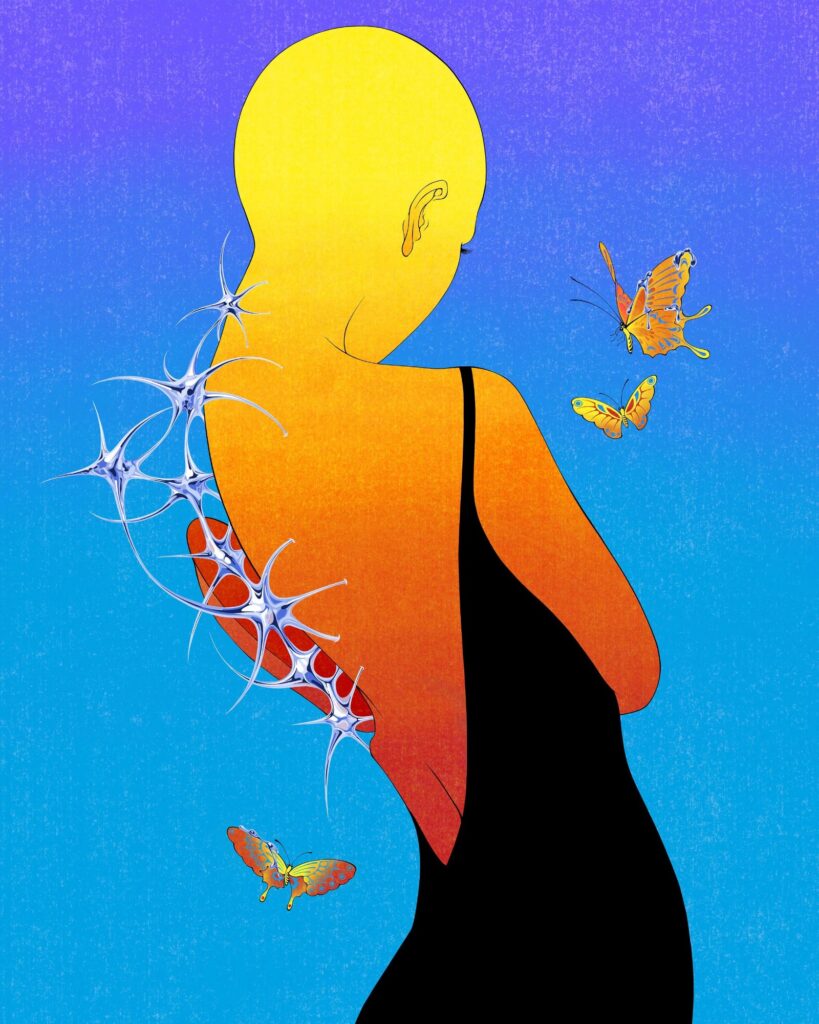
I actually see my work more as drawing than painting, so line is always the foundation for me. I pay a lot of attention to line quality, weight, rhythm, and movement, because that’s often where the structure and energy of the image come from.
Color plays a different role. I sometimes think of it as seasoning: it doesn’t carry the image by itself, but it can shift the mood, add tension, or bring out certain emotional tones. I tend to use color sparingly and intentionally, more to support the atmosphere than to dominate the composition.
Technically, I build that balance by moving back and forth between traditional drawing and digital tools. I often begin with hand drawing, where small accidents or irregularities can lead the image somewhere unexpected. Then I use digital tools to layer, shift, color and refine relationships between line, tone, and composition. For me, traditional drawing brings sensitivity and surprise, while digital allows experimentation and control, and that dialogue is where the balance develops.
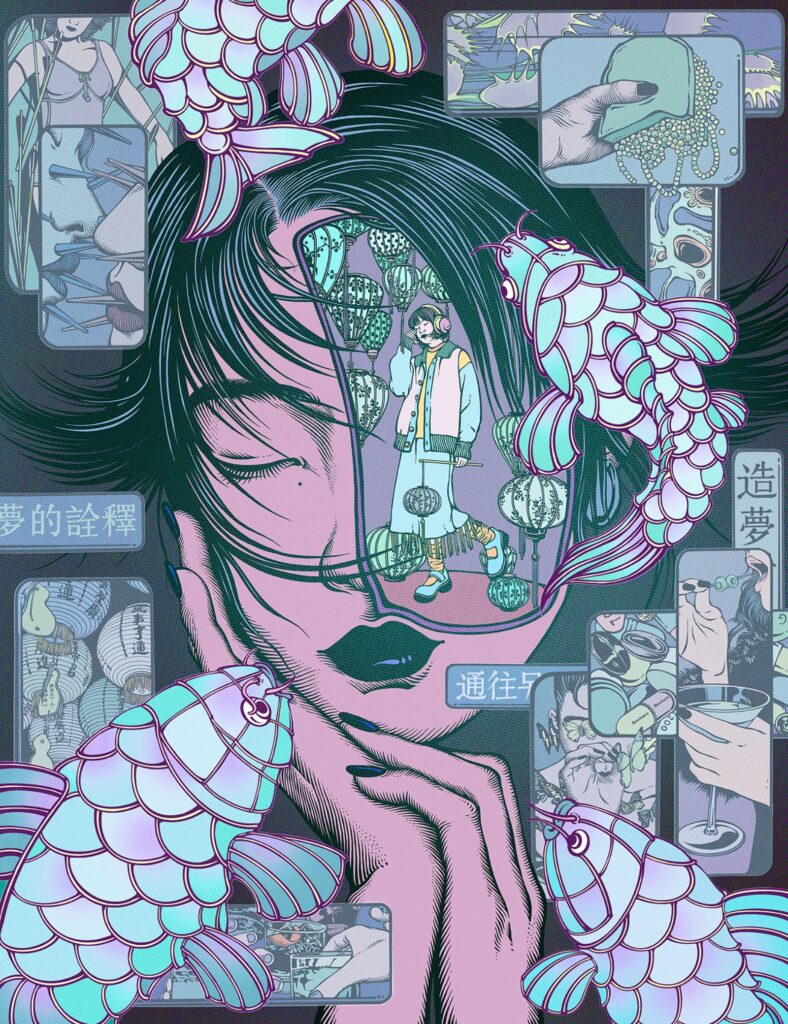
Tattooing introduces a direct and physical dimension to your practice, with different constraints and timeframes. How does this experience influence your sense of scale, permanence, and decision-making in your studio work?
Tattooing has made me think much more consciously about scale, placement, and how an image lives on a body. Because skin is a moving, dimensional surface, it taught me to consider flow, negative space, and how forms interact with anatomy, and that has influenced how I think about composition in my studio work as well.
It has also changed my relationship to decision-making. In tattooing, there are sometimes beautiful “accidents” that happen directly on the skin—unexpected moments that come through freehand adjustments or the way a line responds to the body. For me, that feels very close to hand drawing, and very different from the control of digital tools. Those moments keep reminding me of the value of spontaneity and the sensitivity of the hand, and they influence my studio practice by encouraging me to preserve that hand-drawn openness, even within more constructed or refined processes.
Permanence is another important aspect, and that may be the part that means the most to me. There’s something very meaningful about someone trusting me and choosing to carry my work for the rest of their life, which I’m deeply grateful for. It’s different from my personal studio practice, because many clients come with personal stories or specific meanings they want the design to hold. In some ways, it relates to editorial work, where I’m responding to another person’s narrative while still bringing my own visual language into it. That process has taught me to balance my style with someone else’s idea, while also making the design flow naturally with the body. It has made me think more carefully about responsibility, collaboration, and what makes an image feel both personal and lasting.
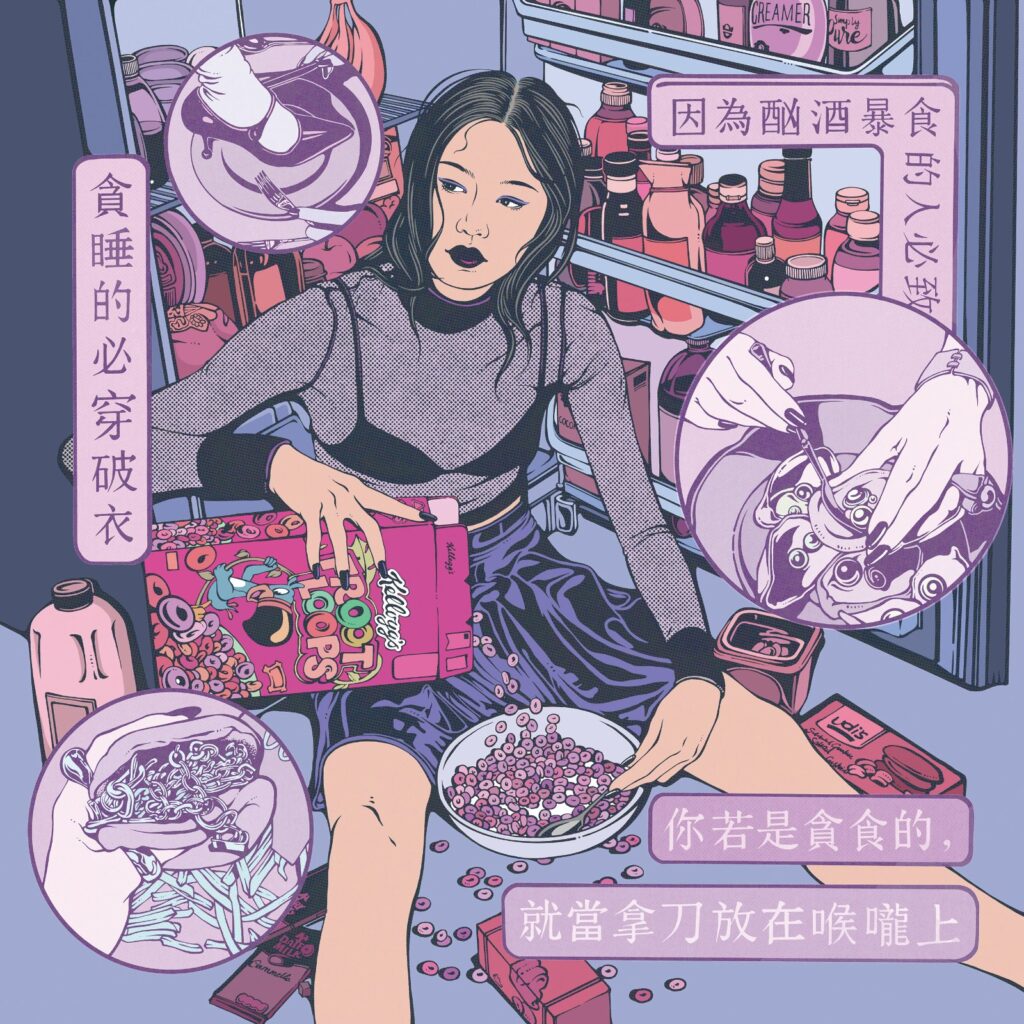
Looking ahead, do you see your work continuing to deepen this intimate, interior focus, or are you interested in expanding toward new contexts, formats, or spatial directions?
I see both happening at the same time. I want to continue deepening that intimate, psychological focus, because it still feels like a space with a lot to explore. I’m interested in pushing these themes further, perhaps through more layered narratives and broader social contexts.
For me, it’s less about moving away from intimacy and more about allowing that focus to evolve across different forms. I’m also increasingly interested in bringing the visual language of my illustration and tattoo work closer together. At the beginning of my tattoo practice, I was exploring different styles and possibilities, but over time I’ve started to see more overlap between the two. Now I’m more interested in deepening that shared language and letting the two practices inform each other more naturally.
At the same time, I’m curious about exploring other mediums beyond illustration and tattooing. No matter the form, drawing and design remain essential to me—they are at the core of how I think. I’m interested in how this visual language can expand into new contexts while still maintaining that foundation.
All images courtesy of Zhiyu You
Zhiyu You website: https://www.zhiyuyou.net